Choosing white-label travel booking software is rarely the buyer's first attempt at this decision. Most agency owners evaluating this category have already spok...
Choosing white-label travel booking software is rarely the buyer's first attempt at this decision. Most agency owners evaluating this category have already spoken to a handful of vendors, sat through demo calls that sounded interchangeable, and walked away with more questions than answers about what they'd actually be paying for over the next three years.
This guide skips the feature-list theater. It's written for the person who signs the contract, not the person who has to be sold to travel agency owners, OTA founders, tour operators, and the CTOs who get asked to explain the architecture after the invoice is already signed.
What "White-Label" Actually Means at the Architecture Level
Most vendor pages define white-label travel booking software as "a ready-made platform you can rebrand as your own." That's technically true, but it tells you almost nothing useful about what you're actually evaluating when you compare one white-label travel portal against another.
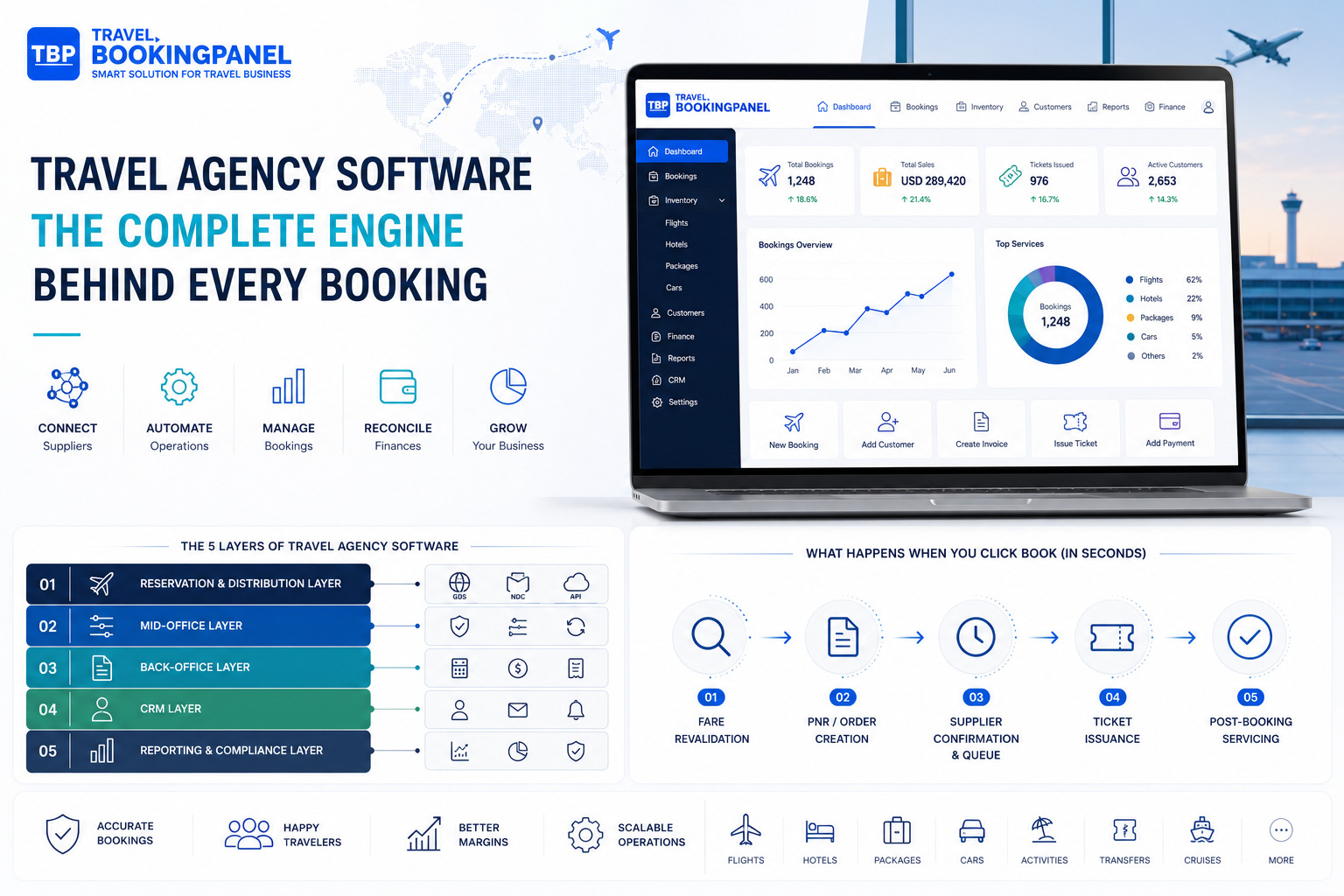
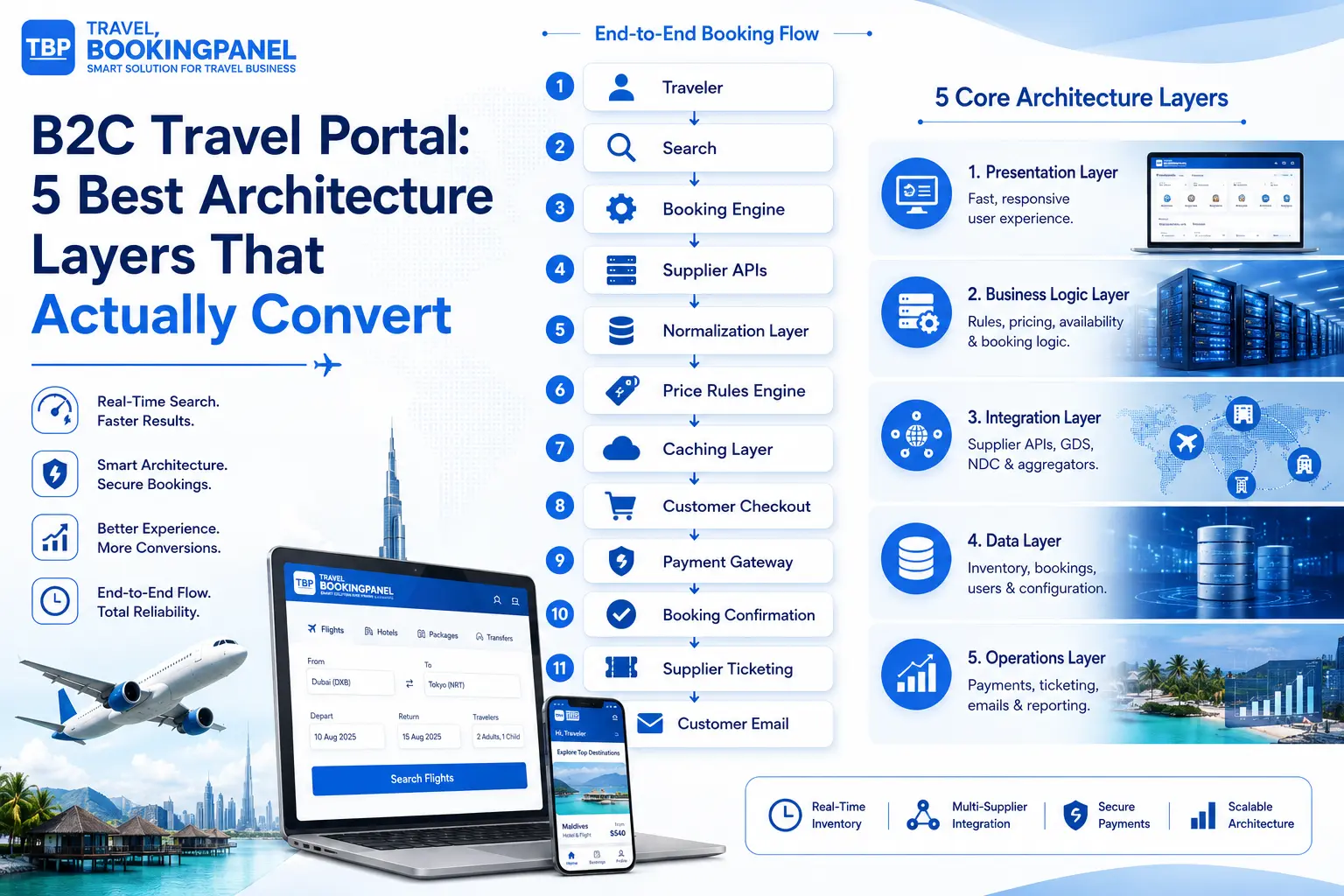
Underneath the branding layer, every white-label travel booking software product is really three separate systems stitched together, and they rarely get built to the same standard:
- The storefront: the customer-facing website or app where travelers search and book.
- The back office: the admin panel where you manage bookings, agents, markups, and reports.
- The supplier layer: the connections to GDS providers, hotel bed banks, and other inventory sources that actually supply the flights, hotels, and packages you sell.
A vendor can be excellent at one layer and mediocre at another. A polished storefront atop a clunky back office is common in this market. So is a back office with strong reporting connected to a supplier layer with only two or three bedbanks behind it.
Why "Fully Customizable" Often Means "Email Us for a Quote"
This phrase appears on nearly every white-label travel portal sales page, and it usually signals the opposite of transparency. When a vendor can't tell you, without a call, what the platform costs, what's included, and what a change request costs later, "customizable" is doing the work that pricing clarity should be doing instead.
This matters more than it sounds. Agencies that have already lost money on a bad software decision were usually burned specifically by scope creep disguised as customization on a platform that was cheap to start and expensive to finish.
The Booking Lifecycle Most Buyers Never See
Before comparing vendors, it helps to understand the actual sequence a booking moves through, because this is where most operational failures in white-label travel booking software actually happen, not in the storefront design.
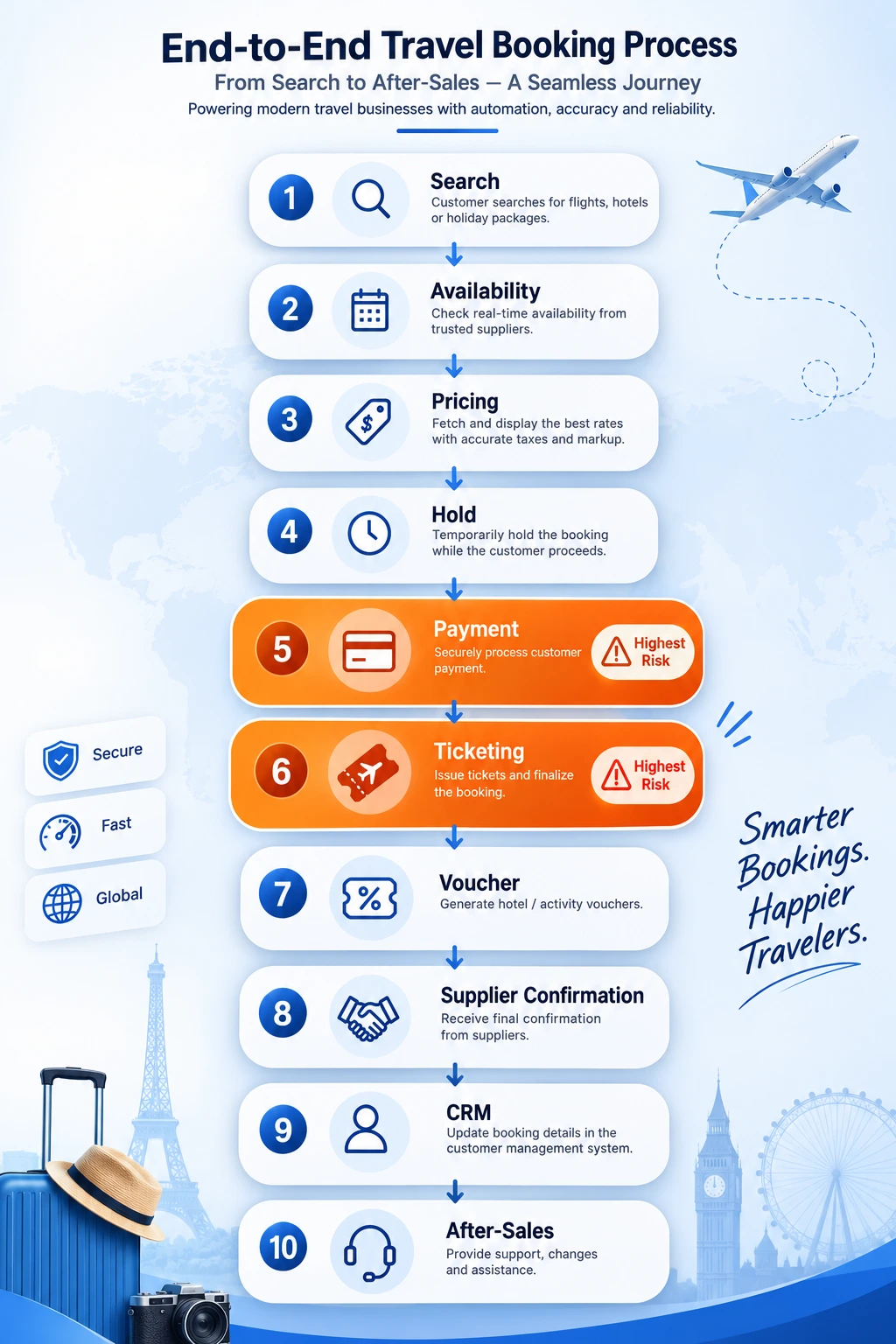
A single booking typically passes through ten stages: search, availability check, pricing, a temporary hold on inventory, payment, ticketing or confirmation, voucher generation, supplier confirmation, a CRM record, and finally after-sales support if something changes.
Every one of those ten steps is a place where a booking can quietly fail, and the quality difference between white-label travel booking software vendors shows up almost entirely in how gracefully each one handles the failure points, not in how the search page looks.
Search and availability
The two stages travelers actually see, and they're also the two where cached data can diverge from what a supplier will actually honor. A result that looks available at the search stage can be gone by the time a traveler clicks through, which is why the hold stage exists in the first place.
The hold stage
Temporarily reserves inventory with the supplier while the traveler completes payment, typically for a window of a few minutes. Platforms that skip this step, or implement it poorly, are the ones where a customer completes checkout only to find the room or seat was sold to someone else in the interim.
Payment and ticketing
Where money changes hands, and the supplier is formally instructed to issue the booking. This is also where a slow or failed API call to the supplier can leave a booking in limbo charged but not confirmed, which is one of the more damaging failure states because it becomes a customer service problem, not just a technical one.
Voucher generation and supplier confirmation
Close the loop for the traveler, but they need to stay in sync. A voucher generated before supplier confirmation is received is a platform cutting a corner that eventually produces a traveler standing at a hotel desk with no matching reservation.
CRM and after-sales
The stages determine how a cancellation, date change, or complaint gets handled, and they're the stages most white-label travel booking software demos never show a buyer because they only become visible after go-live, once real customers start needing changes to real bookings.
What Happens Behind the Search Bar
This is the part most buyer's guides skip entirely, and it's the part that determines whether a platform feels reliable or flaky six months after launch. When a traveler searches "Dubai, 3 nights" on a white-label travel booking platform, that single search doesn't hit one database.
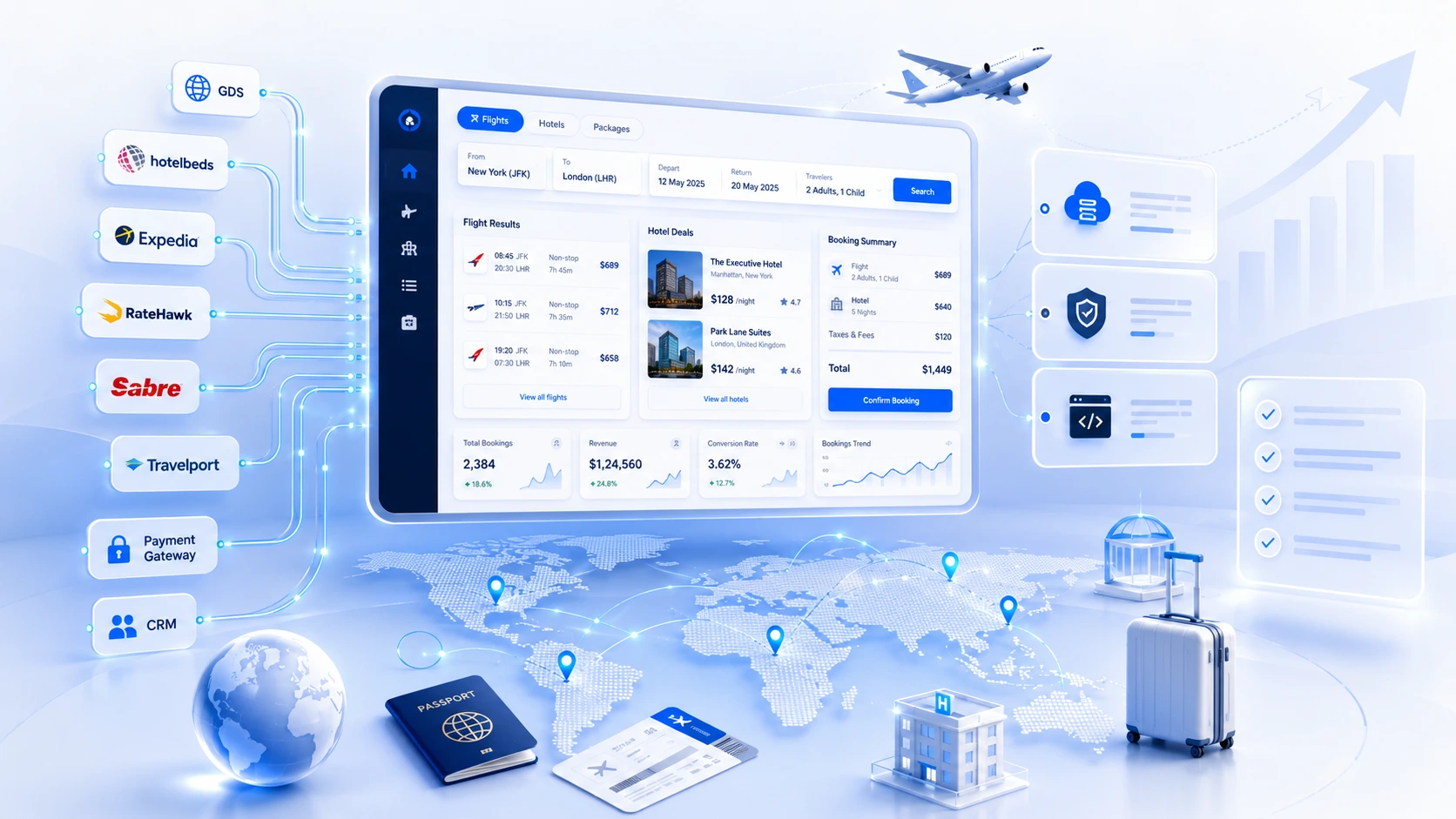
It fans out to every supplier the platform is connected to Hotelbeds, RateHawk, Expedia, TBO, and GDS partners for flights- simultaneously, and the results have to come back, get merged, and be displayed as one clean list before the traveler loses patience. Several problems show up at this stage, and almost no sales page mentions any of them directly.
The Same Hotel, Three Different Prices
Because multiple suppliers often carry contracts with the same hotel, that property can appear under different property IDs, slightly different names, and different room-type labels depending on which supplier returned it. Without a mapping layer that recognizes these as the same physical room, a platform shows the traveler three listings for one hotel, each with a different price and no explanation for the discrepancy.
A hotel API aggregator uses mapping to match these listings to a single canonical property and merge the rates, so the traveler sees one clean listing with the best available price instead of several confusing duplicates. This isn't a cosmetic issue. It directly affects conversion: travelers who see obvious duplicate listings lose trust in the platform's pricing, even when nothing dishonest is happening behind the scenes.
Rate Conflicts Between Suppliers
A related but separate problem is rate conflict: two suppliers return genuinely different prices for what is functionally the same room, because their contract terms, currency conversion, or availability windows differ. A well-built white-label travel booking system doesn't just deduplicate the listing; it needs a rule for which rate wins when suppliers disagree, and that rule should favor accuracy over simply showing the lowest number, since a rate that later gets rejected at the supplier confirmation stage is worse for the traveler than a slightly higher rate that actually holds.
Why an "Instant" Result Might Be a Stale One
The next issue is caching, and it's a genuine engineering trade-off rather than a bug. Hitting every supplier's live API on every single search is slow and can breach supplier rate limits at any real volume. Caching data that changes rarely, like hotel descriptions and amenities, while calling live rates only at the point of booking can cut supplier API calls by 60 to 80 percent without sacrificing rate accuracy.
Get this balance wrong in either direction, and it costs you. Cache too aggressively and you get checkout failures when a "confirmed" rate is no longer actually available. Cache too little and search feels sluggish, or you burn through rate limits with suppliers who then throttle your access. The vendors worth evaluating can explain this trade-off to you in plain terms; the ones who can't usually haven't thought about it.
Booking Queue Failures and Supplier Failover
Even a well-architected platform occasionally hits a supplier that's slow, down, or returning errors mid-search. What separates a mature white-label travel booking software product from a fragile one is what happens next. A platform without failover logic simply fails the whole search or, worse, lets the booking queue for that supplier back up silently until a customer complains.
A platform built for reliability routes around the failing supplier automatically, surfaces results from the suppliers that responded, and retries the failed one in the background so a single supplier outage doesn't become a customer-facing outage.
This is a reasonable, specific question to ask any vendor directly: what happens to a search when one connected supplier times out? A vague answer here is one of the more reliable predictors of post-launch reliability problems.
Dynamic Packaging: Why Bundled Pricing Is Harder Than It Looks
Selling a flight and a hotel separately is one problem. Selling them together as a single package, priced dynamically at the moment of search, is a different and considerably harder one, and it's a feature almost every white-label travel booking software vendor claims to support without explaining what actually has to happen underneath.
A genuine dynamic packaging engine has to price flight and hotel components independently, apply a combined markup that's often different from either component's standalone markup, and do all of this while both components still have live availability from two entirely separate supplier systems. If the flight hold expires before the hotel confirms, or vice versa, the platform needs a rule for what happens to the half of the package that already succeeded.
This is worth asking about directly, because "we support packages" and "we support dynamic packaging with independent component failure handling" describe very different levels of engineering maturity, and only one of them holds up when a supplier is slow to respond.
Markup Engine, Currency Handling, and Payment Settlement
Once the pricing and inventory side is sorted, the second layer that determines day-to-day usability is how the platform handles money markups, currency, and settlement.
Markup Engine Logic
Agencies rarely sell supplier net rates directly; they apply a markup, and in a B2B context that markup often needs to vary by agent tier, destination, or supplier. A shallow white-label travel booking platform offers one global markup percentage. A more mature one lets you set markup rules per agent group, per supplier, and even per booking value bracket, so a sub-agent selling high-volume budget hotels isn't working from the same margin structure as one selling premium packages.
Currency and Settlement
If you sell across multiple currencies, the platform needs a clear policy for when the exchange rate is locked at search time, at booking time, or at supplier settlement time. A mismatch here is a quiet source of margin loss that only becomes visible in month-end reconciliation, when the amount collected from the traveler and the amount owed to the supplier were converted at different rates.
Payment Handling and PCI DSS
Because the platform is processing card payments, the underlying payment architecture matters more than most buyers initially budget attention for. At minimum, ask whether card data touches your servers directly or passes through a PCI DSS–compliant payment gateway without your platform ever storing raw card numbers. A vendor who can't answer this clearly is handing you a compliance liability along with the software.
Booking Reconciliation and Cancellation Synchronization
The last operational layer, and the one that shows up as customer complaints rather than technical bugs, is what happens after the booking is made. Cancellations initiated by the traveler need to sync back to the supplier and reflect correctly in your CRM and reporting, not just mark the booking as canceled on your end while the supplier still holds the reservation.
Reconciliation between what suppliers actually invoice you and what your system recorded as booked is where discrepancies quietly accumulate if the platform doesn't handle this automatically. Agencies running a manual monthly reconciliation process against supplier invoices are, in effect, doing work the software should be doing for them.
Buy, License, or Subscribe: The Real Cost-of-Ownership Decision
This is the section almost no competitor content addresses honestly, because most vendors in this space only offer one of the three models below and have no incentive to compare it fairly against the other two.
The Subscription SaaS Model
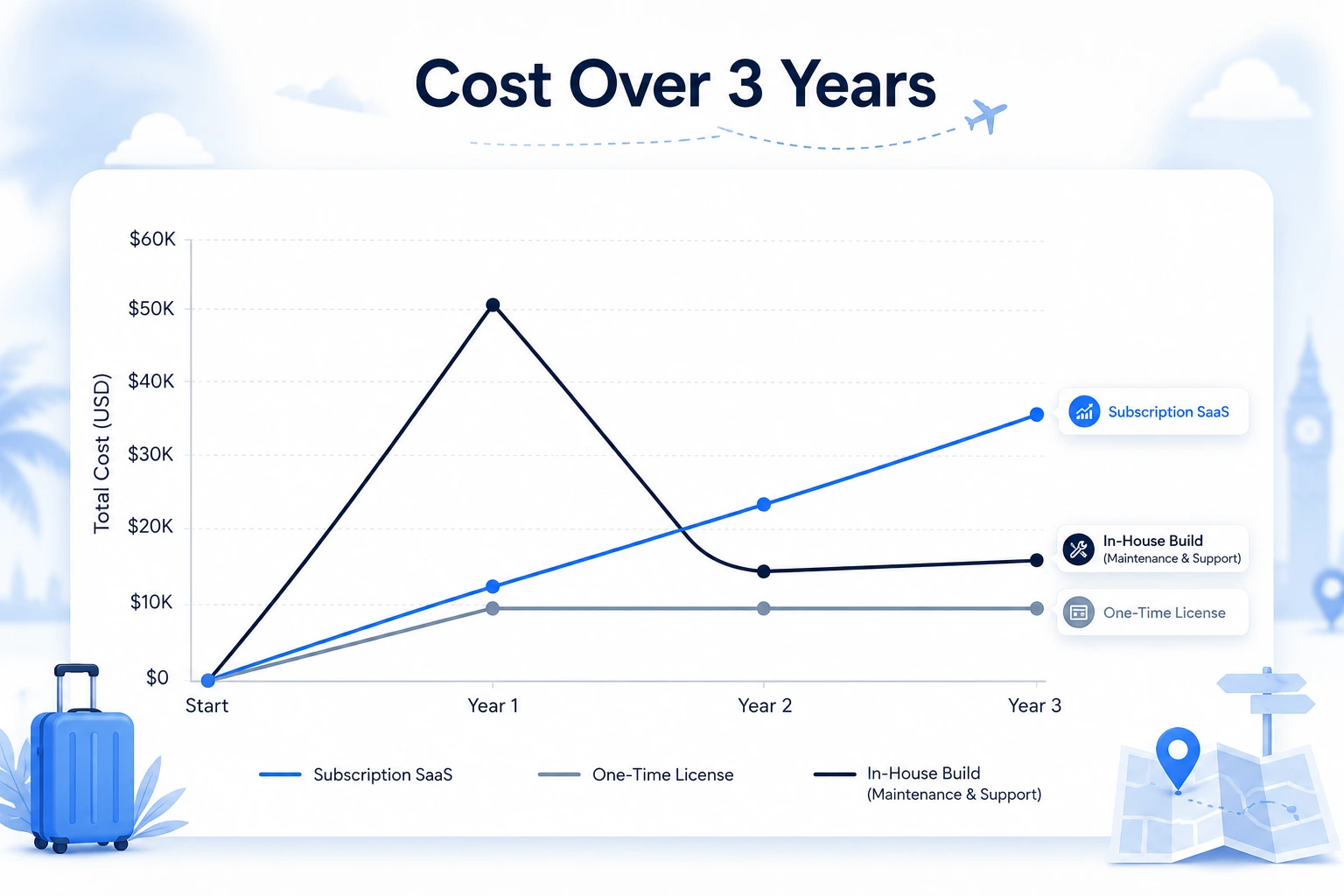
You pay monthly or annually, usually scaled by booking volume or agent seats. The upfront cost is low, which makes it attractive to a new agency. The problem shows up at year two or three: as booking volume grows, so does the subscription tier, and the platform that looked affordable at launch can quietly become one of the largest recurring line items in the business with no ownership to show for it if you ever decide to switch providers.
The One-Time License Model
You pay once for the platform, typically with the source code delivered outright, and you own it going forward. This model shifts the risk profile: a higher, though often still modest, upfront cost, no recurring subscription fee, and critically no vendor lock-in if the company changes its pricing or discontinues a feature you depend on.
TravelBookingPanel's white-label travel agency software is built on this model: a one-time purchase starting around $1,599, with full Laravel source code delivered rather than access to a hosted black box, and lifetime feature updates and security patches included rather than gated behind a renewal. For an agency owner who has already been burned once, the appeal isn't the price point specifically; it's that the total cost doesn't move every time the vendor changes its plans.
The In-House Build
Building your own booking engine gives full control and zero dependency on a third-party product roadmap. It also means budgeting for a development team, a realistic six-to-twelve-month build timeline before the first booking, and ongoing engineering overhead to maintain supplier integrations as APIs change, work a white-label vendor has already absorbed on your behalf.
Most agencies evaluating white-label travel booking software have already ruled out the in-house build on cost or timeline grounds. The real decision, in practice, is subscription versus one-time license, and that decision should be made on a three-year total-cost basis, not a launch-day price comparison.
| Model | Upfront Cost | Recurring Cost | Ownership if Vendor Exits |
| Subscription SaaS | Low | Grows with volume | None |
| One-Time License | Moderate | None | Source code retained |
| In-House Build | High | Engineering overhead | Full |
The Vendor Evaluation Checklist
Once a pricing model is settled, the actual vendor comparison should run through the same questions every time, not the questions a sales deck prompts a buyer to ask, but the ones that predict whether the platform still works the way it needs to a year in.
Supplier and API Coverage
Ask which specific bed banks and GDS providers are integrated, such as Hotelbeds, RateHawk, Expedia, Amadeus, Sabre, and Travelport, and whether that coverage matches the target market. A vendor with strong European inventory but weak coverage in the actual operating region isn't a fit, regardless of how polished the demo looks.
B2B Agent-Tier Support
For agencies planning to resell to sub-agents, the platform needs a genuinely separate agent workspace, not just a discount code layered onto the consumer storefront. Look for markup controls set per agent tier, commission tracking that doesn't require manual reconciliation, and credit-limit management if booking credit is extended to sub-agents.
Source Code Ownership and Exit Risk
This is the question buyers skip most often and regret skipping most. If the vendor disappears, gets acquired, or simply stops supporting an older version, does the buyer own anything, or does the buyer own nothing and have to start over? A platform delivered with source code that can be handed to any developer is a fundamentally different risk profile than a hosted SaaS product where the vendor holds every key.
Regional and Localization Needs
Right-to-left layout for Arabic markets, multi-currency display, and multi-language support matter enormously when selling into the Middle East, South Asia, or other non-English-first markets and are irrelevant vanity features otherwise. There's no reason to pay a premium for localization a given customer base will never see.
Post-Launch Supplier Maintenance
Supplier APIs change over time: new authentication requirements, deprecated endpoints, updated data formats. Ask directly whether ongoing supplier maintenance is the vendor's responsibility after launch or whether every future API change becomes an internal problem to solve.
Support Response Time and What Breaks Outside Business Hours
Bookings don't stop happening at 6 p.m. A payment gateway failure or a supplier outage at midnight local time is a different kind of emergency than a cosmetic bug reported during business hours, and vendors handle this distinction very differently.
Ask specifically what support channel exists outside standard hours, what the realistic response time is for a payment-blocking issue versus a minor one, and whether that support is included in the base cost or billed separately as an add-on tier. A vendor who only commits to email support with no stated response window is telling you, indirectly, how they'll treat a real outage.
Data Portability If the Relationship Ends
Beyond source code ownership, ask what happens to historical booking data, customer records, and agent accounts if the agency later switches vendors. A platform that makes data export difficult or proprietary is functionally another form of lock-in, even under a one-time license model.
Red Flags That Predict a Bad Implementation
A few patterns show up disproportionately often among agencies that describe their software purchase as a costly mistake:
- Vague pricing that only resolves after a sales call. If a vendor can't give a number without a 30-minute call, assume the number is negotiable upward, not downward.
- No named supplier partners. "We integrate with leading global suppliers" is not an answer. Ask for names and verify them independently.
- No stated go-live timeline, or one that seems too fast to check. A platform that claims to go live in minutes should be able to explain what happens in those minutes: API credential setup, domain configuration, and agent account creation, not just assert speed as a selling point.
- No clarity on what happens post-launch. Ask specifically what's included after go-live: is ongoing supplier maintenance the vendor's responsibility, or does every API change become an internal problem?
- No answer on failover behavior. If a vendor hasn't considered what happens when a supplier API is slow or down, that's a signal the platform hasn't been stress-tested at real volume.
A 90-Day Reality Check
"Live in fifteen minutes" and "live in ninety days" usually describe two different things, not two different vendors' speed. The former typically refers to platform provisioning and the software itself becoming accessible. The latter usually reflects the real bottleneck: supplier API credentialing, payment gateway approval, and content population, none of which are fully within the software vendor's control.
A realistic evaluation asks the vendor to separate these two timelines explicitly. A platform that's technically live but has no functioning payment gateway or supplier credentials isn't actually usable yet, regardless of what the onboarding page promised.
Frequently Asked Questions
Is white-label travel booking software the same as building a custom OTA platform?
No. White-label travel booking software is a pre-built platform licensed or subscribed to and rebranded under the buyer's identity, while a custom OTA platform is built from scratch by an in-house or contracted development team, with a longer timeline and higher upfront engineering cost.
Does white-label travel booking software support both B2B and B2C sales?
Most modern platforms in this category support both simultaneously: a public storefront for direct consumers alongside a separate agent portal for B2B sub-agents, each with distinct pricing and access controls.
What's the realistic timeline to launch white-label travel booking software?
Platform provisioning can happen in hours to days, but full go-live, including supplier API credentialing and payment gateway approval, more realistically runs several weeks, regardless of what "instant setup" marketing suggests.
Is a one-time license or a subscription better for white-label travel booking software?
Neither is universally better; a subscription suits an agency that wants the lowest possible upfront cost and expects to reevaluate vendors within a year or two, while a one-time license suits an agency planning to operate the platform for several years, where avoiding recurring fees and retaining source code ownership outweighs a higher initial payment.
Can white-label travel booking software be resold to sub-agents?
Yes, provided the platform includes a genuine B2B agent workspace with per-agent markup controls and commission tracking, a feature that varies significantly between vendors and should be verified with a live demo of the agent portal, not just the consumer storefront.
How to Stress-Test a Demo Before Signing Anything
Every vendor demo of white-label travel booking software is built to go smoothly. That's the point of a demo, and it tells a buyer almost nothing about how the platform behaves under real conditions. A few specific requests during the demo call reveal far more than watching the standard walkthrough.
Ask to search a destination with genuinely low inventory.
This is where duplicate mapping and rate-conflict handling actually show themselves. A platform that looks clean searching Dubai or London can look considerably messier searching a smaller regional destination with only two or three connected suppliers carrying inventory.
Ask what the agent portal looks like, not just the consumer storefront.
A demo that only shows the public-facing website and describes the B2B agent workspace verbally, without actually logging into it, is worth pushing back on. If sub-agent resale is part of the plan, that portal needs to be seen directly.
Ask to see a cancellation processed live.
This single request separates vendors who've built genuine two-way supplier synchronization from vendors who've only built the booking half of the lifecycle. A vendor who hesitates or has to "check with the technical team" about how cancellations sync is revealing a real gap, not just an awkward moment in a sales call.
Ask what the reporting dashboard shows a month after launch, not day one.
Booking volume, supplier-by-supplier commission owed, and agent performance are the reports that actually get used operationally, and they're often the weakest part of an otherwise polished platform. None of these requests require technical expertise to make. They simply require treating the demo as a working session instead of a presentation.
Making the Decision
The agencies that end up satisfied with their white-label travel booking software purchase, twelve months later, tend to be the ones who evaluated the supplier layer and the cost model before they evaluated the interface. The storefront is the part every demo shows. The supplier integrations, the caching strategy, and the ownership terms are the parts that determine whether the platform still serves the business well after the novelty of the demo wears off.
None of this requires taking marketing copy at face value. Ask for supplier names. Ask for a three-year cost projection, not a launch-day price. Ask what's actually owned if the relationship ends. The vendors worth working with will answer all three without hesitation.
Every question in this guide points at the same underlying principle: a white-label travel booking software purchase is a decision about an operational system the business will depend on for years, not a one-time design choice. Treating it that way, asking about supplier failover, cancellation sync, and total cost of ownership with the same seriousness given to the storefront design is what actually separates agencies that outgrow their platform gracefully from agencies re-running this entire evaluation eighteen months from now.
Tags
Own Your Travel Platform. Forever.
Buy once, own forever. Full source code · No monthly fees · No hidden charges.