Every day, thousands of travelers book flights and hotels through platforms like Booking.com, Expedia, and MakeMyTrip, paying brands they recognize instead of t...
Every day, thousands of travelers book flights and hotels through platforms like Booking.com, Expedia, and MakeMyTrip, paying brands they recognize instead of the businesses actually providing the travel services. If you've ever wondered how companies launch their own booking websites instead of relying on online travel agencies (OTAs), you're looking for a B2C travel portal.
A B2C travel portal is a customer-facing booking platform that allows travelers to search, compare, and book flights, hotels, holiday packages, transfers, and other travel services directly under your brand. Unlike B2B systems built for travel agents, there are no agent logins, negotiated net rates, or commission hierarchies, just a seamless booking experience for end customers.
Why Every Other Guide on This Topic Reads Like a Sales Page
Search "B2C travel portal" today, and the pattern repeats almost identically across ranking pages: What is a B2C portal? Benefits, features, modules, APIs, and contact us. It's written to close a sale, not to teach a founder or CTO how the system they're about to buy or build actually behaves under load.
The Actual Competitive Advantage
That gap is the opportunity here. A booking engine that responds in under one second doesn't simply improve user experience, it reduces abandonment during the highest-intent stage of the customer journey, and that speed depends on supplier response times, caching strategy, and how efficiently the platform merges duplicate inventory. Understanding why matters more than knowing that it matters, especially for the technical buyers evaluating whether to build, white-label, or walk away.
What Happens Behind One Search: The Live Booking Flow
Every search inside a B2C travel portal triggers dozens of API requests simultaneously. A single customer searching "Dubai hotels from August 10-15" can generate live inventory requests to Hotelbeds, Expedia Rapid, WebBeds, TBO, DOTW, and other suppliers at once. The booking engine then has to normalize different hotel IDs, currencies, room types, tax structures, and cancellation policies into one clean result set, often in under two seconds, before the traveler loses patience and bounces.
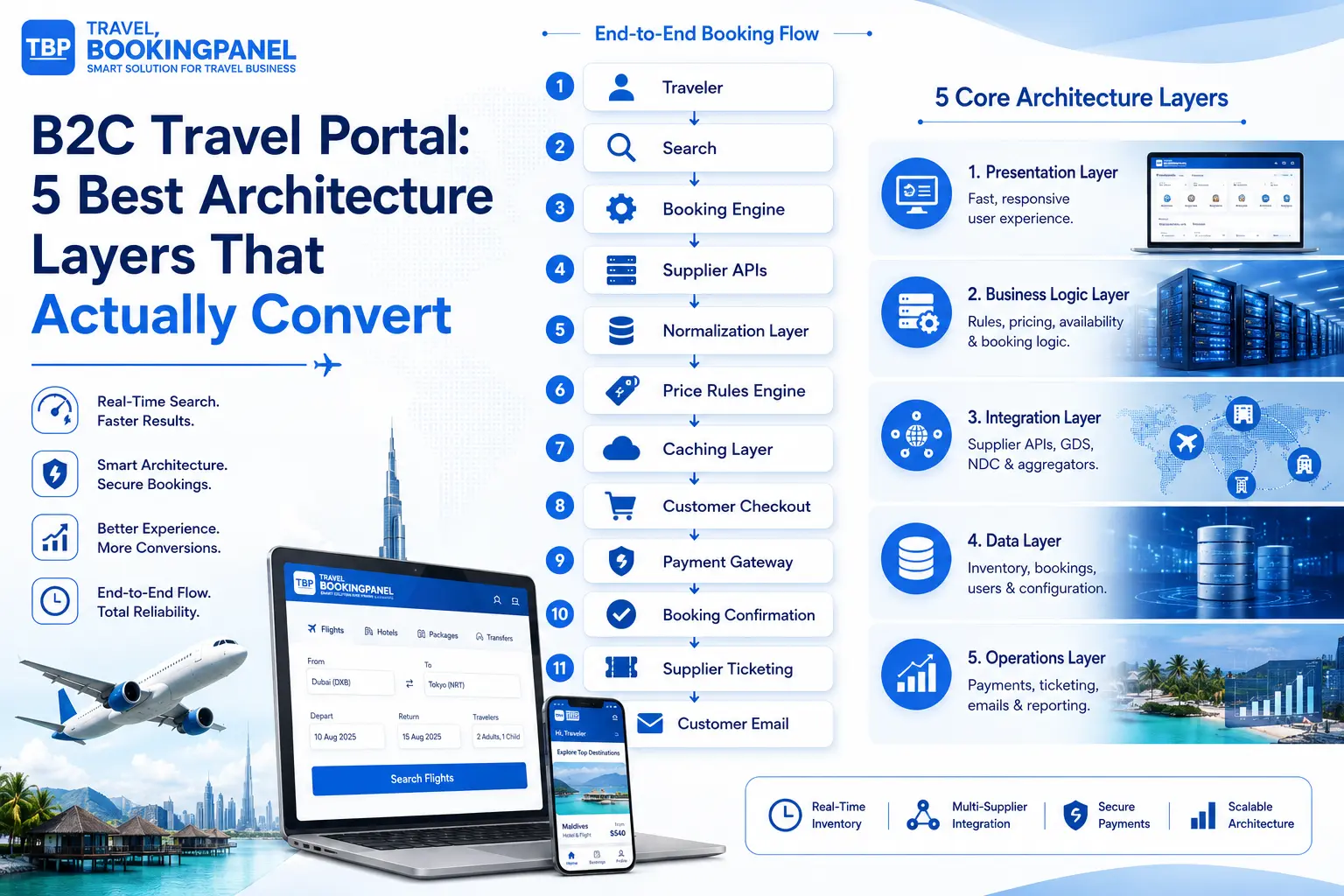
The end-to-end flow looks like this:
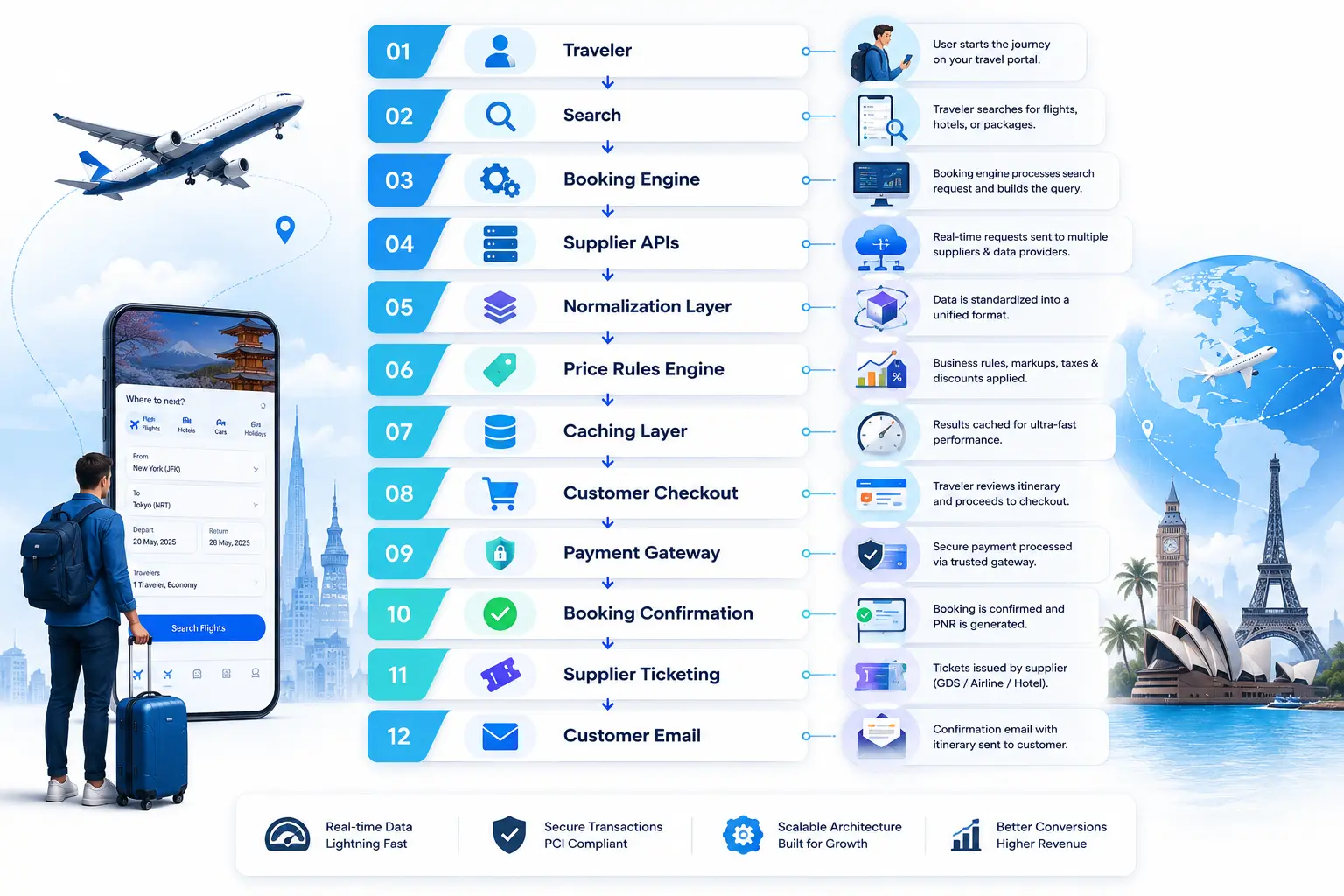
Each stage is a distinct point of failure or delay. The normalization layer alone is doing more work than most vendor pages acknowledge; it's reconciling supplier-specific hotel IDs against a master property database, converting currencies at a live or cached exchange rate, and collapsing duplicate listings from overlapping suppliers before a single price ever reaches the screen.
What Happens After "Booking Confirmed"
The customer-facing flow ends the moment a confirmation screen appears, but the operational flow doesn't. Behind that confirmation, the portal still has to push a formal ticketing request to the supplier, which may confirm instantly or may sit in a pending state for minutes or hours, depending on the property or airline's own systems. A well-designed portal holds the booking in a clearly flagged "confirmed, ticketing in progress" state rather than either lying to the customer with a false instant confirmation or leaving them uncertain whether the booking went through at all.
Mid-Office and Back-Office Take Over From Here
This is also where mid-office and back-office systems take over from the customer-facing booking engine. Mid-office handles the operational side, voucher generation, itinerary documents, and reconciling what was actually confirmed by the supplier against what was promised to the customer.
The back office handles the financial side, matching supplier invoices against what the portal charged the customer, tracking outstanding payables to suppliers, and generating the reporting a finance team needs to close the books each month. Portals that treat mid- and back-office as an afterthought tend to discover, months in, that nobody can answer a simple question like "how much do we currently owe Hotelbeds" without manually reconciling spreadsheets.
The Supplier and API Layer: What Each Source Actually Contributes
Listing supplier names without explaining their role is where most competitor content stops short. Here's what each one actually contributes to inventory and distribution:
- Hotelbeds and WebBeds are large-scale bed banks with pre-negotiated wholesale hotel rates, strong in leisure and secondary markets where direct hotel contracts don't exist.
- Expedia Rapid is a hybrid model combining Expedia's own contracted inventory with broad global coverage, often used to fill gaps left by regional bed banks.
- Sabre, Amadeus, and Travelport, the legacy GDS layer, is still the backbone for flight content and for hotel chains that prioritize rate parity through traditional distribution channels.
- TBO (Travel Boutique Online), a consolidator with deep penetration across the Middle East and South Asia, relevant for portals targeting those corridors specifically.
- Juniper and Mystifly mid-tier aggregators are frequently used to add redundancy or niche route coverage without a second GDS contract.
- NDC (New Distribution Capability) is not a supplier but a data standard; airlines are shifting content here to offer richer fare and ancillary data than legacy GDS formats allow.
- Bed banks are generally the layer that lets a portal offer 500,000+ properties without negotiating 500,000 individual contracts.
The API Landscape Is Shifting, Not Static
The API landscape underneath these names is also shifting in real time, not sitting still. Amadeus has announced it will shut down its Self-Service API portal for independent developers in July 2026, pushing smaller agencies and portal builders that relied on that entry-level tier toward either an Amadeus Enterprise contract or an alternative NDC-first provider. It's a concrete example of why an API stack has to be treated as a decision under annual review, not a one-time build choice.
Contract Structure Changes: What You Can Promise a Traveler
Each supplier also comes with its own contract structure, and that structure changes what a B2C portal can promise a traveler. Bed banks like Hotelbeds and WebBeds typically operate on net-rate contracts, meaning the portal buys inventory at a wholesale price and sets its own retail markup, which is what makes dynamic pricing possible in the first place.
GDS content, by contrast, often carries rate-parity clauses that restrict how far a portal can discount below the airline or hotel chain's own published price. A portal that ignores this distinction risks either violating a supplier agreement or pricing itself out of the market on inventory where it has no real markup flexibility.
The Real Integration Cost Nobody Mentions in Sales Calls
There's also a practical integration cost that rarely makes it into a sales conversation: every supplier ships its own data schema, its own authentication method, its own rate limits, and its own quirks in how it represents something as basic as a cancellation deadline. One supplier might return a cancellation cutoff as a UTC timestamp, another as several days before check-in relative to the property's local time zone.
Multiply that inconsistency across eight or ten suppliers, and it becomes clear why the normalization layer, not the supplier count, is usually the real engineering bottleneck in a B2C build.
Why One Hotel Search Triggers a Dozen API Calls
A single search can legitimately return duplicate hotels under different IDs, duplicate flights across codeshare partners, mismatched currencies, inconsistent tax treatment, and cancellation rules that contradict each other, depending on which supplier's contract terms apply. None of that is a bug, it's the natural result of aggregating inventory from independent sources that were never designed to speak to each other.
How Normalization Actually Fixes It
Normalization is the layer that resolves this. In practice, that means a master property database maps every supplier's hotel ID to one canonical listing, a currency service converts every rate to the traveler's display currency at a consistent point in time, and a rules engine reconciles which cancellation policy actually applies when two suppliers quote different terms for what is functionally the same room.
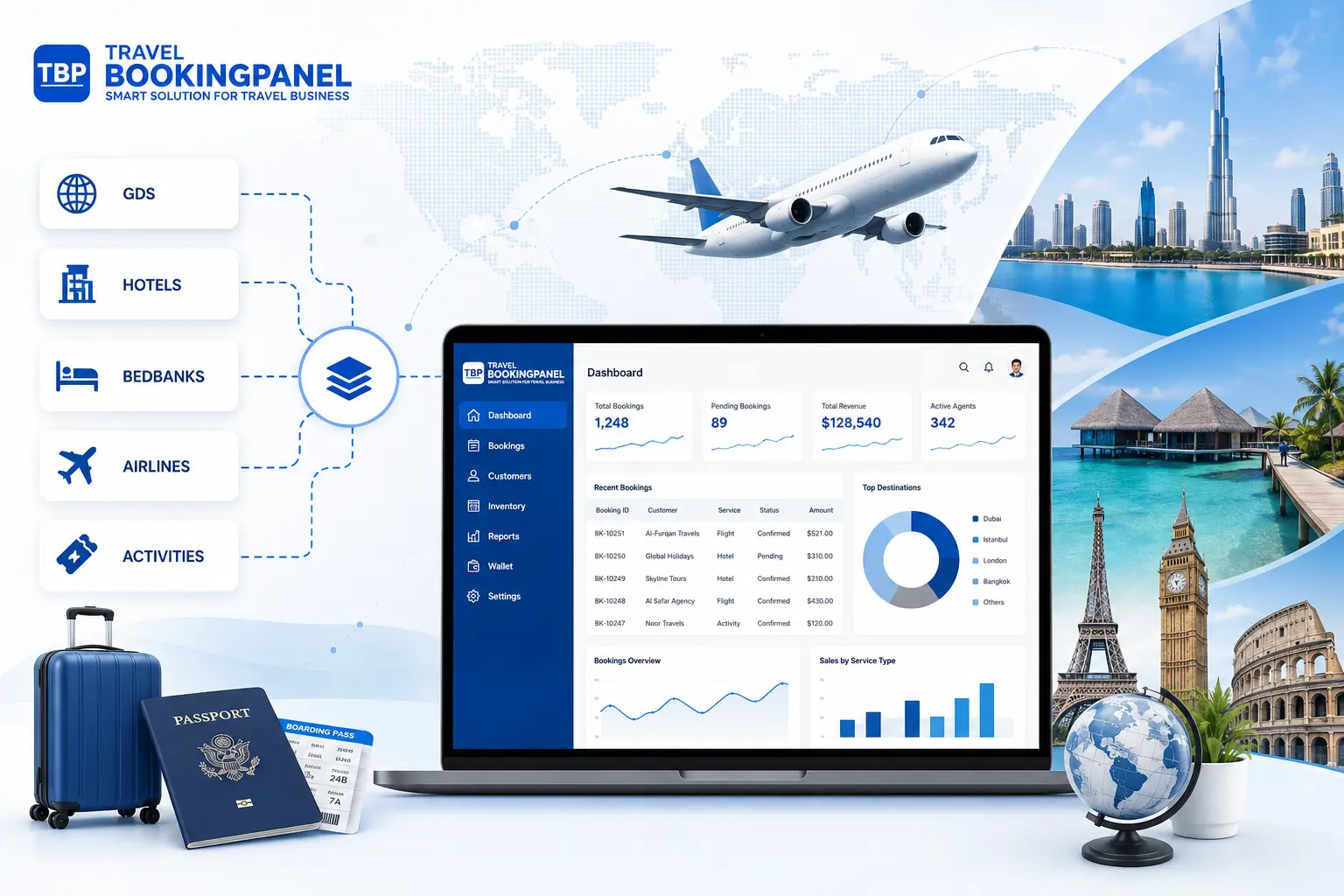
A well-built portal follows a layered path from raw content sources through an integration layer, into the booking engine itself, and finally through mid-office and back-office systems for payments and reconciliation. Content sources like GDS, NDC connections, and bed banks feed into an API integration layer before ever reaching the customer-facing booking engine.
How Price Is Actually Calculated
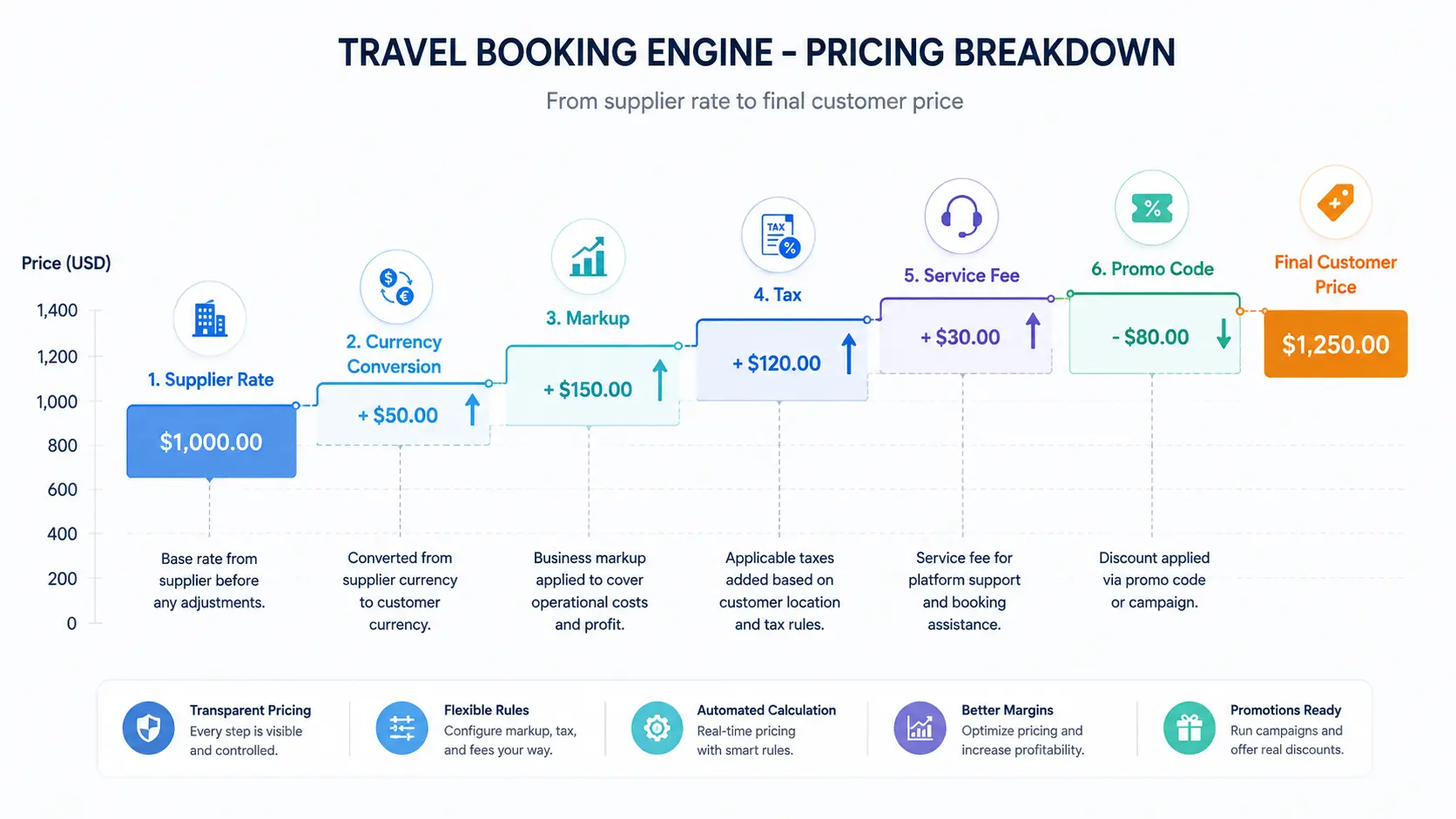
Almost no competitor content walks through the pricing engine. The path from what a supplier quotes to what a customer pays typically runs through six steps:
Where the Pricing Engine Actually Breaks
Each step is configurable, and each introduces its own risk. Markup can be flat, percentage-based, or tiered by supplier and route. Tax rules vary by destination and sometimes by traveler nationality. Service fees need to be disclosed early, not bolted on at checkout.
Hidden costs are one of the most consistently cited reasons travelers abandon a booking at the final step. Promo codes, if applied after tax calculation instead of before, can silently break the margin on high-volume campaigns without anyone noticing until the monthly reconciliation.
Search Speed Is a Conversion Metric, Not a UX Preference
The gap between a 400 ms search response and a 2.5-second one isn't cosmetic; it's revenue. SiteMinder's 2025 traveler survey found that 52% of travelers abandon an online booking specifically because of a poor digital experience, not because they found a better price elsewhere. That's a conversion problem created entirely inside the booking engine, and it's diagnosable and fixable at the infrastructure level.
The infrastructure that makes sub-second search possible rarely gets discussed outside engineering teams, but it's exactly what technical buyers want to see addressed:
- CDN serves static assets and cached search results close to the traveler's location
- Redis or equivalent in-memory cache holds recently searched routes and rates to avoid re-querying every supplier on every repeat search
- Queue workers handle supplier API calls asynchronously, so one slow supplier doesn't block the entire search response
- Rate limiting protects the portal from being throttled or blacklisted by supplier APIs during traffic spikes
- Load balancing distributes search traffic across servers during demand surges (flash sales, holiday booking windows)
- Search indexing pre-processes and indexes frequently searched destinations rather than hitting live APIs for every query
- API retries with backoff retry a failed supplier call intelligently, instead of either failing the whole search or hammering a struggling API
This is the section vendor pages skip entirely because it doesn't sell, but it's exactly what separates a portal that converts from one that quietly bleeds traffic to faster competitors.
Caching Strategy Is Where Most Portals Actually Lose or Win
The instinct is to cache everything, but hotel and flight inventory changes constantly, so an overly aggressive cache shows a traveler a price or availability that's already gone by the time they click through, which does more damage to trust than a slightly slower search. The more durable approach is a tiered cache: static content like hotel descriptions, photos, and amenities can be cached for days since it rarely changes; rate and availability data get a much shorter time-to-live, often measured in minutes, refreshed on a schedule that balances supplier API cost against staleness risk.
High-demand routes and destinations, the ones getting searched hundreds of times an hour during a booking surge, justify a more aggressive prefetch strategy, where the portal proactively refreshes cached rates for its top routes rather than waiting for a live user request to trigger a supplier call. This is also where cost control lives: every supplier API call carries a real cost, so a well-tuned cache isn't just a speed feature; it's a margin protection feature.
Why Mobile Latency Matters More Than Desktop Latency
More than half of travel bookings now happen on mobile, and mobile networks introduce latency variables that a desktop connection doesn't, including inconsistent signal strength, higher round-trip times on cellular data, and devices with less processing headroom to render a heavy results page.
A portal that hits sub-second search times on a fiber connection in a test environment can still feel sluggish on a 4G connection in a real market, which is why load testing against throttled mobile network conditions, not just desktop broadband, is part of a serious performance strategy rather than an afterthought.
B2C vs B2B vs B2B2C: What Actually Changes
| Category | B2C Portal | B2B Portal | B2B2C Portal |
| Who logs in | The general public often uses guest checkout | Credentialed travel agents only | Agents on the front end, their end customers on the back end |
| Pricing shown | Transparent, all-inclusive retail price | Net rate + agent markup, hidden from the end traveler | Agents set their own customer-facing markup |
| Access control | Open | Restricted, hierarchy-based (sub-agents, credit limits) | Layered agent hierarchy plus a public-facing storefront |
| Primary buyer | Individual traveler | Travel agency, DMC, tour operator | Agencies reselling under their own brand |
| Typical use case | Direct-to-consumer OTA, hotel brand booking engine | Wholesale distribution to a travel trade network | White-label storefronts for sub-agents or franchise networks |
The distinction matters commercially, not just technically: a B2C portal competes on price transparency and speed; a B2B portal competes on agent tools, credit terms, and commission visibility.
What a B2C Portal Actually Costs to Build
Build Timeline vs Commission Savings
Custom development from a blank codebase realistically takes 12–24 months. A white-label deployment connecting to pre-integrated supplier inventory can go live in as little as 15 days. The financial case for owning the portal rather than routing everything through a third-party OTA is direct: OTA commissions typically run 15-25% per booking, meaning a business doing $500,000 in monthly volume is paying $75,000-$125,000 a month in commission, which it wouldn't owe on its own portal, a gap that compounds into significant annual savings once the platform is live.
Where to Start
For teams weighing whether to build the API integration and normalization layer in-house or start from a platform that already handles supplier connectivity, pricing rules, and checkout flow, reviewing how TravelBookingPanel structures B2B and B2C distribution is a useful next step before committing engineering resources to a custom build.
The Sections Competitors Never Write
Hidden Costs of Owning a B2C Portal
Commission savings from cutting out an OTA are real, but they're not the whole picture. A self-hosted portal carries its own recurring costs: supplier API fees per call or per booking, PCI DSS compliance overhead, chargeback and fraud losses that an OTA would otherwise absorb, and the engineering time required to keep normalization logic accurate as suppliers change their data formats.
Founders who compare "commission saved" against "zero additional cost" are underestimating the real margin. A more honest comparison weighs the commission saved against infrastructure hosting costs, ongoing supplier integration maintenance, customer support headcount for booking disputes, and the fraud exposure an OTA's own risk team was previously absorbing on the portal's behalf.
API Failover: What Happens When a Supplier Goes Down
A production-grade portal never depends on a single supplier for a given inventory type. When Hotelbeds times out or returns an error, the booking engine should silently fail over to a secondary bed bank rather than showing the traveler an empty results page.
This requires supplier health checks running continuously, a fallback priority order configured per market, and a queue system that can retry or reroute a request without the traveler noticing anything happened.
Dynamic Pricing Logic
Static markups leave money on the table. Dynamic pricing adjusts markup in real time based on demand signals, search volume for a route, days until departure, competitor rate positioning, and historical conversion data at different price points. This is where the pricing engine described earlier stops being a fixed formula and becomes a live optimization system.
Multi-Currency Settlement
Displaying a price in the traveler's local currency is the easy part. Settlement is harder: the portal collects payment in one currency, pays the supplier in another, and has to reconcile foreign exchange risk between the booking date and the settlement date. Portals operating across multiple currencies typically lock an exchange rate at the time of booking to avoid FX exposure eating into the margin between purchase and supplier payout.
Loyalty Engine Design
A points or tier system needs to track not just bookings but partial redemptions, expiry rules, and how loyalty value interacts with promo codes and dynamic pricing so a customer can't accidentally stack a loyalty discount on top of an already-discounted promotional rate in a way that erodes margin.
Refund and Cancellation Workflow
Refund logic has to reconcile the portal's own cancellation policy against the supplier's, and they frequently don't match. A traveler-friendly 48-hour free cancellation window means nothing if the underlying supplier contract is non-refundable. The workflow needs to check supplier terms before confirming a cancellation policy to the customer, not after.
Fraud Detection and Chargeback Prevention
Travel bookings are a high-value target for card fraud precisely because the payout (a confirmed, resellable booking) is immediate and high-ticket. Effective fraud detection layers velocity checks (multiple bookings from one card in a short window), device fingerprinting, and address/IP mismatch flags before a booking reaches ticketing, catching fraud before supplier confirmation, is far cheaper than fighting a chargeback afterward.
Once a supplier has ticketed a booking, reversing it often isn't possible at all, which means the fraud-screening window is effectively the only opportunity to intervene; a portal that screens after ticketing is really just documenting a loss rather than preventing one.
PCI DSS and GDPR: Compliance Infrastructure
Any portal handling card data directly carries PCI DSS obligations; most reduce scope by tokenizing card data through the payment gateway rather than storing it. GDPR (or regional equivalents) adds separate requirements around traveler data retention, consent for marketing use, and the right to have booking history data deleted, which need to be designed into the data model from the start, not retrofitted later.
AI Recommendations and Personalization
Personalization engines that actually move conversion go beyond "customers also viewed." They track a traveler's search patterns, repeat destinations, price sensitivity, preferred cabin class or room type, and surface relevant options before the traveler has to search again, closing a gap where a large share of near-bookers simply leave and never come back to finish.
Travel Disruption and Rebooking Workflows
Flight delays, cancellations, and hotel overbookings happen constantly at scale. A mature B2C portal needs an automated disruption workflow: detecting the disruption via supplier feeds, notifying the traveler proactively, and offering rebooking options rather than leaving the traveler to discover the problem at the airport and call a support line.
The strongest implementations tier the response by disruption severity: a minor schedule change might trigger an automated email with the updated itinerary attached, while a full cancellation triggers a proactive outbound notification with pre-populated rebooking options the traveler can accept in a single tap, rather than forcing them back through a full search flow while already stranded.
Search Indexing for Destination and Property Pages
Static destination and hotel-detail pages carry SEO and AI-discoverability value that a pure booking-flow view misses entirely. Pre-indexing popular destination pages with structured content, schema markup, and cached representative pricing lets these pages get crawled and cited by both traditional search engines and AI answer engines, driving organic entry points into the booking flow that don't depend on paid acquisition.
Portals that treat every page as a dynamic, JavaScript-rendered booking widget with no static, crawlable content underneath are effectively invisible to both search engines and AI Overview-style summarization, regardless of how fast the underlying booking engine actually is.
Expert Insight: Designing for the Buyer Who Reads the API Docs
Where the Industry Is Actually Heading
The OTA industry in 2026 has moved past treating booking aggregation as the finish line. Platforms are increasingly built around modular, API-first architecture that can flex to support flights, hotels, transfers, insurance, and AI-driven trip planning within one ecosystem rather than as bolted-on features. That shift toward AI-powered, modular OTA infrastructure is becoming a defining trend across the industry, and it changes what technical buyers expect to see explained before they'll take a vendor conversation seriously.
What a CTO Actually Asks Before Buying
A CTO evaluating a portal isn't asking whether it has a booking engine, every vendor claims that. They're asking how the platform handles a supplier outage at 2 a.m., what happens to margin when three suppliers quote different cancellation terms for the same room, and whether the caching layer will hold up during a flash sale. Content and sales conversations that answer those questions first, rather than leading with feature lists, are the ones that close enterprise and mid-market deals.
Build, White-Label, or Hybrid: How to Actually Decide
The build-versus-buy question gets framed as a cost comparison, but cost is usually the least useful variable to start with. Three questions matter more:
How Differentiated Does the Booking Experience Need to Be?
If the competitive edge is a genuinely novel checkout flow, a proprietary pricing model, or a booking experience tied to a specific vertical (corporate travel, religious travel, luxury), custom development, or a heavily customized white-label deployment earns its cost. If the differentiation is brand, content, and marketing rather than the mechanics of the booking flow itself, a white-label engine with strong API coverage gets to market faster without sacrificing much.
How Much In-House Engineering Capacity Exists to Maintain It?
A custom-built portal isn't a one-time project; supplier APIs change their schemas, new payment methods need integration, and compliance requirements shift. Teams that underestimate the ongoing maintenance burden of a custom build often end up rebuilding pieces of what a white-label platform would have handled by default.
What's the Actual Booking Volume Today, Not the Projected Volume in Three Years?
A portal architected for enterprise-scale traffic before it has enterprise-scale demand adds complexity and cost without a corresponding return. It's usually more capital-efficient to launch on infrastructure that can scale, and re-architect specific bottlenecks, caching, a particular supplier integration, checkout, once real usage data shows where the pressure actually is, rather than guessing upfront.
The Hybrid Path
A hybrid path is common in practice: launch on white-label infrastructure to validate demand and refine the customer experience, then selectively bring specific high-value components in-house, a proprietary loyalty engine, a custom pricing model, and a differentiated mobile checkout once volume justifies the engineering investment.
Frequently Asked Questions
What's the difference between a B2C, B2B, and B2B2C travel portal?
A B2C portal sells directly to individual travelers at transparent retail prices with open, often login-free access. A B2B portal restricts access to credentialed travel agents who see net rates and add their own markup. A B2B2C portal combines both agents' access to a wholesale layer, while their own end customers see a branded storefront on top.
How much does it cost to build a B2C travel portal, and how long does it take?
Custom development typically takes 12-24 months. White-label deployment on pre-integrated supplier infrastructure can go live in roughly 15 days, at a fraction of the custom-build cost, with commission savings compared to OTA distribution typically reaching six figures annually at moderate booking volume.
Why do B2C travel bookings get abandoned, and how does architecture fix it?
Over half of booking abandonment traces back to a poor digital experience, slow search, hidden fees, or forced account creation rather than price. Fixing it is an infrastructure problem: caching, supplier failover, and transparent upfront pricing calculated the first time correctly.
What APIs does a B2C travel portal need at a minimum?
At a minimum, one GDS or NDC source for flights, one hotel supplier or bedbank API, one payment gateway, and one mid-office system for reconciliation. Competitive portals typically expand to six to eight integrations over time as they add redundancy and niche inventory sources.
How does a B2C travel portal handle fraud, PCI DSS, and multi-currency settlement?
Fraud is caught pre-ticketing through velocity checks and device fingerprinting. PCI DSS scope is usually reduced by tokenizing card data through the payment gateway rather than storing it directly. Multi-currency settlement typically locks an exchange rate at booking time to protect margin from FX movement before supplier payout.
Conclusion and Next Steps
A B2C travel portal isn't defined by its feature list; it's defined by how well its normalization layer, pricing engine, and caching infrastructure hold up under real search volume and real supplier failures. The businesses that treat this as infrastructure to be engineered, rather than a checklist to be ticked, are the ones that convert traffic into bookings instead of losing it to a two-second delay.
If you're evaluating whether to build this from scratch or deploy on infrastructure that already handles supplier integration and normalization, TravelBookingPanel is a reasonable place to start that conversation.
Tags
Own Your Travel Platform. Forever.
Buy once, own forever. Full source code · No monthly fees · No hidden charges.