A B2B travel portal is only as good as its worst supplier connection. Anyone who has run one in production knows the search bar is the easy part; the hard part...
A B2B travel portal is only as good as its worst supplier connection. Anyone who has run one in production knows the search bar is the easy part; the hard part is what happens in the 200 milliseconds after a user hits “search” when five suppliers respond in five different formats, half of them list the same hotel under three different names, and the system has to reconcile all of it before the agent gets bored and closes the tab.
This article walks through how a B2B travel portal is actually built: the aggregation layer, the markup and commission logic, the booking lifecycle, and the mistakes that show up almost every time a team integrates suppliers without a plan for deduplication.
This isn't a feature list. If you've already read ten "top features of a B2B travel portal" articles, this one is written for the next step: understanding the system well enough to evaluate a vendor, brief a developer, or scope a build internally.
What Is a B2B Travel Portal?
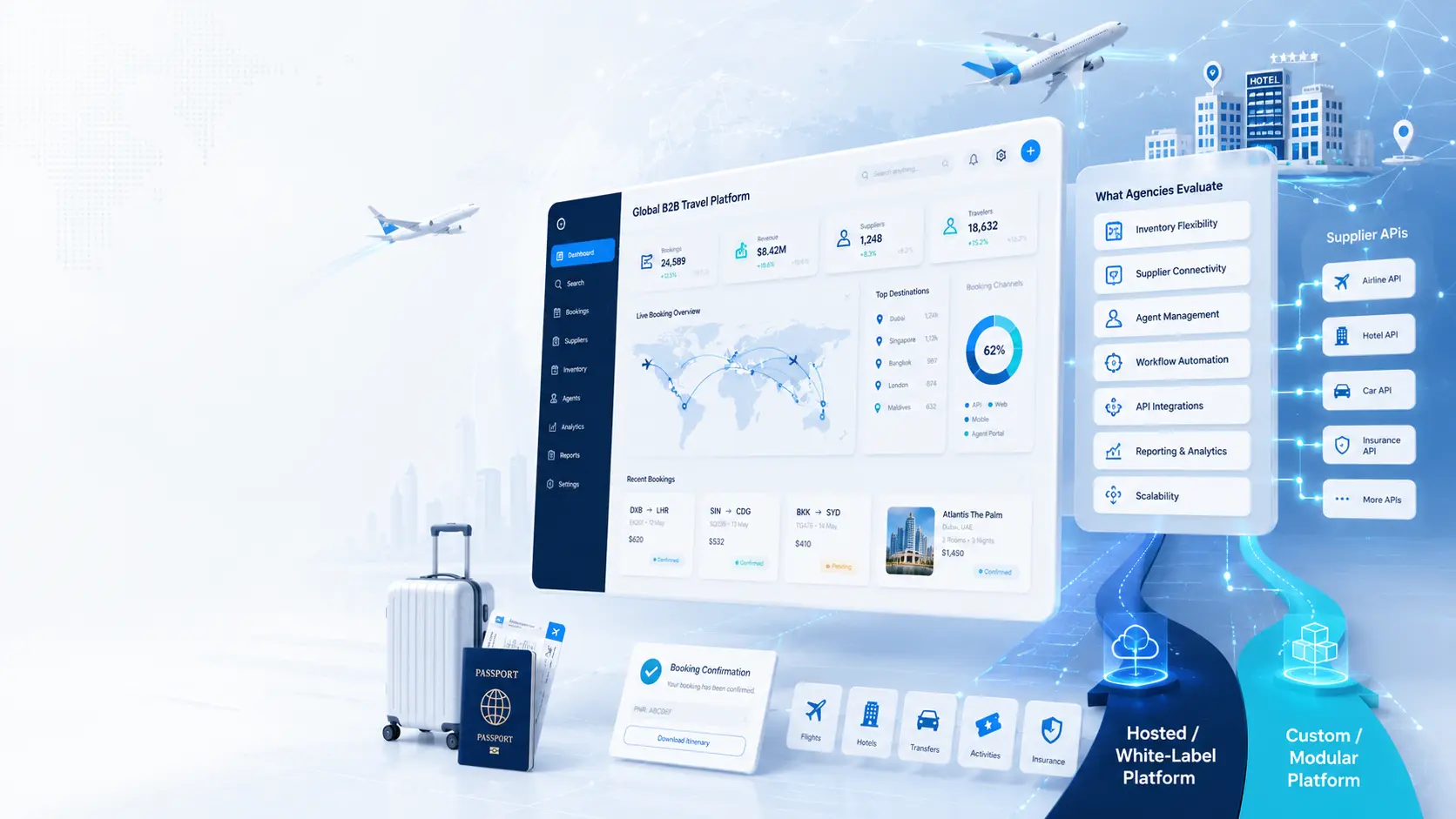
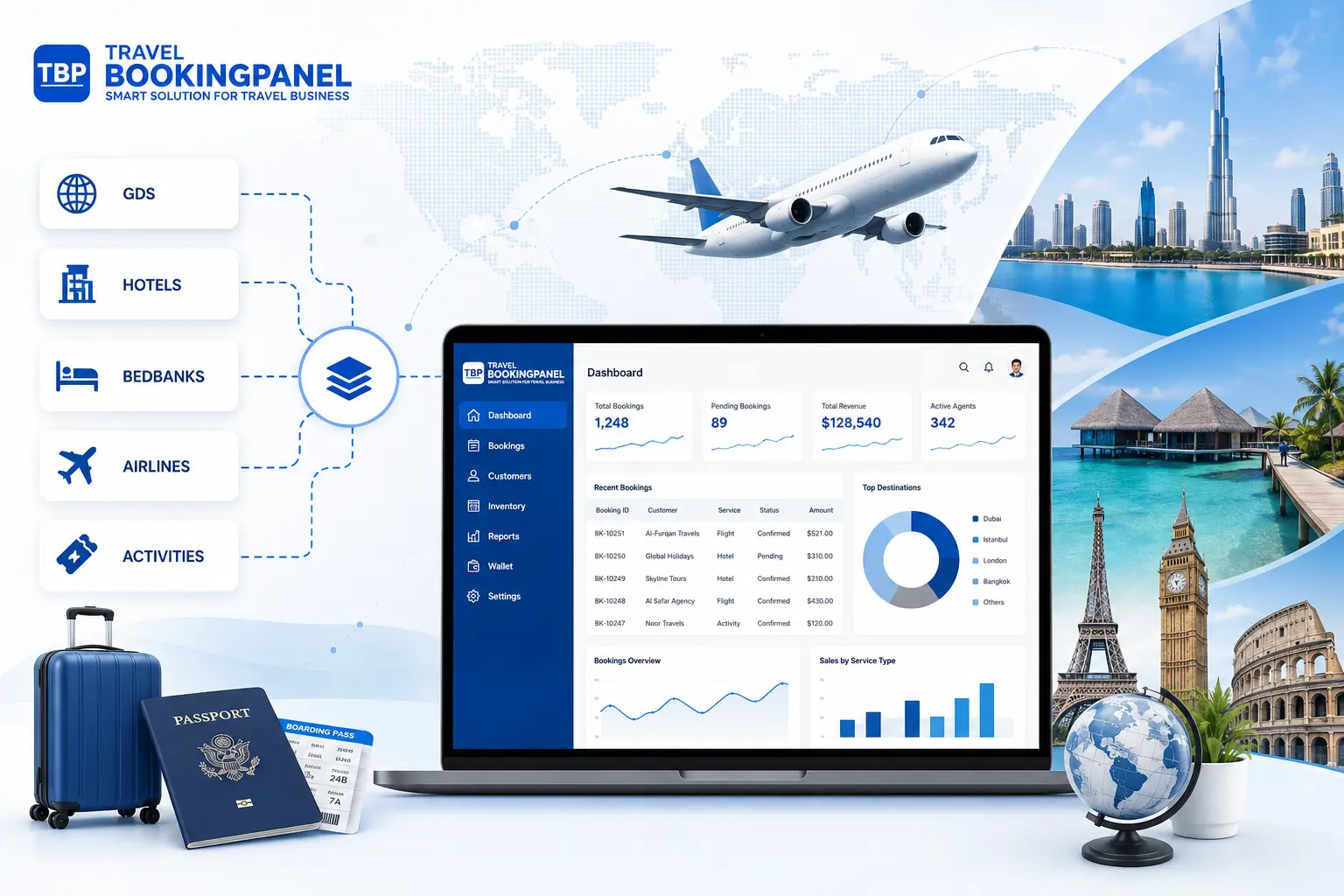
A B2B travel portal is a platform that sits between travel suppliers, airlines, hotel chains, bedbanks, ground transport providers, and travel sellers, meaning agencies, tour operators, DMCs, and corporate travel desks. The portal aggregates inventory from multiple sources, applies business rules like markup and commission, and exposes all of it through a single booking interface instead of forcing sellers to log into ten different supplier systems.
The core job of the platform is distribution management. It has to handle pricing structures that vary by supplier, commission models that vary by agent tier, and business rules that vary by market, all while keeping response times low enough that a search doesn't feel like it's stalling. According to an overview from Zentrumhub, B2B travel portals function as a centralized hub where suppliers distribute inventory, sellers access and book it, and consolidators aggregate content from multiple sources to redistribute to a network of agents a description that captures why the system is fundamentally a distribution and rules engine, not just a booking form.
How This Differs from a GDS
A global distribution system like Amadeus or Sabre is primarily an airline-focused inventory system. It gives access to flights, major hotel chains, and car rentals, historically through a command-based interface that required dedicated agent training. A B2B travel portal is a different layer entirely it typically sits on top of GDS content and adds direct supplier connections, bedbank inventory, vacation rentals, and activities, wrapped in a visual interface with CRM, commission tracking, and itinerary tools that a raw GDS doesn't provide.
In practice, most portals treat the GDS as one supplier among several rather than the entire inventory source. That distinction matters when you're scoping a build, because "GDS integration" and "supplier aggregation" are not the same project; one connects you to a single, standardized feed; the other means building the layer that reconciles inconsistent feeds from a dozen different sources.
Who Actually Uses These Systems
The buyer profile for a B2B travel portal is narrow and technical. It's not a consumer booking a vacation; it's operators who need the system to hold up under volume and business-rule complexity:
- Online travel agencies (OTAs) redistributing inventory to sub-agents
- Destination management companies (DMCs) manage local supplier relationships and net rates
- Travel consolidators aggregating content across suppliers for resale
- Airline distributors managing NDC and GDS content side by side
- Hotel wholesalers managing allotments and net-rate contracts
- Tour operators package flights, hotels, and activities into bundled products
- Corporate travel managers enforcing policy and approval workflows across a traveler base
Global demand for B2B platforms is growing fastest in emerging markets, Asia, the Middle East, and Africa in particular, where reseller networks are the primary channel for scaling a travel business, which is part of why multi-currency and multi-language support isn't optional for most new builds.
The Real Architecture
Most marketing pages describe a portal as "a booking engine connected to suppliers." That's technically true and operationally useless. Here's what the layers actually do and why each one exists.
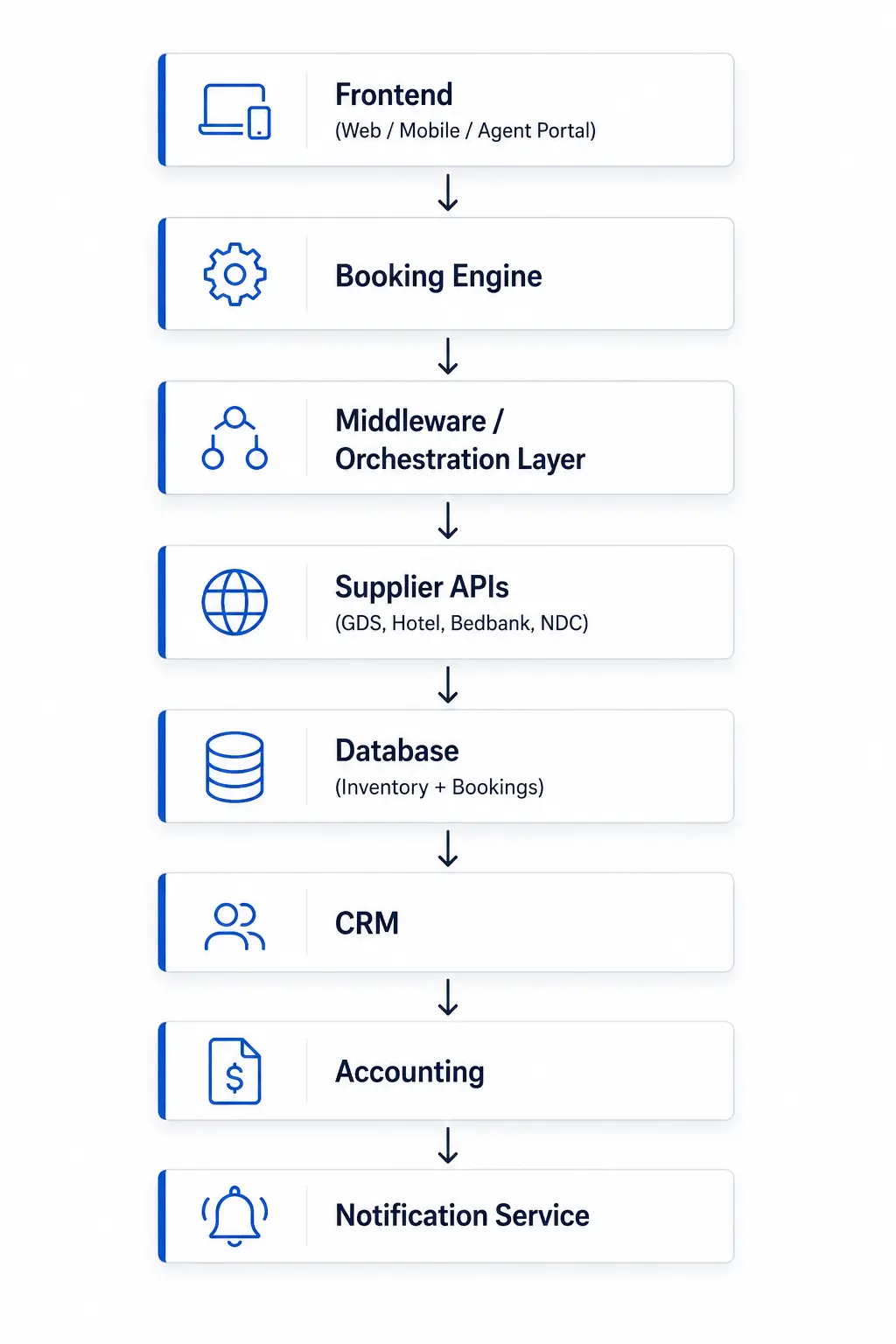
Each layer solves a specific problem:
- The frontend is the interface that an agent or sub-agent actually touches. It has to render fast, even when the backend hasn't finished collecting supplier responses. This is why most production portals show a loading skeleton and stream results as suppliers respond, rather than waiting for the slowest supplier to finish.
- The booking engine owns the session state search parameters, holds inventory, pricing snapshots, and enforces the rules for how long a rate is valid before it needs to be reconfirmed with the supplier.
- The middleware/orchestration layer is where supplier-specific logic lives. Every supplier has a different API shape, a different authentication method, and different error codes. The middleware normalizes all of that into one internal format so the booking engine never has to know which supplier it's talking to.
- Supplier APIs are the actual connections to GDS, hotel XML feeds, bedbanks, and NDC content. This layer is usually the most fragile part of the system because uptime and response time are outside your control.
- The database stores normalized inventory, session holds, and confirmed bookings. This is also where deduplication and rate mapping tables live.
- CRM tracks agent relationships, sub-agent hierarchies, and credit limits separately from the booking data because the access patterns are completely different (reporting and relationship management vs. real-time transactional lookups).
- Accounting reconciles what was booked, what was paid, what commission is owed, and what's still outstanding. This is consistently the most underbuilt layer in first-generation portals.
- The notification service handles booking confirmations, cancellation alerts, and payment reminders, usually decoupled from the booking flow itself, so a slow email provider doesn't hold up a confirmed booking.
Supplier Aggregation: What Actually Happens Under the Hood
"Aggregates multiple suppliers" is the phrase every vendor uses, and the phrase that hides the most complexity. Here's what the pipeline actually looks like when a search request comes in.
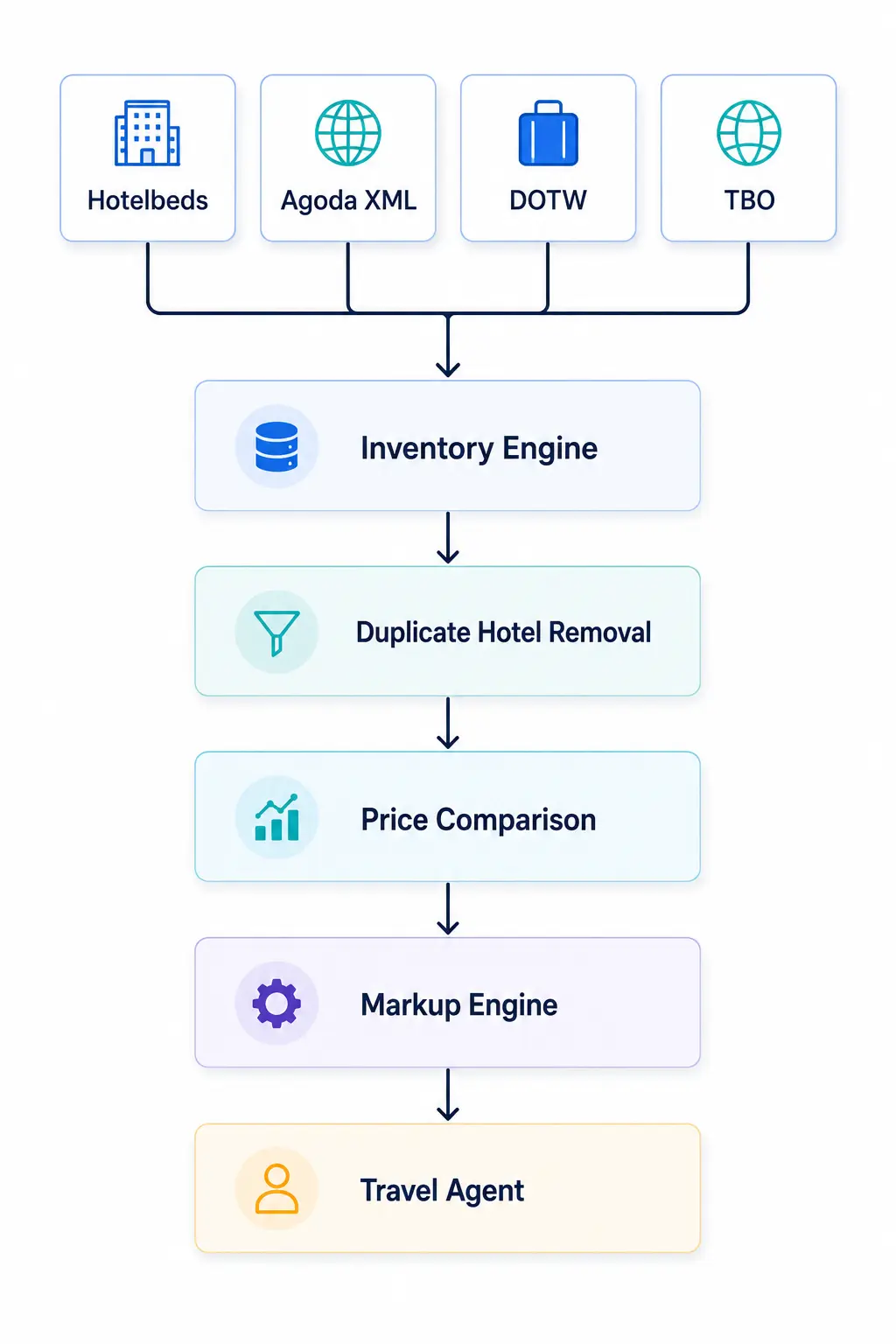
Walking through each stage:
Multi-supplier query
A single hotel search doesn't hit one supplier; it fires simultaneous requests to every connected source that might have inventory for that destination. A multi-source search that pulls from GDS, direct suppliers, and aggregators simultaneously is table stakes for any modern portal, since it directly determines whether the agent sees the full range of available options or a partial, stale picture.
Inventory engine
This is where raw responses from different suppliers land before anything is shown to the user. Each supplier returns data in its own schema, with different field names, currency handling, and cancellation policy formats, so the inventory engine's first job is simply to get everything into a single internal shape.
Duplicate hotel removal
This is the step almost nobody builds correctly on the first attempt. If you integrate five hotel suppliers without a deduplication engine, you get duplicate listings of the same physical property, inconsistent pricing between the duplicates, and agents who lose trust in the results because the same hotel shows up three times at three different prices.
Deduplication typically runs on a combination of GPS coordinates, name-matching algorithms (fuzzy string matching, not exact match; "Hilton Garden Inn Downtown" and "Hilton Garden Inn Downtown City Center" need to resolve to the same property), and a maintained mapping table that gets manually corrected over time as edge cases surface.
Price comparison
Once duplicates are merged, the engine has to decide which supplier's rate to surface for the same physical room type, usually the lowest net rate, but sometimes the one with the best cancellation terms, depending on how the portal is configured.
Markup engine
Net rates get a markup applied before the agent ever sees them, and the markup logic is rarely flat. More on this in the commission section below.
Room and Rate Name Reconciliation
Hotel suppliers don't agree on how to describe the same room. One supplier's "Deluxe King Room with City View" is another supplier's "Superior Room King Bed." Without a room-mapping layer, an agent searching the same hotel across two connected suppliers sees what looks like two different room types at two different prices when it's actually the same physical room.
Most mature portals solve this with a room-type taxonomy, a controlled vocabulary that supplier room names get mapped into, combined with ongoing manual review, because automated mapping alone tends to have a 5-10% error rate on ambiguous room descriptions.
Rate Shopping and Timeout Handling
Real-time multi-supplier search has a hard constraint: the slowest supplier in the batch determines how long the user waits, unless you build around it. Production systems typically set a timeout window (often 3-5 seconds) per supplier, return results from whichever suppliers respond in time, and either drop or asynchronously append late responses.
If a supplier's API is down or degraded, the system needs a fallback path; otherwise, a single supplier outage takes down search results for every property that supplier was covering, even if three other suppliers had the same hotel available.
API Layer: Flights, Hotels, and the NDC Shift
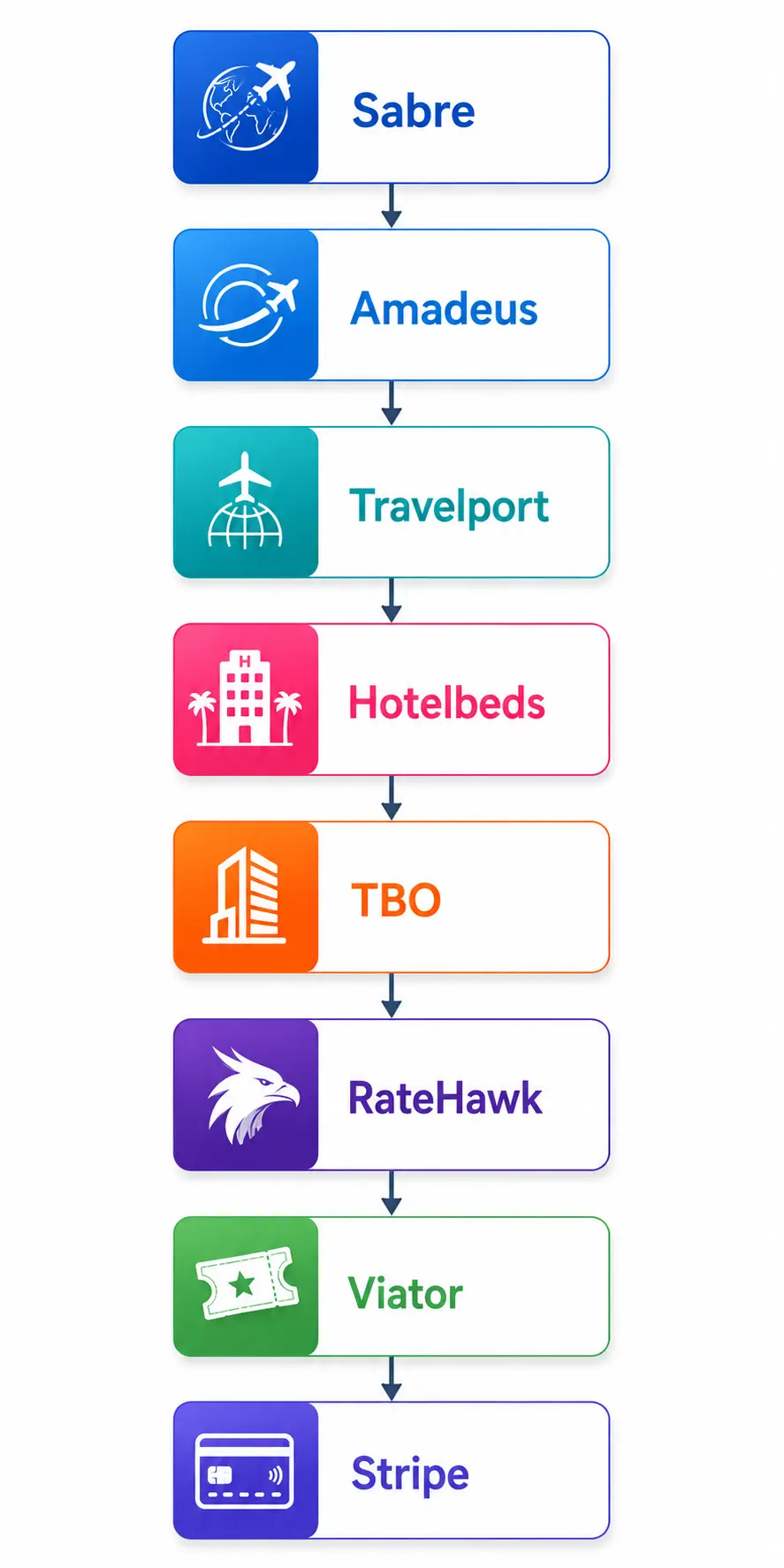
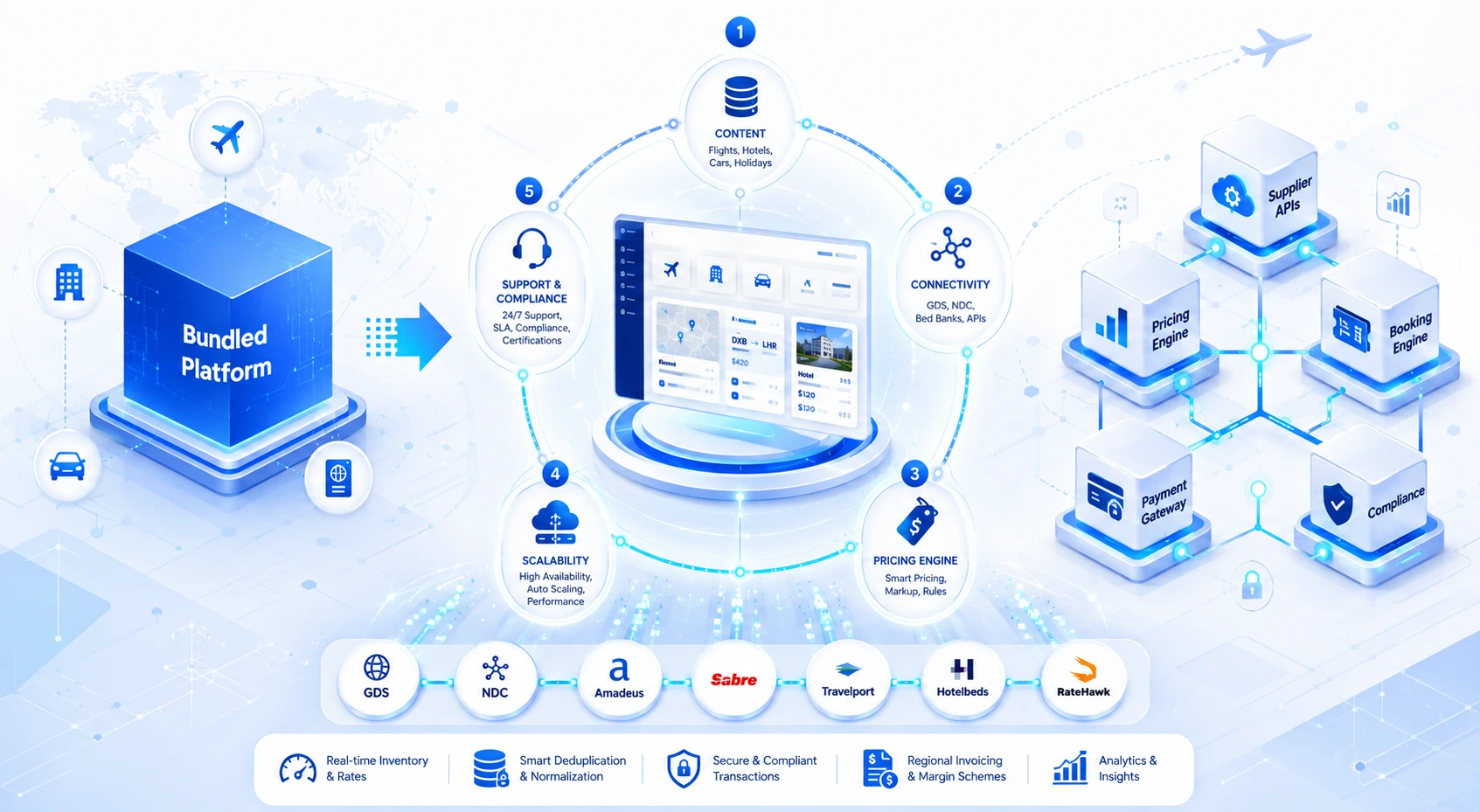
Each connection in that chain exists for a different reason:
- Sabre, Amadeus, and Travelport are the three major GDS providers, primarily for airline content plus some hotel and car inventory. Amadeus Selling Platform Connect, for example, provides end-to-end flight commerce through APIs covering availability, pricing, booking, and post-booking actions, which is why it's commonly used as the backbone for branded B2B portal experiences rather than a full standalone system.
- Hotelbeds, TBO bedbanks, and hotel aggregators offering net-rate hotel inventory outside the GDS, typically with broader coverage in specific regions.
- RateHawk is an additional hotel supplier used to widen inventory coverage and give the price comparison engine more data points to work with.
- Viator activities and tours content, filling out package products beyond flights and hotels.
- Stripe payment processing, sitting outside the supplier layer entirely but critical to the booking lifecycle, closes out cleanly.
New Distribution Capability (NDC) is reshaping this layer. Airlines, including Lufthansa, Emirates, and Singapore Airlines, have moved toward mandating NDC for ancillary content, which means portals that only connect through legacy GDS channels increasingly miss ancillary revenue and richer fare content that's only available through NDC-native connections. For a portal built today, deciding how much of the flight layer to build on NDC versus legacy EDIFACT/GDS messaging is one of the bigger architectural calls a team makes early on.
API Comparison Table
| API / Supplier | Flights | Hotels | Cars | Activities |
| Amadeus | Yes | Limited | Yes | No |
| Sabre | Yes | Limited | Yes | No |
| Travelport | Yes | Limited | Yes | No |
| Hotelbeds | No | Yes | No | Limited |
| TBO | Limited | Yes | Limited | Limited |
| RateHawk | No | Yes | No | No |
| Viator | No | No | No | Yes |
This table is meant as a starting scoping reference, not a purchasing recommendation. Actual coverage varies by market and contract tier, and it's worth confirming current regional coverage directly with each supplier before committing to an integration.
Markup, Commission, and Agent Hierarchy Logic
This is where most of the actual business logic in a B2B portal lives, and it's the layer least visible from the outside. A portal typically supports multi-level agent hierarchies; a master agent sits above sub-agents, who might sit above their own retail agents, and pricing has to be inherited and adjusted at every level.
Structured agent hierarchy tools let administrators manage thousands of sub-agents across multiple levels, with per-tier markup, commission, and credit limit configuration, which is what allows a wholesaler to sell the same inventory to different partner tiers at different margins without maintaining separate catalogs. Markup is rarely a flat percentage. In a mature system, it's usually conditional on some combination of:
- Agent tier (master agent vs. sub-agent vs. retail)
- Supplier (some suppliers get a higher markup because net rates are more competitive)
- Destination or season (higher-demand periods often carry different markup rules)
- Booking value (percentage markup with a floor or ceiling to avoid under- or overcharging on very low- or very high-value e-bookings)
Margins also vary significantly by channel, which matters when a business is deciding which suppliers to prioritize in the aggregation layer. DMC platforms offering net rates tend to allow markups in the 20-35% range; OTA commission programs typically pay a fixed 10-15%; and GDS-sourced hotel bookings often yield only 5-12% (dmcquote.com). A portal that's optimized entirely around GDS hotel content is leaving a meaningfully different margin profile on the table compared to one that prioritizes direct bedbank and DMC relationships.
Commission tracking runs in parallel to markup and has to answer a different question: not "what did the agent pay," but "what does the platform owe the agent or sub-agent for driving the sale." Getting these two calculations tangled together is a common source of accounting errors in early-stage builds. Markup and commission need to be tracked as separate ledger entries, not derived from each other after the fact.
Booking Lifecycle: Search to Reconciliation
A booking isn't done when the confirmation email goes out. The full lifecycle looks like this:
- Search multi-supplier query, aggregation, dedup, price comparison (covered above)
- Hold the system reserves the selected rate for a defined window, usually by calling the supplier's hold or "session" API, since most suppliers won't guarantee a rate indefinitely
- Confirm the booking is finalized with the supplier, and a supplier-side confirmation number is returned
- Ticket/voucher issuance for flights, this means actual ticketing (which can happen asynchronously from booking confirmation); for hotels, it's typically a voucher generation step
- Payment capture is charged against the agent's credit line or captured directly, depending on the payment model
- Accounting syncs the transaction, gets recorded against the agent's ledger, markup and commission entries are created, and the accounting system reflects the booking as revenue-in-progress rather than final revenue until reconciliation is complete
- Post-booking servicing cancellations, amendments, and refunds, each of which has to reverse or adjust the accounting entries created in step 6
- Commission reconciliation, supplier payouts, and agent commissions get settled, usually on a periodic batch cycle rather than in real time
Steps 6 and 8 are consistently where in-house builds break down. Teams build a solid booking engine, get search and confirmation working reliably, and then discover that reconciling what suppliers actually paid against what the system expected them to pay, accounting for currency conversion timing, supplier-side adjustments, and partial cancellations, is a much bigger project than the booking flow itself.
Build vs Buy: Cost and Complexity Framework
Instead of a flat development quote, it's more useful to scope a build (or evaluate a vendor's coverage) module by module. Complexity here reflects integration difficulty, edge-case density, and ongoing maintenance load, not calendar time, since that varies by team size and supplier count.
| Module | Estimated Complexity | Why |
| Flights | High | NDC + GDS dual-path support, fare rules, and ticketing timing |
| Hotels | Medium | Rate mapping and dedup across suppliers is the main cost driver |
| Transfers | Medium | Fewer suppliers, but availability logic varies widely by market |
| Activities | Medium | Inventory is fragmented across many small regional suppliers |
| Visa | Medium | Document handling and country-specific rule variation |
| CRM | High | Multi-tier agent hierarchy, credit limits, permissions |
| Accounting | High | Reconciliation across suppliers, currencies, and commission tiers |
This table is meant to help a buyer or founder evaluate scope, not chase a specific price point. Two vendors quoting very different numbers for "a B2B travel portal" are frequently scoping a different subset of these modules.
Build vs buy
Building from scratch makes sense when the differentiator is the business logic itself, a highly specific markup model, or a niche market with unusual supplier relationships. Buying a white-label platform makes sense when the differentiator is the supplier network and agent relationships, not the software.
GDS-first vs bedbank-first
GDS-first architectures get broad airline coverage quickly but weaker hotel margins. Bedbank-first architectures require more supplier integration work upfront but tend to produce better net rates and higher markup headroom on hotels.
Single-supplier vs multi-supplier
A single supplier is faster to launch and easier to maintain but leaves the business exposed to that supplier's outages, pricing changes, and coverage gaps. A multi-supplier is more resilient and gives better price comparison, but the deduplication and reconciliation costs scale with every supplier added.
Decision Frameworks for Software Buyers
Three questions come up in almost every serious evaluation conversation. None of them has a universally correct answer; the right call depends on supplier relationships already in place, target markets, and how much engineering capacity is available for ongoing maintenance.
GDS vs bedbank as the primary hotel source
A GDS-first hotel strategy gets you broad, standardized coverage with less integration effort, but hotel margins on GDS bookings tend to sit at the low end (roughly 5–12%, per the margin breakdown above). A bedbank-first strategy leading with Hotelbeds, TBO, DOTW, or similar requires more upfront integration and deduplication work but typically produces stronger net rates and more markup headroom. Most mature portals end up running both, using the GDS as a coverage fallback and bedbanks as the primary margin driver.
Single-supplier vs multi-supplier per category
Multi-supplier aggregation is the obvious answer for a mature platform, but it's not the right starting point for every business. A new consolidator with a narrow regional focus and one strong local supplier relationship may get more value from starting single-supplier and deep-integrating (real-time inventory, direct contract rates, faster support) before taking on the deduplication overhead of a second or third source.
White-label vs custom build
A white-label platform is the faster path to market and shifts the deduplication, reconciliation, and supplier-uptime problems onto the vendor at the cost of differentiation and, usually, a ceiling on how deeply markup and commission logic can be customized. A custom build removes that ceiling but means the buyer inherits every engineering problem described in this article, including the ones that don't show up until three months after launch (accounting reconciliation being the most common example).
Evaluation Checklist for Software Buyers
Before signing with a vendor or greenlighting an internal build, it's worth getting direct answers to these questions, most of which won't be volunteered in a sales demo:
- Is there a dedicated deduplication engine, or does the platform rely on suppliers not overlapping in inventory?
- How are room types mapped across suppliers: automated matching only, or automated plus manual review?
- Is markup logic configurable per agent tier, per supplier, and per season, or is it a single global percentage?
- Are commission and markup tracked as separate ledger entries or derived from one another?
- What happens to search results when one connected supplier's API is down or slow? Is there a timeout and fallback, or does the whole search stall?
- Is NDC content supported natively, or only through legacy GDS messaging?
- How is accounting reconciliation handled across currencies and commission tiers, batch cycle, real-time, or manual?
- What's the actual API response time under load, not just in a clean demo environment?
A vendor or internal team that can answer all eight of these clearly, without hedging, is a strong signal that the aggregation and accounting layers were actually built with production volume in mind, not just assembled to pass a demo.
Frequently Asked Questions
What is the difference between a B2B travel portal and an OTA platform?
An OTA platform is consumer-facing individual travelers to search, book, and pay directly. A B2B travel portal is built for travel sellers (agencies, sub-agents, DMCs) to access supplier inventory under negotiated rates, with markup, commission, and credit management layered on top, none of which a consumer-facing OTA needs.
Do I need a GDS integration if I already have a hotel API and bedbank connections?
It depends on whether flights are part of the product. GDS integration is primarily relevant for airline content; if the portal is hotel-only, a GDS connection adds cost without adding value. If flights are in scope, most portals still connect to at least one GDS for coverage, even when NDC and direct airline APIs are also integrated.
How long does it take to build a B2B travel portal from scratch?
The timeline depends heavily on which modules are in scope (see the complexity table above) and how many suppliers need integration. A narrow, single-supplier hotel-only MVP is a different project from a multi-supplier platform with flights, CRM, and full accounting reconciliation. Treating them as the same "build a travel portal" estimate is where most timeline overruns start.
What causes duplicate hotel listings in a B2B travel portal?
Duplicate listings almost always trace back to missing or weak deduplication logic when multiple suppliers are integrated. Each supplier returns its own hotel ID and name formatting, and without a mapping table plus fuzzy name-matching, the same physical property gets treated as multiple distinct listings.
Is NDC replacing GDS for B2B travel distribution?
Not entirely, at least not yet. NDC is increasingly mandated by airlines for ancillary content and richer fare data, but most portals run NDC and legacy GDS messaging side by side rather than fully replacing one with the other, since GDS still covers content and airlines that haven't moved to NDC.
Common Implementation Mistakes
A few patterns show up often enough in real integrations that they're worth calling out directly:
No deduplication engine
Covered above, but worth repeating because it's the single most common gap: teams integrate multiple hotel suppliers, skip the dedup layer to hit a launch date, and end up with duplicate listings, inconsistent pricing, and agents who stop trusting search results.
Flat markup instead of tiered logic
A flat markup percentage is simple to build and almost always wrong for the business a few months in, once different agent tiers and supplier margins need different treatment.
Underbuilt accounting and reconciliation
The booking engine gets most of the design attention because it's the visible part of the product. Reconciliation, matching what was booked against what suppliers actually charged, across currencies and commission tiers, gets treated as an afterthought and becomes the most expensive thing to retrofit later.
No fallback logic for supplier outages
If one supplier's API goes down and there's no fallback path, search results for every hotel that supplier covers disappear, even when other connected suppliers have the same properties available.
Treating room names as exact-match strings
Supplier room-type descriptions are inconsistent by design (they're marketing copy, not a structured taxonomy), and exact-match logic will silently miss matches that fuzzy matching and a maintained mapping table would catch.
Key Takeaways
- A B2B travel portal is fundamentally a distribution and rules engine; the booking form is the least complex part of the system.
- Supplier aggregation without deduplication produces duplicate listings and pricing inconsistency; the dedup and rate-mapping layer is where most of the real engineering effort goes.
- Markup and commission logic needs to be tiered and conditional, not flat. Margins vary meaningfully by supplier channel (DMC net rates, OTA commissions, and GDS hotel bookings).
- NDC adoption is changing how the flight API layer needs to be architected, particularly for airlines mandating NDC for ancillary content.
- Accounting and reconciliation are consistently the most underbuilt layer in first-generation portals, not the booking engine itself.
- Scoping by module complexity (flights, hotels, CRM, accounting) gives a clearer picture of build cost than a single flat quote.
Tags
Own Your Travel Platform. Forever.
Buy once, own forever. Full source code · No monthly fees · No hidden charges.