Choosing travel software is rarely about finding the platform with the most features. The better question is whether the system fits the way your agency actuall...
Choosing travel software is rarely about finding the platform with the most features. The better question is whether the system fits the way your agency actually sells, manages suppliers, and handles customer relationships. If you're searching for a TripFro alternative, the honest answer is: it depends on where your current setup is actually failing you, not on which vendor has the longer feature list.
Most comparison content around travel booking software falls into two categories. The first is generic "alternative list" sites that stack logos next to each other without understanding how a travel agency's business actually runs day to day. The second is vendor-produced comparison pages that quietly steer every conclusion toward their own product. Neither is particularly useful when you're the one who has to live with the decision for the next three years.
This guide sits between those two extremes. It's built around the framework experienced travel technology buyers actually use before committing budget to a new platform, including a scorecard you can apply to any B2B travel portal, tour operator software, or white-label OTA platform on your shortlist, plus a realistic look at what switching actually costs.
Direct Answer: Is There Something Better Than TripFro?
A booking engine is only one part of a travel technology ecosystem. The difficult problems usually appear behind the booking button: supplier synchronization, reconciliation, agent permissions, and operational visibility. Whether a TripFro alternative is "better" depends almost entirely on where those specific pain points live in your current operation, not on a side-by-side feature checklist.
If your agency is small, newly launched, and mainly needs a working booking flow to go live quickly, TripFro-style platforms can be a reasonable starting point. If your agency has scaled past a certain transaction volume, added sub-agents, or expanded supplier relationships, the same platform that worked at launch often becomes the bottleneck.
What TripFro-Type Platforms Typically Get Right
Entry-level and mid-market travel portal providers generally cover the basics competently:
- Fast deployment for agencies that need to go live in weeks, not months
- A reasonably complete starter feature set, flight, hotel, and package modules bundled together
- Lower upfront cost compared to custom-built systems, which matters for agencies still proving out their model
For a small agency booking its first hundred reservations, this combination is often genuinely enough. The problems tend to show up later, not on day one.
Where the Limitations Usually Show Up
The friction almost always appears as an agency scales past its starting size. This is the pattern reported consistently by growing travel agencies moving off entry-level platforms:
Manual Reconciliation Between Supplier Invoices and Platform Records
Most starter platforms record a booking, but reconciling what the supplier actually invoiced against what the platform shows as owed is often a manual, spreadsheet-driven process. At low volume, this is annoying. At a few hundred bookings a month, it becomes a part-time job for someone on the team.
Rigid Agent-Tier Permissions
Travel agencies rarely have a flat commission structure. Sub-agents, preferred partners, and in-house staff usually need different markup rules, different visibility into pricing, and different approval workflows. Platforms built for a single generic "agent" role force these differences into manual workarounds, spreadsheets, side agreements, or manual invoice adjustments after the fact.
Limited API Flexibility for Niche Suppliers
Once an agency wants to add a regional bed bank, a niche activity supplier, or a specialized ground transport provider, platforms without an open API architecture often can't accommodate it without a lengthy vendor request, if they can accommodate it at all.
Reporting That Shows "What" But Not "Why"
Booking totals and revenue summaries are standard. What's usually missing is reporting that connects supplier performance, agent behavior, and margin erosion, the kind of visibility a travel technology manager actually needs to make decisions.
This pattern lines up with a broader shift in the industry: more agencies are treating branded, owned booking infrastructure as core operations rather than a plug-and-play add-on, since a patchwork of manual workarounds quietly caps how much an agency can grow before something breaks.
The 7-Point Travel Platform Scorecard
Use this scorecard to evaluate any platform, TripFro, a TripFro alternative, or a system you already run. Score each dimension from 1 (weak) to 5 (strong), then total the result.
| Dimension | What to Check |
| Inventory flexibility | Can you add new suppliers without a development cycle? |
| Supplier connectivity | Does it support GDS, bed banks, and direct APIs simultaneously? |
| B2B agent management | Can you define custom markup and permission tiers per sub-agent? |
| Booking workflow automation | Does confirmation, invoicing, and reconciliation happen without manual entry? |
| Customization limits | Can the UI, workflow, and business logic adapt to your model, or only the vendor's? |
| Reporting depth | Do reports show booking trends, or just booking totals? |
| Long-term scalability | Will this system still fit at three times your current transaction volume? |
How to Score Each Dimension in Practice
Inventory Flexibility (1-5)
Score this by asking your vendor directly: "If I sign a new supplier contract next month, what's the process to connect it?" A score of 5 means self-service API mapping. A score of 1 means a support ticket and an unspecified timeline.
Supplier Connectivity (1-5)
Check whether the platform natively supports GDS content, bed bank aggregators, and direct hotel or activity contracts at the same time, or whether it's optimized for just one channel type. Agencies that rely on a mixed supplier strategy, which is most agencies past the early stage, need genuine multi-channel support, not a single strong integration surrounded by workarounds.
B2B Agent Management (1-5)
This is where generic platforms fail most visibly. Ask whether markup rules, credit limits, and booking visibility can be set per agent tier without a developer, and whether sub-agents can be onboarded without manual account setup each time.
Booking Workflow Automation (1-5)
Walk through what happens after a booking is confirmed. Does the invoice generate automatically? Does the supplier payable update without manual entry? Every manual step here is a recurring labor cost, not a one-time inconvenience.
Customization Limits (1-5)
Ask what happens when your workflow doesn't match the platform's default assumptions. Rigid platforms force your business to adapt to the software. Flexible ones adapt the software to your business. This is usually the single biggest differentiator between platforms that scale with an agency and ones that get outgrown.
Reporting Depth (1-5)
Booking counts and revenue totals are table stakes. Ask whether the platform can show margin by supplier, agent performance trends, or the source of pricing errors, the operational visibility that a travel technology manager is actually evaluated on.
Long-Term Scalability (1-5)
This is the hardest to assess in a demo, because most platforms look scalable at low volume. Ask specifically about performance and support response times at three to five times your current booking volume, and ask for references from agencies that have actually operated at that scale on the platform.
A platform scoring below 20 total points is usually one that will need replacing again within 18-24 months, worth knowing before you migrate, not after you've already paid for onboarding twice.
Related Questions to Cover
Which Platform Gives More Flexibility?
Flexibility isn't a single feature; it's really three separate questions, and most buyers only evaluate one of them.
Flexibility in Supplier Connections
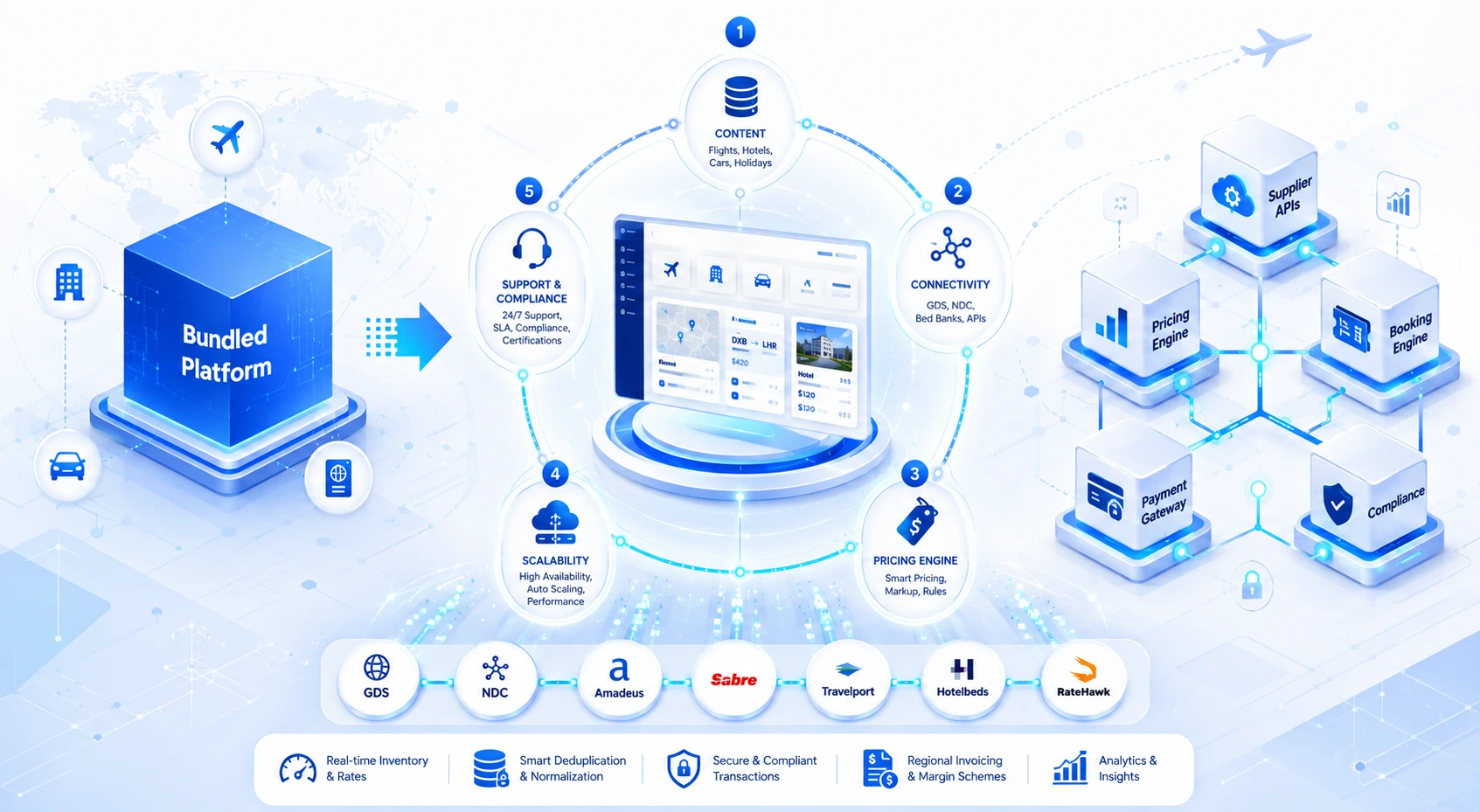
Some platforms lock you into a single GDS or bed bank relationship. Others are built API-first, letting you plug in new supplier feeds as your agency's needs shift. According to AltexSoft's analysis of OTA platform architecture, booking engines vary significantly in how they handle multi-supplier integration, content mapping, and dynamic packaging, and this is usually the single biggest differentiator between a platform that scales and one that doesn't.
Flexibility in Business Model
Can the platform run B2B, B2C, and hybrid models from one back office, or does it force you into one lane? This matters more than most buyers initially realize, since agency business models tend to evolve. A pure B2B agency today may want a B2C storefront in two years, and rebuilding on new infrastructure at that point is expensive and disruptive.
Flexibility in Customization
This is the one buyers underestimate most. A platform that's flexible on paper but requires vendor tickets for every UI or workflow change isn't actually flexible in practice; it's flexible in a sales deck. Ask for a live example of a workflow change implemented for another client and how long it took.
What Are the Hidden Limitations of TripFro?
Most comparison content skips this entirely, but it's the section that matters most to anyone who has actually run a travel agency for more than a year.
The Hidden Cost of Switching Travel Software
Migration is never just "moving data." A realistic switch involves six distinct cost centers, each worth planning for individually.
Existing booking data migration: Historical reservations, customer records, and loyalty data need a clean transfer, and data quality issues that were invisible in the old system tend to surface during migration, such as duplicate records, inconsistent supplier codes, and incomplete customer profiles.
Supplier API changes: Every existing supplier integration needs to be remapped on the new platform. This isn't always a like-for-like process; some suppliers offer richer API access to certain platforms than others.
Agent training: Sub-agents and staff need onboarding to a new interface, and productivity typically dips during the transition period, a cost that rarely appears in a vendor's pricing sheet.
SEO impact: URL structure changes on customer-facing booking pages can temporarily affect search visibility if redirects and technical SEO aren't handled carefully during the migration. This is a real, measurable risk for agencies that rely on organic traffic for direct bookings.
Customer portal changes: Repeat customers who are used to a specific booking flow need to relearn a new interface, which can temporarily affect conversion rates immediately after launch.
Payment gateway migration: Reconciling payment processor settings, PCI compliance requirements, and payout schedules across a platform switch is often underestimated and can create short-term cash flow visibility gaps.
None of this means switching is a bad idea. It means switching should be a deliberate decision made with the scorecard above, not a reaction to a single bad month or one frustrating support ticket.
Which Alternative Fits My Business Model?
This is where most "alternative" articles fall short; they compare feature lists without asking who the reader actually is. The right platform depends heavily on which of these two profiles matches your situation.
For Small-to-Mid Agencies Prioritizing Speed
A hosted SaaS platform with pre-built supplier connectivity gets you live in weeks rather than months. This suits agencies where the operational bottleneck is deployment speed, not deep customization, and where the team doesn't have in-house technical resources to manage a more complex system.
For Agencies With Complex, Non-Standard Workflows
A modular or custom-built platform, the model behind purpose-built systems like TravelBookingPanel, which focuses on configurable B2B travel portal architecture, Laravel-based booking systems, and white-label deployment for OTAs and tour operators, tends to fit better when agent-tier logic, markup rules, or supplier mix don't match an out-of-the-box template.
This matters most for agencies operating in markets with specific compliance or supplier requirements, such as Umrah and Hajj travel operators serving the Saudi Arabian travel software market, where standard Western-built platforms often lack the localized supplier and workflow support these operators need.
For Travel Technology Managers Evaluating an Architecture
If you're the one being asked about API design, scalability, and security rather than just "does it look nice," the evaluation shifts toward developer flexibility, integration depth, and long-term maintainability rather than front-end features. This audience typically weighs multi-currency handling, white-label capability, and how easily the platform's codebase can be extended without vendor lock-in.
Should I Choose a White-Label Travel Platform or Build Custom?
The Deployment Speed Argument
Building a booking engine in-house typically means a year or more of engineering work before there's a sellable product, plus ongoing maintenance of every supplier integration. A white-label or SaaS platform with existing supplier connections can be live in weeks, which matters enormously for agencies that need revenue sooner rather than later.
The Control Argument
Full custom builds make sense mainly for larger, well-funded operators with dedicated engineering teams and workflow requirements that no off-the-shelf platform can support. Agencies where the booking workflow itself is a competitive advantage, not just infrastructure.
A Simple Way to Decide
| Factor | Hosted / White-Label | Custom / Modular Build |
| Time to launch | Weeks | Months to a year+ |
| Upfront cost | Lower | Higher |
| Ongoing flexibility | Limited to the vendor roadmap | High, but requires dev resources |
| Best fit | Agencies prioritizing speed | Agencies with non-standard workflows |
| Maintenance burden | Handled by the vendor | Handled in-house or via a dev partner |
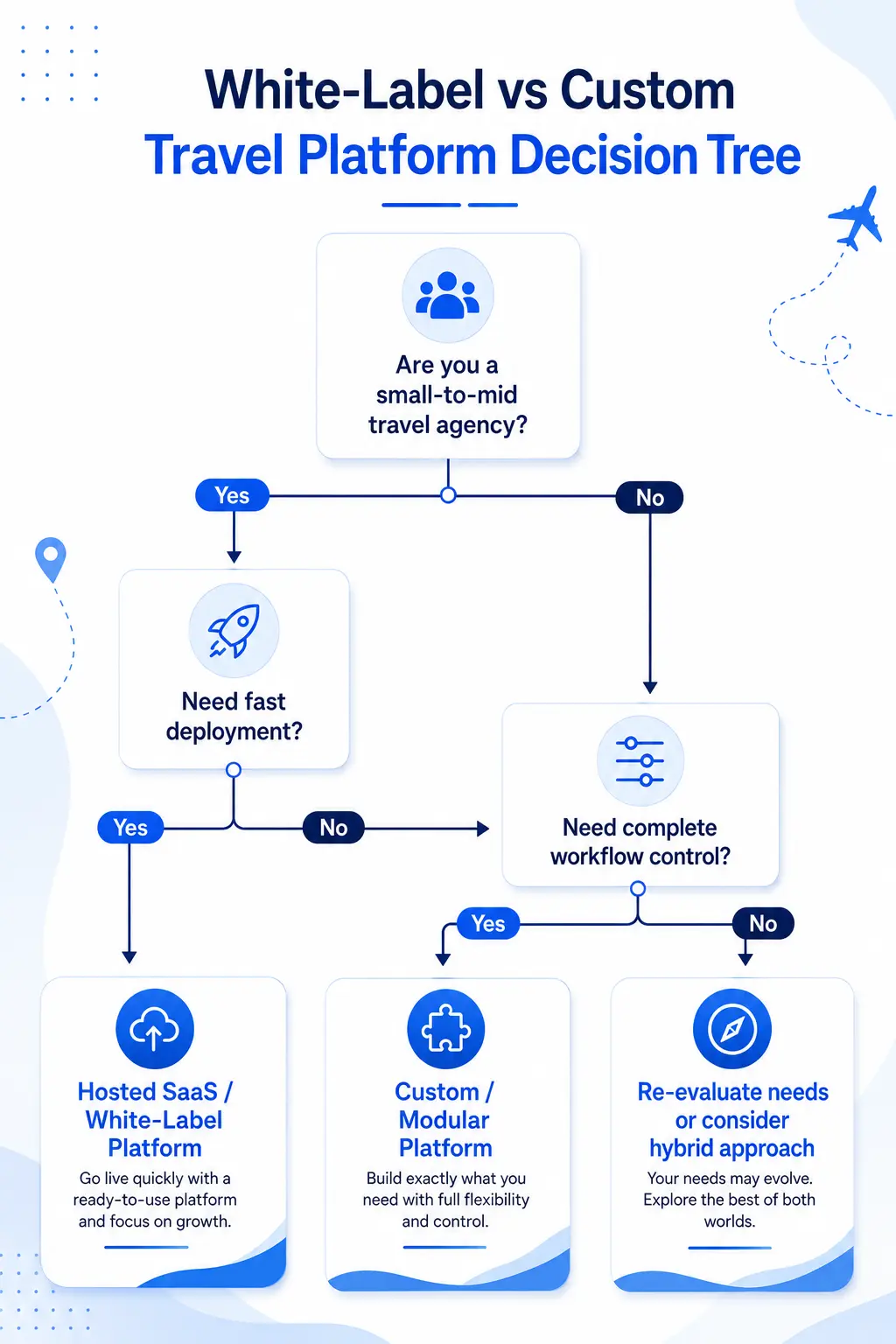
Ask two questions in order:
- Does your agency need to launch fast, with a lean team? → A hosted or white-label platform is almost always the right starting point.
- Does your business model depend on workflow logic that no vendor template supports? → A modular or custom-built platform, even if it costs more upfront, usually pays for itself in reduced operational friction over the following two to three years.
How to Run a Real Platform Evaluation Before Switching
Most agencies evaluate travel software the same way they'd evaluate a consumer app: a demo call, a features PDF, and a decision within a week. For a system that touches every booking, supplier relationship, and agent payout, that's not enough diligence. Here's a more rigorous process.
Week 1: Map Your Current Workarounds
Before looking at any vendor, document every manual process your team currently relies on, such as spreadsheets tracking commissions, manual emails to suppliers for availability checks, and side calculations for multi-currency conversions. This list becomes your evaluation checklist. A platform that doesn't eliminate most of it isn't worth switching to.
Week 2: Score Two or Three Shortlisted Platforms
Run the 7-point scorecard above on each shortlisted platform, using live sandbox access rather than a guided demo where possible. Guided demos are built to hide weak points; sandbox access exposes them.
Week 3: Ask for Reference Clients at Your Scale
A platform that works well for a 5-person agency may behave very differently at 50 sub-agents and thousands of monthly transactions. Ask vendors for a reference client operating at your target scale, not just their largest logo.
Week 4: Model the Migration Cost, Not Just the Subscription Cost
Take the six-part hidden cost breakdown above and put rough numbers against each line item: staff hours for data migration, expected agent training time, and estimated conversion dip during the transition. Compare that total cost against the ongoing operational cost of staying on your current platform for another 12 months. This is usually the number that actually settles the decision, not the monthly subscription price difference between vendors.
Small Agency vs Mid-Size vs Multi-Branch: Different Evaluation Weight
The scorecard dimensions matter differently depending on agency size, and it's worth weighing your evaluation accordingly. Small, single-location agencies should weigh inventory flexibility and deployment speed most heavily; the goal is to get a working system live without a long implementation project.
Mid-size agencies with sub-agents should weigh B2B agent management and reporting depth most heavily, since commission logic and performance visibility become daily operational needs rather than nice-to-haves.
Multi-branch or multi-country operators should weigh supplier connectivity, multi-currency support, and long-term scalability most heavily, since these agencies are the ones most likely to hit the ceiling of a generic platform within the first year.
When NOT to Choose a TripFro Alternative
Switching platforms is not always the right decision. If TripFro (or your current system) already matches your supplier network, your agent structure, and your day-to-day workflow, migration may disrupt without solving a real problem. The signal to watch for isn't dissatisfaction with a feature; it's a recurring operational cost.
If your team is doing manual reconciliation every week, or if agent commission errors are a regular support ticket, that's a workflow-fit problem worth solving. If the frustration is closer to "I saw a competitor's platform with a nicer dashboard," that's not usually a reason to migrate.
A useful gut check: list every workaround your team currently relies on spreadsheets, manual emails, and side calculations. If that list is short and stable, the platform is probably fine. If it's growing every quarter, that's the real signal.
Expert Insight: Evaluating Travel Technology Ecosystems
A travel booking portal is judged in demos on search speed and interface polish. It's judged in production on reconciliation accuracy, agent permission logic, and how visible operations are to the people running the business day-to-day. Buyers who focus only on the demo experience are optimizing for the wrong evaluation window.
This shift toward owning booking infrastructure rather than renting it through third-party tools reflects a broader trend in B2B travel distribution: branded, agency-owned booking systems are increasingly seen as core infrastructure rather than a later-stage upgrade, particularly as agencies scale their sub-agent networks and multi-currency operations.
API Architecture and Documentation Quality
Well-documented, RESTful APIs with sandbox environments signal a platform built for integration, not just internal use. Poor or missing documentation is often a leading indicator of deeper technical debt.
Depth of Supplier Integrations
Look beyond the number of logos on a supplier page. Ask specifically about GDS coverage, bed bank aggregator relationships, and whether direct hotel or activity contracts are supported alongside aggregated inventory.
Multi-Currency and Multi-Language Support
For agencies operating across borders, a common pattern for B2B travel portals serving the Middle East and South Asian markets, native multi-currency handling with real-time exchange rate updates is not optional infrastructure; it's a daily operational requirement.
Security and Compliance Posture
PCI-DSS compliance for payment handling, data encryption standards, and role-based access control aren't marketing checkboxes; they're the difference between a platform that survives a security audit and one that creates liability.
Developer Flexibility for Custom Workflow Logic
Even on a largely off-the-shelf platform, the ability to extend specific workflows, custom approval chains, non-standard commission logic, and unique supplier requirements without waiting on a vendor's product roadmap is often what separates a platform an agency outgrows from one it grows into.
These aren't "nice to have" checkboxes, they're usually the difference between a platform that supports growth and one that quietly becomes the next migration project eighteen months from now.
Frequently Asked Questions
Is there something better than TripFro?
It depends on the specific operational gap you're trying to close. For agencies needing deeper agent management, more flexible supplier connectivity, or a workflow that doesn't fit a generic template, a more configurable B2B travel portal is usually a better fit than a generic starter platform.
Which platform gives more flexibility?
Flexibility should be evaluated across three dimensions: supplier connections, business model support, and customization depth, rather than judged from a single demo or feature list.
What are the hidden limitations of TripFro?
The most common limitations reported by growing agencies are manual reconciliation, rigid agent permission tiers, limited API access for niche suppliers, and reporting that lacks operational depth.
Which alternative fits my business model?
Speed-first agencies with lean teams generally do better with hosted SaaS platforms. Agencies with non-standard workflows, regional supplier requirements, or complex agent structures generally do better with modular or custom-configured platforms.
Should I choose a white-label travel platform or build a custom one?
Choose white-label if speed to market and lower upfront cost matter most. Choose custom or modular if your workflow logic is genuinely non-standard and you have the resources to manage ongoing development.
Total Cost of Ownership: Looking Past the Subscription Fee
Vendors compete on subscription price because it's the easiest number to compare. It's also the least useful number for predicting what a platform will actually cost your agency over three years.
What the Subscription Fee Doesn't Include
- Transaction fees or per-booking charges that scale with volume.
- Cost of additional supplier API connections beyond the base package.
- Support tier upgrades are needed once your team relies on the platform daily.
- Custom development requests for workflow logic that the platform doesn't natively support.
A More Useful Comparison Framework
Instead of comparing monthly subscription cost alone, compare the total three-year cost across four categories: subscription and transaction fees, migration cost (using the six-part breakdown above), estimated custom development requests based on your workflow gaps, and the estimated cost of continued manual workarounds if you stay on your current system.
Agencies that skip this exercise tend to choose based on the lowest sticker price, then discover the "cheaper" platform requires significant custom development to handle their actual agent structure development costs, which erases the initial savings within the first year.
Key Takeaways
- Better than TripFro depends on where your specific operational friction lives, not on a generic feature comparison.
- Use the 7-point scorecard (inventory flexibility, supplier connectivity, agent management, workflow automation, customization limits, reporting depth, scalability) on any platform you're considering, and score honestly rather than optimistically.
- Migration has six real hidden costs: data, supplier APIs, agent training, SEO, customer portals, and payment gateways. You need a plan before you sign a new contract.
- Hosted/white-label platforms suit speed-first agencies; modular or custom platforms suit agencies with non-standard workflows or heavy API and localization requirements.
- Don't switch platforms reactively; switch when the scorecard and recurring operational costs both point in the same direction, and only after mapping the real migration cost against the operational cost of staying put.
Tags
Own Your Travel Platform. Forever.
Buy once, own forever. Full source code · No monthly fees · No hidden charges.