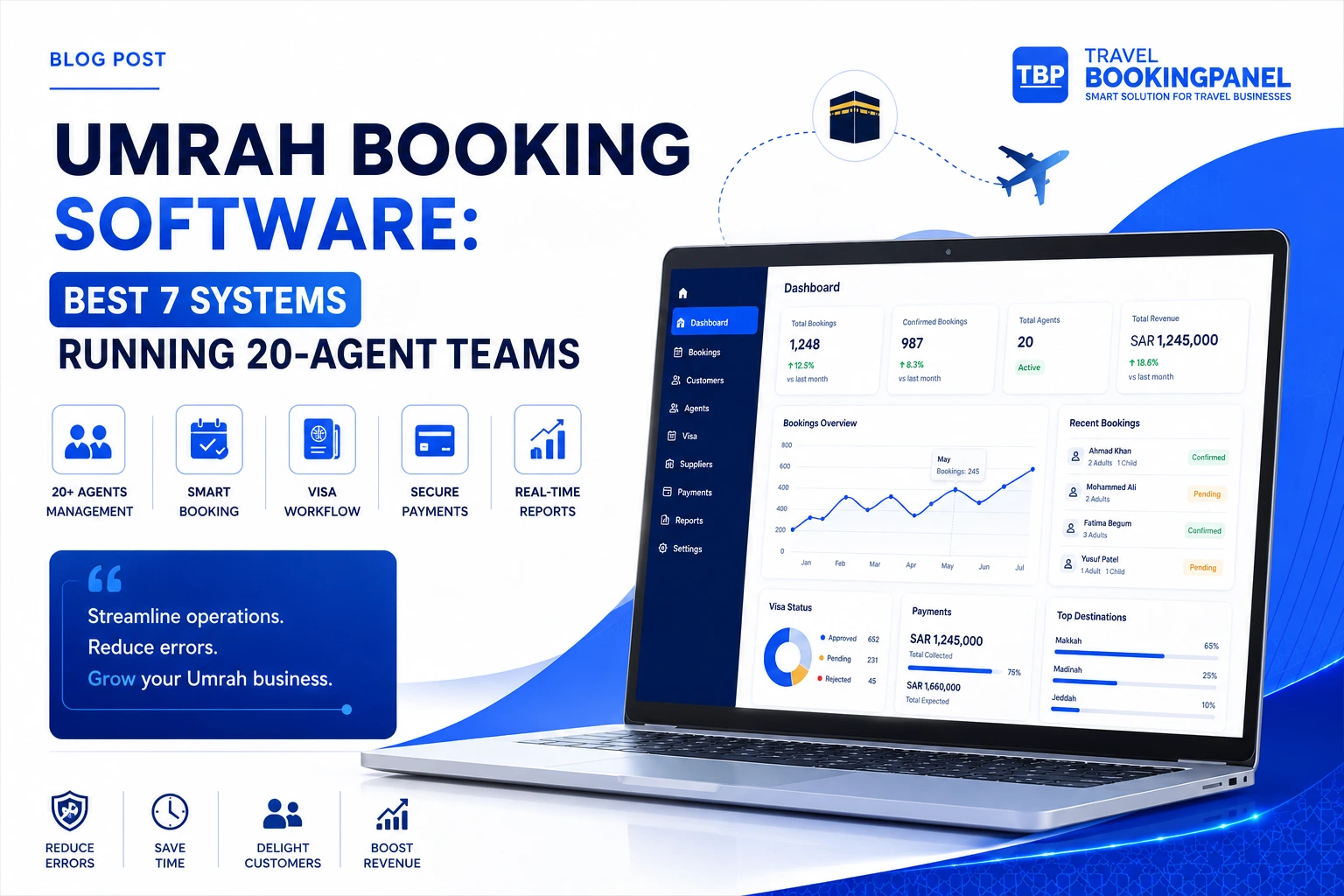
Most content on Umrah booking software reads like a brochure. CRM, booking engine, visa management, payment gateway, request a demo. That pattern repeats across...
Most content on Umrah booking software reads like a brochure. CRM, booking engine, visa management, payment gateway, request a demo. That pattern repeats across nearly every ranking page on this topic. It's written for someone comparing vendors, not for someone running one.
This piece is written for the second person: an operator managing 15-30 agents, a few hundred bookings a month, and a growing list of things that break when volume goes up.
What follows isn't a feature list. It's a breakdown of how the software actually structures daily operations where money leaks without it, how the modules connect, what real operational complexity looks like, and what changes when Saudi regulation shifts under your feet.
Direct Answer: What Umrah Booking Software Actually Does
Umrah booking software unifies five functions that most agencies still run as separate, disconnected tools. The booking engine, the CRM, supplier coordination, the visa workflow, and accounting all sit inside one connected record instead of five. In a spreadsheet-and-WhatsApp operation, a quote lives in a chat thread.
A confirmation lives in an email. A payment lives in a different spreadsheet from the one tracking visa status. Each handoff between those tools is a place where information gets lost, duplicated, or delayed. Dedicated software collapses those handoffs into a single passenger record that moves through the lifecycle without re-entry.
Why the Software Purchase Isn't the Real Decision
Agencies that treat this as a software purchase tend to underperform their own expectations. They buy the platform, migrate their existing spreadsheet logic into it, and end up with an expensive version of the same disconnected process.
Agencies that treat it as an operating model redesign get a different outcome. They map the actual workflow first, where inquiries come from, how quotes get built, who touches the visa file, and how refunds get approved, and then configure the software around that map. The tool is identical in both cases. The result isn't.
Where Agencies Lose Money Without It
Every disconnected step in the operation has a cost attached to it, even when nobody's tracking it on a spreadsheet of its own.
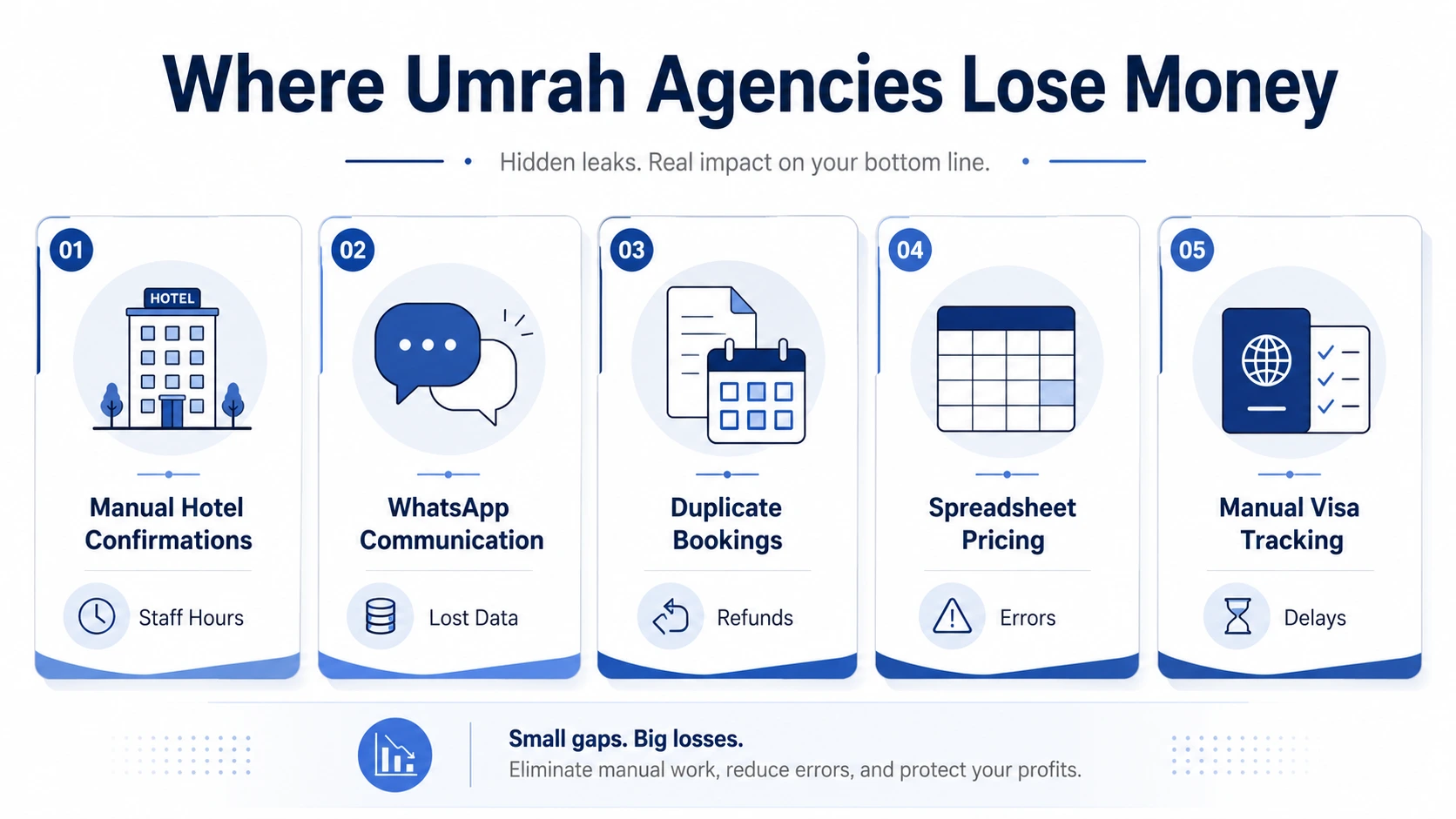
| Stage | Hidden Cost |
| Manual hotel confirmations | Staff hours spent re-checking availability |
| WhatsApp-based communication | Lost or buried booking information |
| Duplicate bookings | Refunds and damaged customer trust |
| Spreadsheet pricing | Human calculation errors at scale |
| Manual visa tracking | Delays during the worst possible week of departure |
The WhatsApp-to-Spreadsheet Failure Pattern
Here's how this typically plays out inside a 20-agent agency during peak season. An inquiry comes in through WhatsApp. An agent quotes a package from memory or a static PDF because pulling live availability takes longer than just answering.
The customer confirms, but that confirmation lives in a chat thread, not in a system anyone else can see. Operations finds out about the booking secondhand, usually a day later, when the agent forwards a screenshot. By then, the hotel allocation window had narrowed, and operations were now negotiating for rooms that were available yesterday.
None of this shows up as one dramatic failure. It shows up as a slow bleed: a few hours here, a duplicate hold there, and a refund next month that nobody connects back to the original miscommunication.
Why Duplicate Bookings Are More Expensive Than They Look
Duplicate bookings deserve their own attention because the visible cost of the refund is usually the smaller number.
Software vs Spreadsheet: A Structural Comparison
Most comparisons stop at "software is more efficient." That's not specific enough for an operator to act on. Here's what actually shifts when an agency moves off spreadsheets and into a connected system, measured across the five variables that matter operationally. The higher cost is due to the supplier relationship. Hotels and transport providers track cancellation rates per agency.
An agency with a high duplicate-and-cancel rate gets worse allocation priority during peak season, which compounds the original problem. A connected system prevents duplicates by checking existing passenger records before a new booking is created, a basic function that spreadsheets structurally can't perform at scale.
| Measure | Spreadsheet-Based Operation | Software-Based Operation |
| Time per booking | 20-40 minutes, including manual cross-checking | 5-10 minutes, using pre-validated data |
| Error rate | Higher manual re-entry across separate tools | Lower single source of truth per passenger |
| Staff needed per 100 bookings/month | 3-4, dedicated to coordination alone | 1-2, with the system handling coordination |
| Revenue leakage | Refunds, duplicate holds, and missed upsells | Reduced, though not eliminated |
| Customer satisfaction | Inconsistent, depending on which agent handled it | More consistent process-driven, not person-driven |
Time Per Booking: Where the Minutes Actually Go
In a spreadsheet operation, most of the 20-40 minutes isn't spent talking to the customer. It's spent verifying information that already exists elsewhere, checking whether a hotel room is actually available, confirming that a visa document was received, or reconciling a price against last week's rate sheet. A connected system removes the verification step because the data is already validated at the point of entry.
Staff Allocation: The Number That Actually Justifies the Cost
This is the metric most agencies underweight when evaluating software cost. A platform subscription looks expensive next to a spreadsheet that's "free." It looks different next to the salary cost of two to three coordination staff whose entire job is manually checking what a connected system checks automatically.
The travel software market itself reflects this shift toward centralized, subscription-based platforms. Subscription-based pricing now dominates the sector, and current market research on online travel agency software shows booking engine platforms holding the largest single share of the market, driven by demand for systems that streamline reservations and improve conversion. Agencies aren't buying "software" in the abstract; they're buying a shift in how staff time is allocated.
Migrating From Spreadsheets Without Breaking Peak Season
Most agencies don't hesitate about whether to switch. They hesitate on when, because nobody wants to migrate systems three weeks before Ramadan booking volume hits.
The Realistic Migration Window
The safest migration window is right after a peak season ends, not right before the next one starts. That gives the team a lower-volume period to run the new system in parallel with the old process, catch data-mapping errors, and train agents before the next surge in inquiries.
What to Migrate First
Not everything needs to move on day one. A staged migration typically follows this order:
- Active bookings for the current or next departure window. These need to be accurate immediately.
- Supplier contact and pricing data are the foundation on which everything else depends.
- Historical customer records useful for CRM value, but not urgent for day-one functionality.
- Past financial reconciliation can often stay in the old spreadsheet as an archive rather than a live migration.
Agencies that try to migrate all four categories simultaneously tend to lose more time to data-cleaning than agencies that sequence it.
The Parallel-Run Period
Running the new system and the old spreadsheet side by side for two to four weeks isn't wasted overhead. It's the only reliable way to catch the gap between what the spreadsheet assumed and what the software actually enforces.
Spreadsheets tolerate inconsistency, two different price formats, a missing field, a typo in a supplier name. Software often doesn't, and those small inconsistencies surface as errors during the parallel-run period rather than during live peak-season operations.
The Modern Umrah Technology Stack
"Software" is too vague a word for what's actually running underneath a scaled agency. There are eleven distinct components, and understanding each one separately changes how you evaluate a platform.
Core Booking Layer
The booking engine handles package configuration, availability logic, and pricing rules. This is the layer most vendors lead with in sales conversations, but it's only as good as what feeds it.
Supplier APIs connect to hotel, transport, and flight inventory in real time. This is the part most agencies underestimate, because "integrated" gets used loosely in vendor marketing.
An API is what actually allows different systems to share live data availability, pricing, and confirmation status instead of requiring someone to manually check a supplier portal and re-enter what they find. The reliability of your booking engine is really the reliability of this layer underneath it.
Why "Integrated" Doesn't Always Mean Real-Time
Vendor sales conversations often use "integrated" loosely. In practice, there's a meaningful difference between a system that pulls live supplier availability on each search and one that syncs a static feed once or twice a day. The second version looks identical in a demo. It behaves very differently during peak booking weeks, when hotel availability can change multiple times within a single hour.
This distinction matters more in Umrah booking than in general leisure travel, because pilgrim demand concentrates so heavily around specific windows, Ramadan, school holiday periods, and the weeks immediately before and after Hajj season. A stale feed during a low-volume month might never cause a visible problem. The same stale feed during a demand spike produces overbookings.
What This Means for Customer Trust Upstream
Research on how far in advance travelers now research and price-compare before booking has consistently pointed toward more browsing, not less, as digital options expand. That trend applies to Umrah pilgrims and their families, too; many now compare multiple agencies' pricing and package inclusions before committing, often across several sessions rather than a single conversation.
A booking engine with unreliable live data doesn't just risk an operational error. It risks losing that comparison-shopping customer to a competitor whose quoted price and availability held up when the customer came back to confirm.
The payment gateway processes deposits, balances, and multi-currency transactions and reconciles them against the booking record automatically rather than requiring a manual match at month-end.
Operational Layer
CRM tracks the customer relationship past the first booking, repeat pilgrims, family bookings, and referral history. Most agencies have this data; few have it in a form they can query. Visa workflow manages document collection, submission status, and approval tracking per passenger. This is the module with the most operational complexity, because it has to adapt to policy changes without a full rebuild.
Document storage centralizes passports, visas, and contracts per pilgrim in one place, rather than across email attachments and shared drive folders with inconsistent naming. The notification engine automates status updates to customers and agents, like "visa approved," "hotel confirmed," and “payment received,” without requiring a staff member to manually send each one.
Business Layer
Accounting reconciles supplier payments, agent commissions, and customer receivables against the same booking record used by operations, instead of a parallel finance spreadsheet. The customer portal gives pilgrims direct visibility into their own booking status, which reduces the volume of "where's my visa" inquiries hitting agents directly.
Reporting Surfaces, whose packages, agents, and seasons are actually profitable, is a question most spreadsheet-run agencies can only answer approximately. Arabic and multilingual support are non-negotiable for GCC-facing operations, and a frequent gap in platforms built primarily for Western OTA markets.
How These Modules Actually Talk to Each Other
The stack only creates value if the modules pass data automatically instead of requiring manual re-entry between them. Here's the lifecycle in sequence.
- Inquiry enters the CRM directly, not a chat thread that someone has to manually transcribe later
- Package configuration pulls live supplier availability instead of a static rate sheet
- Supplier confirmation locks the hotel and transport allocation against real inventory
- Visa workflow triggers automatically once the booking is confirmed, not after someone remembers to start it
- The payment gateway processes the deposit and updates accounting in the same motion
- The notification engine pushes status updates to the customer portal without manual intervention
- Reporting captures the booking for margin analysis at the moment it happens, not at month-end reconciliation
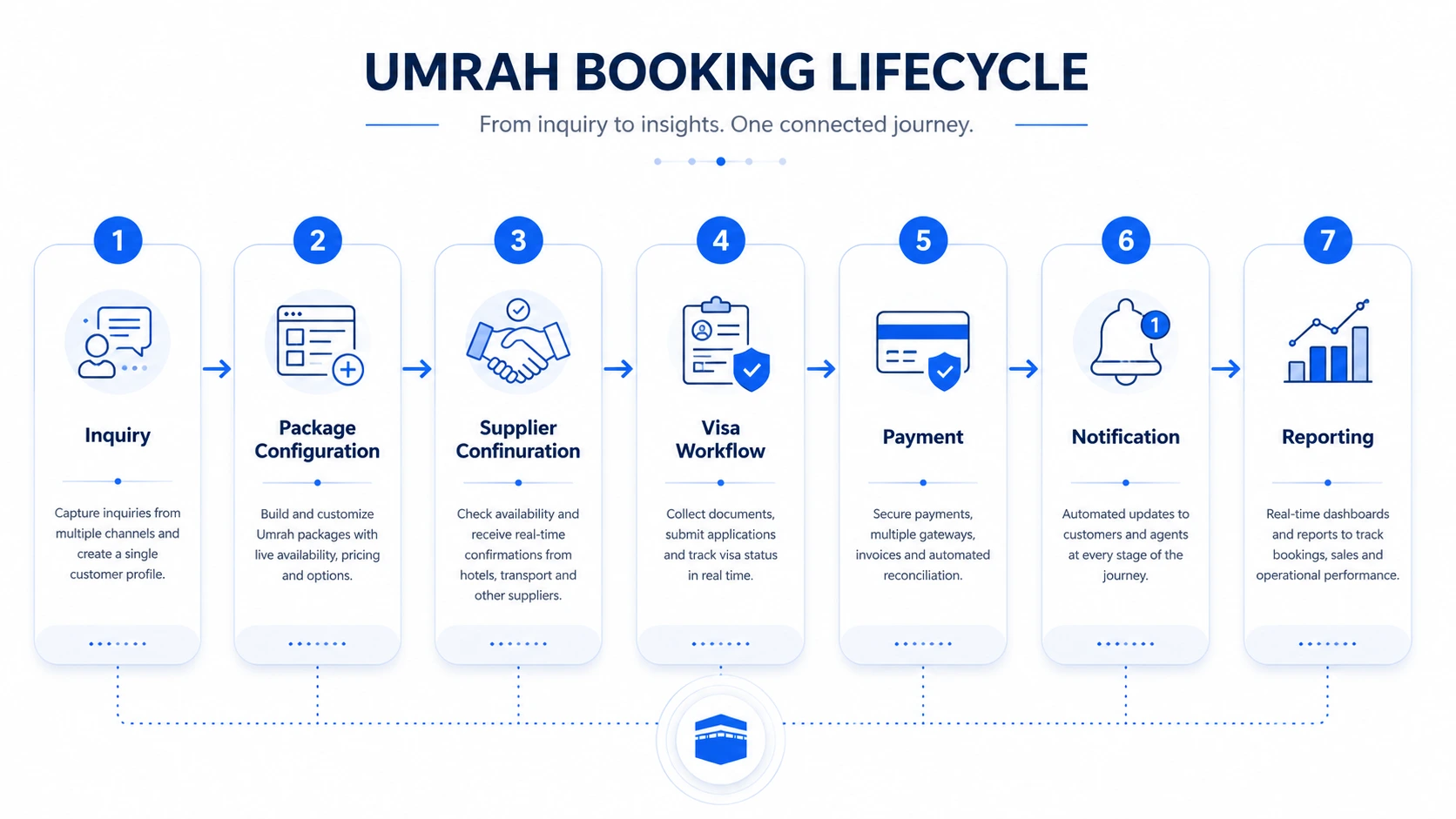
Every step that requires a human to manually re-enter data from the previous step is a place where the lifecycle can break under volume. That's the actual audit to run on any platform you're evaluating, not how many modules it has, but how many manual handoffs remain between them.
What Happens When Saudi Rules Change
Few operators talk about this directly, but it's the part that actually determines whether a software choice ages well. Saudi Arabia has been rapidly digitizing the pilgrimage journey through official government platforms, and that pace has been increasing rather than slowing down.
The Nusuk Shift
The Ministry of Hajj and Umrah's Nusuk platform now handles visa issuance, accommodation coordination, and transportation directly for international pilgrims. Nusuk Umrah, a service introduced in August 2025, lets pilgrims outside Saudi Arabia apply for Umrah visas and arrange pilgrimage-related services online, without routing through a separate intermediary at that specific step.
That's not a minor UX update to a government website. It's a structural shift in who touches the visa and booking data first, and it changes what an agency's visa workflow module actually needs to plug into.
Why This Matters for Your Software Architecture
If your visa workflow module is built as a static checklist, a fixed sequence of steps, and someone follows a regulatory change like this, they manually break it. Someone has to manually redesign the process every season, usually under time pressure right before peak booking windows open.
If it's built as an API-connected workflow instead, it can absorb new verification steps, new document requirements, or new platform integrations without a full rebuild. Nusuk has been positioned as part of Saudi Arabia's broader pilgrimage digitization program tied to Vision 2030, which signals that more platform-level changes are coming, not fewer.
Building for Adaptation, Not Just Compliance
The practical takeaway isn't "watch the news for policy updates." It's a software architecture decision made before the policy changes, not after. Software that treats government platforms like Nusuk as an integration point, a system to connect with, tends to hold up better than software that treats them as a competitor to route around.
Hotel verification requirements, transport authorization rules, and official document standards have all shifted in recent seasons. Agencies whose systems could absorb those changes through configuration, rather than custom development work, moved through each transition with less disruption.
The Hidden Complexity of Umrah Operations
Most people outside the industry assume the equation is simple: hotel plus visa equals done. Operators know it isn't, and this is usually the part of the process that separates an experienced operator from a new entrant.
Supplier Contracts and Seasonal Pricing
Supplier contracts renew on different cycles and different terms, which means pricing isn't one static number pulled from a rate sheet. Ramadan demand shifts pricing sharply compared to the rest of the calendar, and agencies that don't model this separately end up either underpricing peak-season packages or overpricing off-season ones.
Occupancy and Family Structure
Room allocation across quad, triple, and double occupancy isn't just a pricing variable; it directly affects which hotels can even accommodate a given group size. Child policies vary by hotel and by age bracket, which means the same family booking can produce different pricing and room configurations depending on which property is assigned.
Movement and Logistics
Transport windows are tied to prayer times and crowd control schedules, not just point-to-point distance. A transfer that looks simple on a map can be constrained by access hours around the Haram during peak periods.
Airport pickup coordination across multiple arrival cities, Jeddah and Madinah, both of which see significant pilgrim traffic, adds a scheduling layer that a single-city operation doesn't have to manage.
Documentation and Financial Exceptions
Documentation has to match Saudi verification requirements exactly, and small mismatches can delay an entire group rather than just one passenger.
Refund logic differs by supplier, by season, and by cancellation window, which means a single refund policy printed on a website rarely reflects what actually happens operationally when a cancellation comes in three weeks before departure.
Group Composition and Ziyarah Scheduling
Group bookings rarely arrive as a clean, uniform block. A single reservation might include elderly pilgrims who need slower-paced Ziyarah itineraries, families with young children, and independent travelers joining the same package for cost efficiency.
Scheduling Ziyarah visits and trips to historically and religiously significant sites around Makkah and Madinah, around this mix means building flexibility into what looks, on paper, like a fixed itinerary.
A system that treats the itinerary as static text in a PDF can't easily accommodate a subgroup splitting off for a slower schedule. A system that treats each passenger as an individual record linked to a shared group booking can.
Why This Complexity Is the Actual Differentiator
None of this complexity is visible in a feature list. It's visible in the difference between a system that handles these exceptions gracefully and one that requires a phone call to the vendor's support line every time something doesn't fit the default template.
This is also the part of the operation that's hardest for a new entrant to replicate quickly. Anyone can list "visa management" as a feature. Fewer operators have actually built a system or chosen one that holds up against the full combination of seasonal pricing, occupancy exceptions, and scheduling flexibility described above.
Expert Insight: Where Systems Introduce Unnecessary Complexity
The instinct in software evaluation is to look for more features. The better instinct is to look for fewer manual handoffs.
The Re-Entry Test
A system that requires an agent to re-enter the same passenger data three times, once for the booking, once for the visa file, and once for the invoice, hasn't actually solved the spreadsheet problem. It's moved the same problem into a nicer interface, at a higher monthly cost.
What a Real Booking Lifecycle Looks Like Operationally
Here's a simplified version of what a single passenger record should look like moving through a well-configured system, from first contact to departure.
- Customer inquiry logged with contact details and preferred travel window
- Package options generated from live supplier availability, not a static PDF
- Quote sent and confirmed, converting the same record into a booking
- Passenger documents are uploaded once, into a single file; the visa workflow reads directly from it
- Deposit processed, automatically updating both the booking status and the accounting ledger
- Visa status tracked and pushed to the customer portal without a manual check-in call
- Final balance collected ahead of departure, triggering automatic voucher generation
- Post-trip record retained in the CRM for future family or group bookings
The number of manual phone calls or WhatsApp check-ins required across that entire sequence is the real measure of whether a system is working.
The Build-vs-Buy Decision
For agencies evaluating whether to build this internally or adopt an existing platform, the workflow above, not the module count, is the right basis for comparison. TravelBookingPanel's Umrah Management Software is structured around this exact lifecycle, with source code ownership as the differentiator for agencies that want to customize the workflow rather than rent access to someone else's default configuration.
Frequently Asked Questions
How is Umrah booking software different from general travel agency software?
General travel software handles flights, hotels, and generic vacation packages. Umrah-specific software adds visa workflow logic, Ziyarah scheduling, occupancy rules unique to religious group travel, and closer alignment with Saudi verification requirements, none of which a generic OTA platform is built around by default.
Can Umrah booking software handle visa processing directly, or only bookings?
Most dedicated platforms include a visa workflow module that tracks document submission, status, and approval on the agency side. It doesn't replace Saudi government's visa systems directly; it manages the agency's coordination of that process, including the handoff points where government platforms like Nusuk are involved.
What's the realistic cost of switching from spreadsheets to dedicated software?
Cost varies significantly by vendor and deployment model, hosted subscription versus owned source code. The more useful number for most agencies isn't the license fee; it's the staff-hour reduction. Agencies typically need fewer dedicated coordination staff per 100 bookings once manual cross-checking is removed from the process.
How long does implementation take for a mid-size agency?
Implementation timelines depend on agency size, the number of suppliers that need to be connected, and how much historical data needs to be migrated. Most systems can be configured within a few weeks for a mid-size operation, though supplier API integrations can extend that timeline if a supplier's own systems are slow to respond.
Does Saudi Arabia's Nusuk platform replace the need for agency software?
No. Nusuk handles the pilgrim-facing visa and permit layer directly, along with a growing set of digital services for individual pilgrims. Agencies still need their own system to manage packages, supplier coordination, customer relationships, and accounting. Nusuk is a platform to integrate operationally, not a substitute for agency-side software.
What happens to sub-agent or B2B partner access when an agency adopts a unified system?
Most platforms support controlled access tiers, allowing sub-agents or partners to view and manage their own bookings within the same system without full administrative access to the agency's complete customer base or financials.
Should a growing agency build custom software or buy an existing platform?
This depends on how specific the agency's workflow is and how much internal technical capacity exists to maintain custom code. Owning source code gives full customization control but requires either an in-house developer or an ongoing technical relationship. A hosted platform trades some customization for faster deployment and vendor-maintained updates, including regulatory changes on the Saudi side.
Key Takeaways
- Umrah booking software's value comes from connecting workflows, not from feature count or module quantity.
- The real cost of spreadsheet-based operations shows up as staff hours, refunds, and an inconsistent customer experience, rarely as a single visible failure.
- The technology stack has eleven distinct components across three layers; evaluate each layer separately rather than judging the platform as a whole.
- Saudi digitization through Nusuk means the visa workflow architecture needs to absorb regulatory change through configuration, not require a rebuild every season.
- The hidden operational complexity, occupancy rules, seasonal pricing, transport windows, and documentation exceptions are where real operational expertise actually shows up.
- The best systems minimize manual re-entry across booking, visa, and invoicing steps; that's the real audit to run before choosing a platform.
Tags
Own Your Travel Platform. Forever.
Buy once, own forever. Full source code · No monthly fees · No hidden charges.