Choosing a Travelopro alternative isn't about finding a "better" vendor. It's about matching a platform's architecture to your supplier mix, your market's compl...
Choosing a Travelopro alternative isn't about finding a "better" vendor. It's about matching a platform's architecture to your supplier mix, your market's compliance rules, and the level of engineering control you actually need.
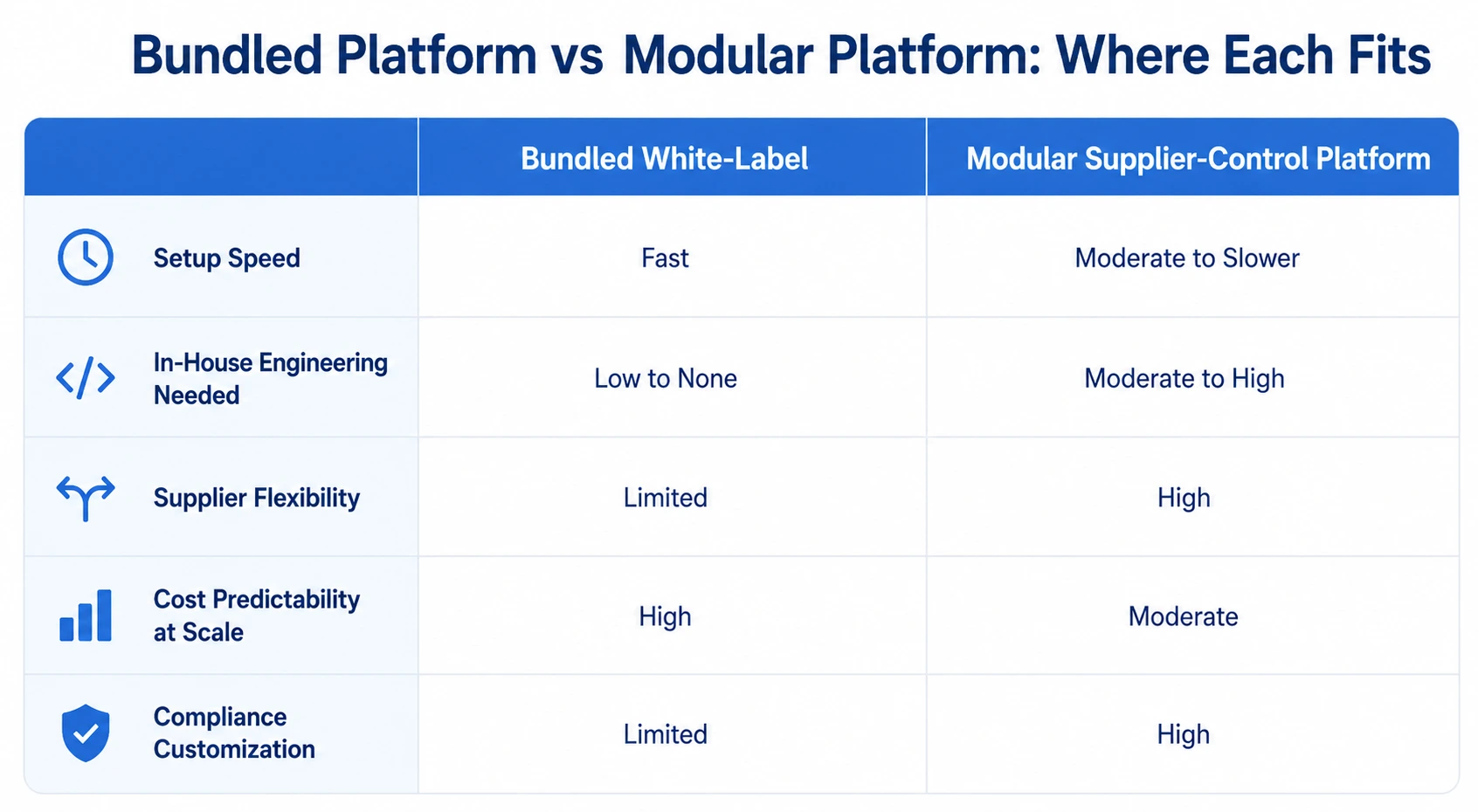
Travelopro works well for operators who want a single, bundled white-label build. It creates friction for operators who need modular control over supplier connectivity, pricing logic, or invoicing across fragmented markets like the GCC.
This guide gives you four things most comparison articles skip: a real evaluation framework, a failure-mode library drawn from actual production incidents, a migration checklist for switching platforms without breaking bookings, and an honest look at where different platform models, including our own, fit and don't fit.
Is Travelopro the Right Choice?
Short answer: it depends on your integration role, not just your feature checklist.
What the Review Data Actually Shows
Travelopro has a large volume of positive service reviews. Independent review aggregation shows most reviewers praising responsive support, timely delivery, and professional website design work. A smaller number of detailed complaints raises a different concern.
They point to API integration pricing and a gap between quoted and production costs, according to Serchen's Travelopro review data. That split matters less as a verdict on one vendor. It matters more as a general warning for the category: in travel tech, the sales demo and the production contract can diverge.
Whoever you choose, clarify API integration pricing structure, code ownership, and data-handling terms before signing. Do this before your first supplier integration starts, not after.
Where a Bundled Platform Fits Well
- You want one vendor responsible for the full build, front to back.
- You don't have in-house engineering and want to minimize technical decisions.
- Your supplier list is relatively fixed and unlikely to expand quickly.
Where It Creates Friction
- You need to add or swap suppliers independently after launch.
- Your market requires invoicing logic like the UAE's margin scheme, which a generic build wasn't designed around.
- You want cost visibility before integration expenses scale with supplier count.
Travel API Comparison Matrix
Most "Travelopro alternative" articles compare vendor names. That's the wrong unit of comparison. The real decision is between four *architectural categories*, and each one solves a different problem.
| Category | Example | Integration Model | Best Fit | Key Limitation |
| Bundled white-label build | Travelopro-style vendors | A single vendor owns the front-end, back-end, and most supplier connections | Operators with no in-house engineering wanting a fast, turnkey launch | Limited flexibility to swap suppliers or customize invoicing logic later |
| GDS-based stack | Amadeus, Sabre, Travelport | Direct GDS connection, often via Selling Platform Connect or similar tools | Agencies needing deep airline inventory and NDC access | Certification delays, GDS-specific pricing tiers, and steep technical onboarding |
| Aggregator layer | RateHawk, Hotelbeds, and other bed banks accessed via a hub API | One integration exposing 90-100+ underlying suppliers with deduplication built in | OTAs want broad hotel/flight coverage without integrating each supplier separately | You inherit the aggregator's supplier relationships with less control over individual contract terms |
| Custom build | In-house or agency-built platform (e.g., TravelBookingPanel-style modular systems) | You choose and integrate suppliers directly, or through a mix of aggregators and direct connections | Operators with specific regional compliance needs or long-term plans to control margin, supplier mix, and invoicing | Requires ongoing engineering investment; slower initial time-to-market |
How to Read This Table for Your Own Decision
Don't ask "which row is best." Ask which row matches your actual constraints today. If you have zero in-house engineering and need to launch in under three months, the bundled row usually wins on speed. If you need airline NDC depth specifically, the GDS row matters more than anything else on this list.
If your priority is breadth of hotel inventory without ten separate contracts, the aggregator row is built for exactly that. Aggregator platforms can compress supplier onboarding from what would otherwise take a year or more down to days because the underlying integrations already exist in the source. The custom-built row is the right answer only when your compliance requirements or supplier strategy genuinely can't be served by an off-the-shelf combination of the other three.
The 5-Layer Evaluation Framework
Score any vendor, including the ones in the table above, against these five layers using your own supplier list, not a generic feature sheet.
| Layer | What to Check | Red Flag |
| Content | Inventory depth for your specific market and route corridor | Broad demo coverage that thins out for your actual corridor |
| Connectivity | Number and quality of GDS/NDC/bed-bank integrations, and normalization handling | The vendor can't explain how duplicate listings get merged |
| Pricing | Whether integration costs are fixed, tiered, or open-ended per supplier | Quoted price excludes "custom" API work with no cap |
| Scale | System behavior under booking-volume spikes | No mention of caching, failover, or session-state handling under load |
| Support | Response time for certification and integration issues specifically | The support team can't speak to GDS certification timelines |
A useful exercise: score each vendor 1-5 per layer against your real supplier list. Most comparisons fall apart the moment you replace generic checkboxes with your actual corridor and supplier count.
Why Multi-GDS Orchestration Isn't Plug-and-Play
This is the section most comparison content skips entirely, and it's the part that determines whether your platform holds up after launch.
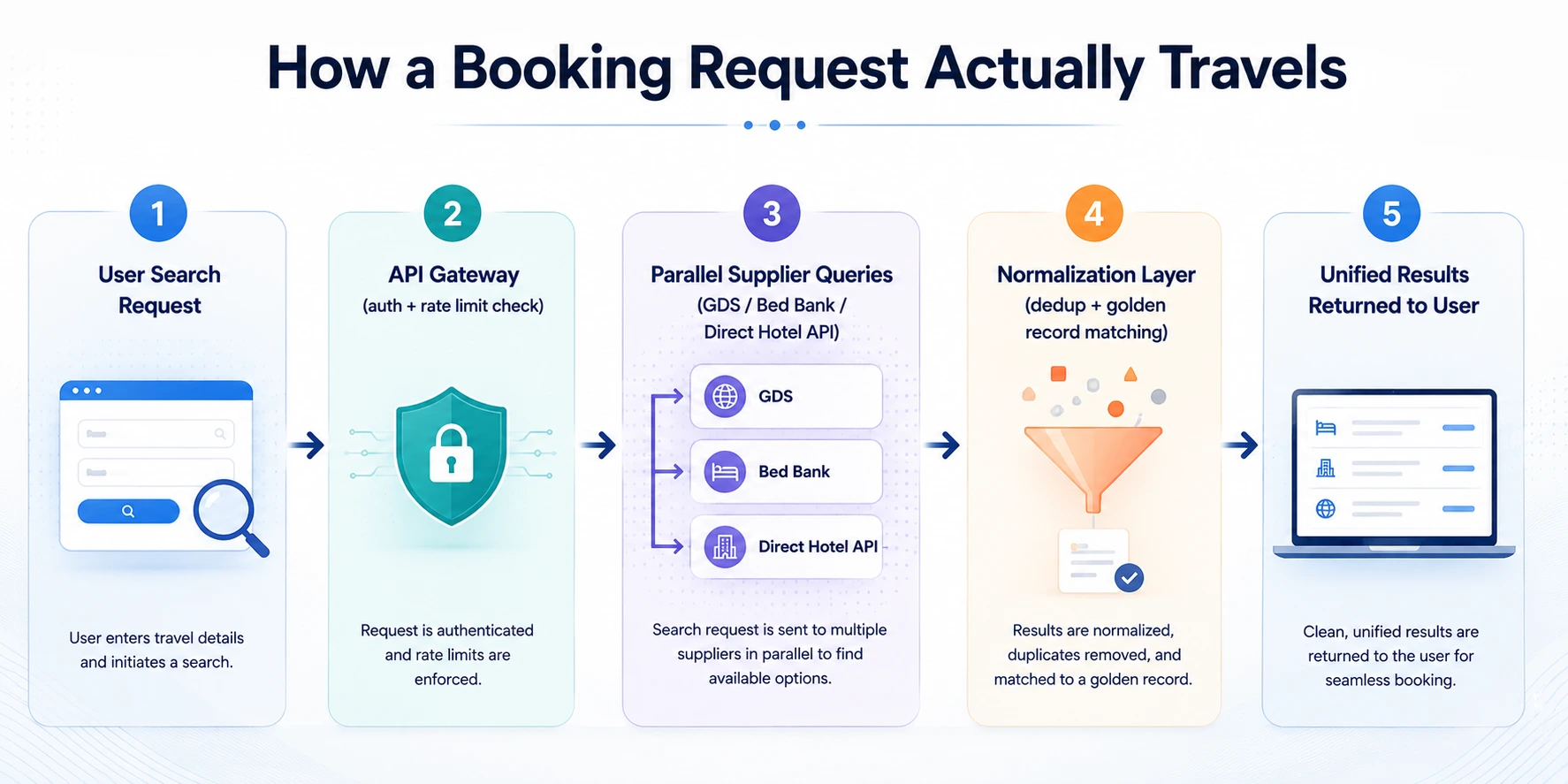
How Inventory Normalization Works Across Suppliers
The single biggest data challenge in travel tech is duplicate inventory. A property listed by one GDS as "Marriott on Main Street" might appear from an OTA feed as "J.W. Marriott Downtown Center," with a slightly different address. Pull from both sources, and your platform shows two duplicate hotels.
Availability is split between them. The user gets confused, and worse, the booking flow can double-count remaining rooms. Room types have the same problem. "King Deluxe with View" and "King Bed, City Scenery" are frequently the same room, described two different ways by two different suppliers, according to API7.ai's breakdown of travel API integration.
The Fix Isn't cosmetic
The standard solution is a mapping strategy, usually a specialized service using machine learning to assign a single "golden record" ID to each unique property and room type across every supplier feed.
Skip this step, and your platform's UX degrades quietly every time you add a new supplier. Nobody notices in a demo. Everyone notices at scale.
Where API Latency and Certification Delays Break OTA UX
Engineering teams building multi-supplier platforms run into delays that never appear in a sales pitch. GDS certification testing can add 6-8 weeks even after your code is production-ready, because you're on the provider's approval schedule, not yours.
NDC alone has seven major schema versions currently in active use, which means "NDC support" from one vendor may not mean the same thing as "NDC support" from another source. Response formats can vary even within a single API. That forces real data-transformation work just to present a consistent interface to your front end.
Why "One Normalized API" Claims Deserve Scrutiny
Some platforms market a single universal API layer as the entire solution to orchestration. The mechanism is real; a well-built gateway can aggregate schedules, fares, and hotel availability from hundreds of suppliers behind one clean interface, but "normalized" doesn't mean "complete." Coverage still depends on which suppliers sit behind that gateway and how recently their content was reconciled.
Failure Mode Library: What Actually Breaks in Production
Every OTA platform eventually hits the same handful of failure patterns. Knowing them in advance is more useful than any feature comparison, because these are the incidents that consume engineering weeks and erode customer trust.
Duplicate Booking from Missing Confirmation
Sometimes a booking succeeds on the supplier side, but the customer never receives confirmation because the PNR fails to generate, or the confirmation email gets rejected by the receiving mail server. The customer assumes the booking failed. They rebook. Now you have a duplicate reservation and, often, a disputed charge to untangle the source.
Mitigation: automated monitoring that flags missing confirmations within minutes, plus a manual resend path through WhatsApp, SMS, or push notification as a backup to email.
Inventory Desync and Overbooking
This happens when your availability display, your pricing engine, and your actual supplier-side inventory check pull from three different data sources that aren't talking to each other in real time.
The mismatch lives in the gap between those systems. One source says a room is available. Another says it was sold ten minutes ago. The booking engine doesn't know which one is current, and the guest finds out at check-in.
Mitigation: a unified integration layer where availability, pricing, and inventory checks all read from one continuously updated source of truth, typically the PMS or a real-time supplier feed, not a cached snapshot source.
Payment Mismatch and Checkout Collapse
Card declines, 3D Secure timeouts, and currency mismatches are the leading causes of abandoned bookings. A traveler in one country booking a hotel in another can hit several of these failure types in a single transaction.
When a GDS or supplier API lags or times out mid-checkout, the booking session can collapse entirely, leaving the customer unsure whether they were charged.
Mitigation: direct escalation paths to your payment processors, an alternate-gateway retry on failure, and a manual authorization fallback for edge cases that automated retries can't resolve.
Untraceable Booking-State Failures
This is the failure mode that costs the most engineering time, and it's architectural rather than a single bug. The checkout process works most of the time, but when something breaks, such as a failed payment, a double booking, or a sync issue, nobody can trace why because there's no single owner of the booking state.
This typically happens when a booking flow was built feature by feature: flights first, then hotels, then car rentals, each bolted onto the existing flow without revisiting the underlying state model. By the time the platform hits real scale, the booking engine is a pile of features, not an architectural source.
Mitigation: a single, explicit booking-state machine that every feature (flights, hotels, and cars) writes to and reads from, so incident investigation doesn't require pulling in the entire engineering team.
| Failure Mode | Root Cause | First Sign You'll Notice | Structural Fix |
| Duplicate booking | Missing/failed confirmation | Customer disputes or rebooks | Automated confirmation monitoring + backup channel |
| Inventory desync | Availability, pricing, and supplier checks on separate data sources | Overbooking at check-in | Single real-time source of truth |
| Payment mismatch | Currency, 3DS, or gateway timeout | Abandoned checkout | Multi-gateway retry + manual fallback |
| Untraceable state failure | Feature-by-feature booking flow with no central state owner | Incidents take days to diagnose | Explicit booking-state machine |
Migration Checklist: Switching Platforms Without Breaking Bookings
If you're moving away from Travelopro or any bundled platform toward a modular setup, the risk isn't the new platform. It's the transition window.
Step 1: Audit Data Migration Risk Benchmarking Code
Start by cataloging what actually needs to move: customer records, historical bookings, loyalty balances, and any supplier-specific IDs your current platform generated internally.
Supplier-specific IDs are the trap most teams miss. If your old platform assigned its own internal hotel or room IDs, those won't map cleanly to a new aggregator's ID scheme without a mapping pass.
Step 2: Plan Supplier Re-Binding BeCutover
Every supplier connection, GDS credentials, bed bank contracts, and payment gateway keys need to be re-established and re-certified on the new platform. This is not a copy-paste operation.
GDS certification alone can take 6-8 weeks per connection. Sequence your supplier re-bindings so the highest-volume suppliers are certified first, and keep the old platform live in parallel until each new connection is confirmed stable.
Step 3: Protect Booking Continuity During the Transition
Existing bookings made on the old platform need to remain serviceable, modifiable, cancellable, and refundable for as long as their travel dates are in the future. This can mean months of dual-platform operation for long-lead-time bookings like package tours or corporate travel.
Decide upfront: will the old platform stay read-only for existing bookings, or will you migrate live reservations into the new system's data model? The second option is more thorough but carries a real risk of data loss if the mapping between old and new booking records isn't tested first.
Step 4: Run a Parallel-Operation Period
Don't cut over in one step. Run both platforms simultaneously for a defined window, typically one full booking cycle for your busiest product line, before decommissioning the old one. Monitor the failure modes above specifically during this window. Migration periods are when inventory desync and duplicate bookings are most likely to spike because two systems are temporarily authoritative for overlapping supplier data.
Related Questions Worth Answering
Is Travelopro the Right Choice for Every OTA?
No, and no single vendor is. Travelopro suits operators prioritizing a bundled, low-engineering-effort build. It's a weaker fit for operators who need supplier-level flexibility or region-specific invoicing logic built in from day one.
What Better Platforms Exist, Depending on the Use Case?
"Better" depends entirely on the integration role. If you're reselling marketplace inventory, an aggregator like RateHawk or a hub API may suit you best. If you need deep airline NDC access, a GDS-based stack through Amadeus or Sabre matters more than anything else.
Platforms built specifically for GCC and Middle East B2B operators, modular by design, with regional compliance built in, serve a different need than either of the above.
What Will You Lose or Gain by Switching Platforms Mid-Build?
You typically gain flexibility and cost predictability at scale. You typically lose the sunk cost of prior integration work and face a migration period where supplier connections need retesting and recertification, exactly as outlined in the checklist above.
Neither is automatically the right trade. It depends on how far along your current build is and how painful your current constraints have already become.
Real-World Constraint: GCC Compliance Isn't Optional
A platform's supplier list means little if it can't produce a compliant invoice for a UAE-regulated travel agency. This is where generic, non-region-specific builds tend to fail quietly.
The Margin Scheme Problem
Under the UAE's Tour Operator Margin Scheme (TOMS), VAT is calculated on your profit margin, not the full selling price. If package components are consumed outside the GCC, the margin is zero-rated instead.
Get the agent-versus-principal classification wrong, and your VAT liability calculation is wrong along with it, according to EASMEA's VAT compliance guide for travel agencies.
The E-Invoicing Layer on Top of That
The UAE's phased e-invoicing mandate requires B2B and B2G travel invoices to be transmitted as structured data through an accredited service provider. Margin-scheme sales must be tagged correctly, with VAT displayed as zero on the invoice line while the actual margin calculation stays off-invoice.
A platform's billing engine needs to identify margin-scheme sales at the point of issue and tag them accordingly. Mis-flagging a sale is now caught at validation, not months later during an audit.
| Compliance Requirement | What It Means for Your Platform |
| TOMS margin-based VAT | Billing engine calculates VAT on margin, not gross price, and classifies agent vs principal role per transaction |
| Zero-rating for non-GCC consumption | The system tracks the "place of supply" per package component |
| E-invoicing (2026 rollout) | Invoices are transmitted as structured data via an accredited provider, with margin-scheme sales flagged and VAT hidden per line |
| Multi-currency handling | AED-equivalent VAT is shown alongside the transaction currency, with the exchange rate traceable |
A platform's API list is a technical spec. Its ability to generate a correctly tagged margin-scheme invoice is a regulatory requirement. Only one of those shows up in most feature comparisons.
Tradeoff Honesty: No Platform Is Fully NDC-Complete
Vendors love to claim full NDC support. In practice, NDC adoption varies by airline and by region. Some major carriers now route the large majority of bookings through NDC or direct channels. Others still lean heavily on legacy EDIFACT formats. The current NDC schema landscape spans multiple active versions, and airline-side certification against those versions is uneven across the industry.
What matters isn't whether a platform claims NDC support in the abstract. It's whether that support covers the specific airline clusters your customers actually book. Ask any vendor, including us, for NDC coverage broken down by airline cluster relevant to your market, not a single yes/no answer.
Expert Insight: Where TravelBookingPanel Fits and Doesn't
We built TravelBookingPanel for operators who need modular supplier control across fragmented markets, particularly across the world and the GCC, where invoicing rules and supplier mixes shift by country. That was a deliberate choice, not a default. It means more configuration work upfront in exchange for flexibility later, the ability to add, remove, or renegotiate individual suppliers without rebuilding your platform.
That approach isn't the right fit for every operator. If you want a fully bundled, turnkey white-label setup with minimal engineering involvement from day one, a vendor like Travelopro may genuinely be the simpler starting point. The honest answer is that platform choice should follow your operating model, not the other way around.
Key Takeaways
The question "what's the best Travelopro alternative" doesn't have a single answer, because the platforms being compared aren't solving the same problem. A bundled build minimizes decisions but limits flexibility later. A GDS-based stack gives you airline depth at the cost of certification lead time. An aggregator compresses supplier onboarding but hands you less contract-level control.
A modular, custom-built platform takes more upfront configuration but holds up better as your supplier list and regional compliance requirements grow. The five-layer framework content, connectivity, pricing, scale, and support give you a way to score any vendor against your actual needs rather than a generic feature list. The failure mode library tells you what to test for before launch, not after an incident, and in markets like the UAE, a platform's compliance architecture, not just its API count, often ends up being the deciding factor.
Tags
Own Your Travel Platform. Forever.
Buy once, own forever. Full source code · No monthly fees · No hidden charges.