If your hotel generates $2 million in annual bookings and 60% of those come through OTAs at an average 20% commission, you're writing a check for over $240,000...
If your hotel generates $2 million in annual bookings and 60% of those come through OTAs at an average 20% commission, you're writing a check for over $240,000 every year to a platform that owns your guest data, controls your cancellation rates, and can bury your listing whenever an algorithm shifts. That's not a distribution strategy. That's a dependency. Hotel booking portal development is how hotels break that cycle. A well-built direct booking portal doesn't just give you a website widget; it restructures where revenue flows, who owns the guest relationship, and how much of every transaction you actually keep.
This article isn't going to tell you to "add a booking engine to your site." It's going to show you exactly where hotels lose money inside their portal architecture, which integrations determine whether your portal actually converts, and what the build-vs-buy decision looks like when you run the real numbers in 2026.
The Real OTA Commission Problem (It's Not Just 15%)
Every hotel manager knows the headline number. Booking.com takes 15-18%. Expedia runs 15-25%. Agoda sits between 15% and 25%. The number gets acknowledged, filed under "cost of doing business," and moved past.
That framing is exactly how hotels end up keeping less of every dollar they earn, even as revenue grows.
The Math Nobody Does Upfront
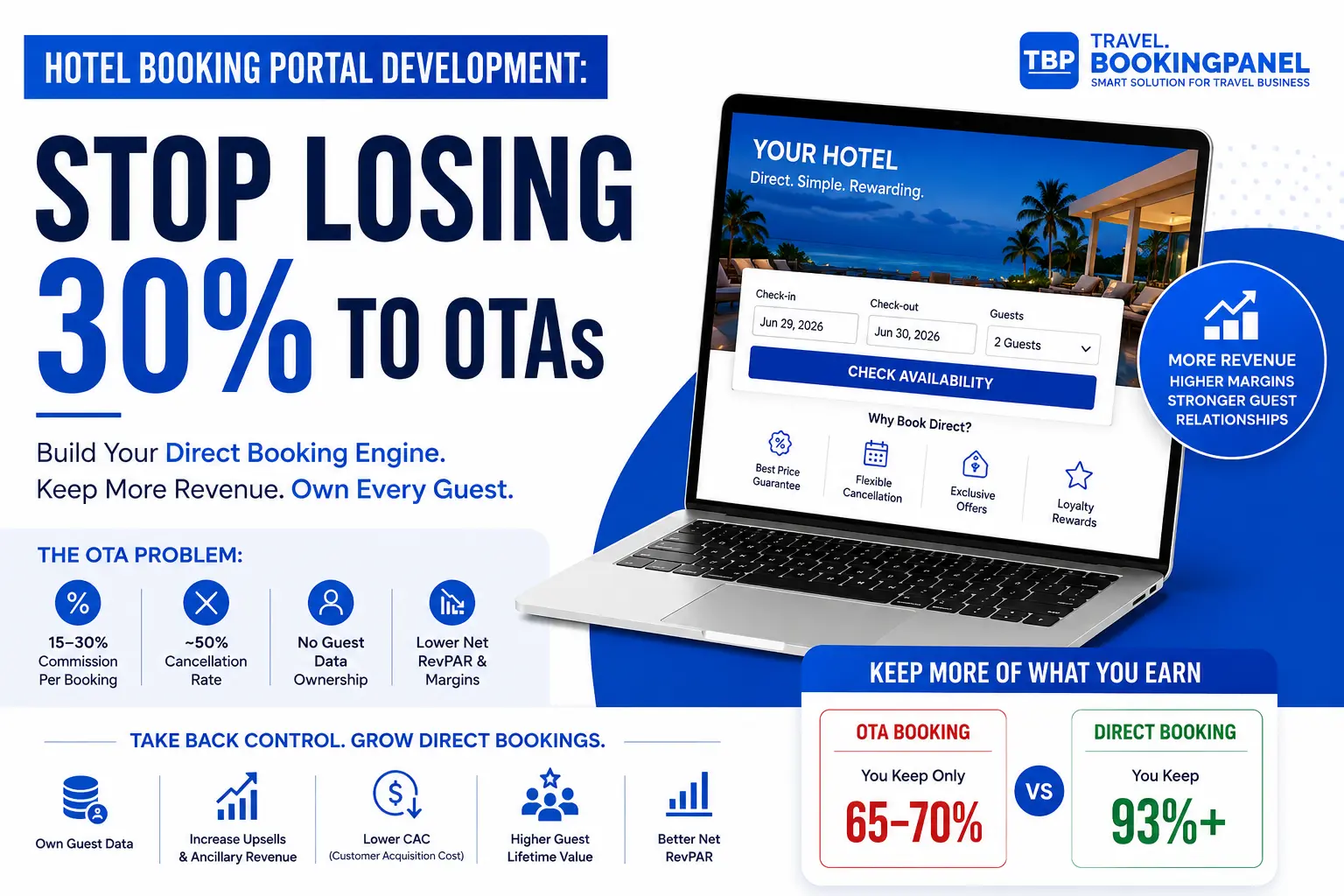
Industry commission data puts the average OTA fee at 15-30% per booking, depending on platform and participation in promotional programs. But the stated commission is only the starting line. Once you fold in the real cost layers, high cancellation rates, lost upsell revenue, payment processing fees, currency conversion, and the invisible cost of not owning your guest data- the true effective cost of OTA distribution in 2026 is closer to 30-35% per reservation.
Here's what that looks like at scale. A mid-size hotel property doing $2 million in annual bookings, with 60% of volume flowing through OTAs at a blended 20% commission, is paying out roughly $240,000 per year in platform fees alone. Factor in that OTA bookings carry approximately a 50% cancellation rate compared to roughly 18.2% for direct channels, and the actual revenue impact compounds significantly, because every cancelled OTA booking is a room that could have been sold direct at a lower cancellation risk and a higher net margin.
The Per-Booking Revenue Gap Is Wider Than Most Realize
SiteMinder's 2025 reservation data, drawn from over 125 million bookings, puts a precise number on this: direct bookings generate an average of $519 per reservation, compared to $320 from OTA bookings, more than 60% more revenue per transaction. The contribution margin on direct bookings sits at 93.2%, versus 82.7% for OTA bookings.
That gap isn't just about commission. It's about the entire downstream economics: higher average order value when a guest books directly, lower cancellation risk, upsell revenue that isn't shared with a third party, and the long-term value of a guest who returns through your own channel the next time.
RevPAR vs Net RevPAR: The Metric That Reveals Everything
There's a metric most hotel operators aren't tracking, and it's the one that actually tells the truth about channel profitability. HotStats data analyzed by TeaCode shows that global RevPAR has grown 19% since 2019, but distribution costs per available room have surged 25% over the same period. Hotels are celebrating revenue recovery while keeping a smaller share of every dollar.
Net RevPAR, room revenue minus distribution costs, divided by available rooms, is the only metric that tells you whether your channel strategy is working. A hotel showing strong RevPAR growth while its OTA dependency increases is running in place. The goal of hotel booking portal development is to shift that ratio: more direct volume, lower cost per acquired booking, and higher net RevPAR.
What a Direct Hotel Booking Portal Actually Recovers
Hotel booking portal development is often framed as a technology investment. It's more accurate to frame it as a margin recovery project with a technology component.
The Revenue Layer That OTAs Quietly Absorb
When a guest books through Booking.com or Expedia, several revenue streams disappear simultaneously. The obvious one is commission. The less obvious ones are what compound the loss.
OTAs control the guest communication pre-arrival, which means your upsell prompts for room upgrades, airport transfers, spa bookings, and early check-in fees either don't reach the guest at all or go through the OTA's own upsell tools (which, in some contract structures, carry their own commission). The guest data generated by that stay, email, preferences, and booking history belong to the platform, not to you. When that guest wants to book again, they return to the OTA because that's where their history lives.
A direct booking portal changes this entirely. You own the pre-arrival communication sequence, the upsell workflow, the post-stay follow-up, and the loyalty trigger that brings the guest back through your channel next time. The first direct booking is where you break even on acquisition cost. Every subsequent direct booking from that guest is effectively free.
The Cancellation Rate Disparity and Its Revenue Impact
This is the variable that doesn't appear on commission invoices but shows up clearly when you calculate net revenue per available room. Cloudbeds data from 2025 puts OTA booking cancellation rates at approximately 50% on major platforms like Booking Holdings, compared to roughly 18.2% for direct bookings.
For a hotel operating at scale, this disparity means that a significant portion of OTA bookings never generates actual revenue; they generate phantom occupancy that prevents the room from being sold on other channels during the same window, then cancel close to arrival when re-selling options are limited. A direct booking portal with well-designed cancellation policies and direct guest engagement reduces this exposure materially.
Skift's 2030 Direct Booking Projection
The trajectory of the market supports this shift. Skift Research projects that direct digital hotel channels will overtake OTAs by 2030, reaching $400 billion or more in annual bookings compared to $333 billion from OTA platforms. Hotels that build their direct booking infrastructure now are positioning ahead of a structural channel shift, not chasing a trend.
The Integrations That Determine Whether Your Portal Wins or Fails
After analyzing dozens of hotel booking portal deployments, one failure pattern repeats itself consistently: the portal gets built, but the back-end integrations are either incomplete, poorly architected, or running on outdated sync protocols. The result is a portal that looks functional but leaks revenue at every seam through overbookings, rate mismatches, disconnected inventory, and manual reconciliation that consumes staff hours.
The integrations below aren't optional add-ons. They're the infrastructure that determines whether your hotel booking portal development investment pays off or quietly underperforms.
PMS Integration: The Non-Negotiable Foundation
Your property management system is the operational center of your hotel. Every booking, regardless of channel, needs to live in the PMS as a single source of truth. When the PMS isn't connected to your direct booking portal in real time, the following failures become routine: rooms get sold twice, rate updates don't propagate, guest preferences don't carry across touchpoints, and your front desk is manually reconciling data that should never have required human intervention.
RMS Cloud's 2026 integration research found that properties with proper PMS and channel manager integration see overbookings drop by 90% or more, with a 30% reduction in manual OTA management time within the first quarter of implementation.
Webhook vs Polling: Why Sync Speed Is a Revenue Issue
Most hotel operators don't think about the architecture underneath their integration, but the difference between webhook-driven and polling-based sync is measurable in lost bookings and double-booking incidents. Older polling-based integrations check the PMS every 5-15 minutes for changes. In a high-demand window, a concert weekend, a major conference, or peak holiday season, a 10-minute sync cycle is long enough to sell the same room twice.
Modern integrations use webhooks: event-driven pushes that fire the moment a reservation is created, modified, or cancelled. The room is locked across all channels in seconds, not minutes. For a hotel booking portal competing with OTAs that update inventory in near-real-time, webhook architecture isn't a premium feature; it's table stakes.
The Field Mapping Problem Nobody Warns You About
There's a subtle integration failure that affects guest experience without triggering any obvious error. When two systems use different data schemas, certain fields get stripped during the sync. Guest comments, accessibility requirements, dietary flags, late-arrival notes, and special request data can disappear between an OTA's booking form and your PMS. A guest who requested a ground-floor room for mobility reasons arrives to find that it was never logged. This isn't a guest service failure; it's an integration architecture failure that erodes trust in your direct channel over time.
Channel Manager: Your Rate Parity Enforcer
In hotel booking portal development, the channel manager serves as the bridge between the PMS and all booking channels. It automatically syncs rates, availability, and reservations across OTAs, GDS networks, metasearch platforms, and the hotel's booking engine. Without it, hotels must manually update rates, reconcile bookings, and manage rate parity across multiple systems.
According to Hotelogix's 2026 integration analysis, the global hotel channel management sector is projected to grow from $804.6 million in 2024 to $1.54 billion by 2032, driven by hotels' increasing need to manage distribution across OTAs, GDS, and direct channels simultaneously. The investment the market is making in channel management infrastructure reflects how central it has become to hotel revenue strategy.
Pooled vs Allocated Inventory Architecture
This is a decision that directly impacts how much inventory you can sell and through which channels. Allocated inventory models assign a fixed block of rooms to each distribution channel: 10 rooms to Booking.com, 5 to Expedia, and 5 to your direct site. When Booking.com's block sells out, rooms on your direct site might still sit empty, or vice versa.
Pooled inventory architecture treats all available rooms as a single shared resource that any channel can draw from in real time. When a room is booked on any channel, it's immediately unavailable everywhere else. Pooled inventory maximizes occupancy, eliminates the risk of artificial channel-level sellouts, and gives your direct booking portal access to full availability at all times, which is a conversion advantage when guests compare your site to OTAs.
GDS Connectivity: Amadeus, Sabre, and Travelport
If your target guest mix includes corporate travelers, group bookings, or agency-booked business, GDS connectivity is not optional. The three major global distribution systems, Amadeus, Sabre, and Travelport, connect your inventory to over 600,000 travel agents and corporate booking tools worldwide. For independent hotels and smaller chains trying to access business travel volume without building direct corporate sales relationships, GDS is the fastest path into that market segment.
A critical consideration in hotel booking portal development is ensuring that GDS connectivity is fully integrated with both the channel manager and PMS rather than operating as a separate booking stream. When reservations flow through a unified system, inventory, rates, and availability remain synchronized across all channels, and GDS bookings are automatically recorded in the PMS without manual intervention. This reduces reconciliation work, minimizes data discrepancies, and ensures that GDS reservations are processed with the same speed and accuracy as direct bookings.
Payment Gateway and PCI-DSS v4.0 Compliance
As of March 2025, PCI-DSS v4.0 is in full force. Every payment integration touching your hotel booking portal, your booking engine, OTA payment passthrough, POS terminals, and payment gateway must now meet the new tokenization, audit-logging, and customized-approach requirements.
This matters for hotel booking portal development in two practical ways. First, non-compliant payment integrations expose your operation to significant financial and reputational risk. Second, PCI compliance isn't a one-time setup; it requires ongoing audit attestation from your PMS vendor and every integration partner that handles cardholder data. When evaluating vendors, ask for a current attestation of compliance before signing, not during onboarding.
Beyond compliance, payment architecture affects conversion. Hidden payment costs, such as credit card processing fees, currency conversion charges of 1-3%, and chargeback exposure, can significantly erode the net revenue advantage of a direct booking. Designing your payment stack to minimize these costs is part of building a profitable portal, not an afterthought.
Revenue Management System Integration
Static pricing is a direct booking conversion problem. Guests comparing your portal to OTAs in 2026 are looking at dynamic rates on those platforms, rates that shift based on demand signals, competitor positioning, and booking window. If your direct portal shows a fixed rate while Booking.com shows a lower rate for the same room on the same night, you've lost the conversion regardless of how well everything else works.
An integrated Revenue Management System (RMS) analyzes real-time demand data, historical patterns, competitor rates, and market events to adjust your pricing dynamically and pushes those updates across all channels simultaneously through your channel manager. The result is a direct booking price that reflects actual market demand and competes effectively, rather than a static rate that makes your portal look outdated by comparison.
The Mistakes That Destroy Booking Conversion
Most articles about hotel booking portal development focus on features. Almost none of them explain how a hotel loses money because of specific architectural and design failures at the portal level. This section covers the mistakes that recur in underperforming portals, not as a checklist but as a pattern-recognition exercise.
Disconnected Availability, Pricing, and Inventory
This is the single most common cause of portal conversion failure, and it's invisible from the outside. When a guest searches your direct booking portal, sees availability, proceeds to checkout, and finds the room is suddenly unavailable or the price has changed, they don't retry. They go back to Booking.com, where the experience is consistent.
This failure has one root cause: your inventory, pricing, and availability systems are not talking to each other in real time. The availability display pulls from one data source. The pricing engine pulls from another. The actual inventory check at checkout pulls from a third party. The mismatch happens in the gap between those systems. Fixing it requires a unified integration layer where all three signals come from a single source of truth, your PMS, updated continuously.
Mobile UX Failure at the Checkout Stage
Mobile devices now drive over 61% of accommodation bookings, but Contentsquare's 2025 digital experience data shows that the travel and hospitality sector has a 44% digital frustration rate, the highest of any industry. The gap between mobile traffic and mobile conversion in hotel portals is enormous, and most of it is lost at the checkout stage.
The specific failures are consistent: too many form fields, too many steps between room selection and payment confirmation, slow page load times (53% of users abandon a booking when load time exceeds 3 seconds), and payment flows that don't support the digital wallets mobile users expect. A direct booking portal that works well on desktop but poorly on mobile isn't a direct booking portal, it's a desktop portal that loses the majority of its traffic before conversion.
No Trust Architecture at Checkout
OTAs have spent billions building consumer trust in their checkout flows. Your direct portal hasn't. When a guest reaches your checkout page and sees an unfamiliar payment interface, no visible security signals, no clear cancellation policy framing, and no social proof, they hesitate. The solution in hotel booking portal development isn't a visual redesign or a few cosmetic tweaks.
It comes from building trust directly into the booking experience through clearly displayed cancellation policies, visible PCI-DSS security badges, real-time room availability confirmation, and pricing transparency. For guests making their first direct booking, showing that the rate matches or beats what they would find on an OTA can remove a major source of hesitation and increase the likelihood of completing the reservation. That hesitation is a conversion leak.
The Rate Parity Trap That Costs You Either Way
Here's a dynamic that makes direct booking portals more difficult to compete with in 2026: OTAs actively bid on your hotel's brand name in Google Ads. When a guest searches your hotel name directly, the first result they often see is a Booking.com ad, meaning you pay commission on a guest who was already looking for you by name.
This problem has a structural solution following the EU's Digital Markets Act, which forced Booking.com to remove rate parity clauses for hotels in the EEA from July 2024, allowing those properties to offer lower prices on their own websites. For hotels outside the EEA, rate parity enforcement remains a constraint in many OTA contracts, but there are legal mechanisms available: exclusive member rates, direct booking benefits (complimentary upgrades, early check-in, loyalty points), and package pricing that bundles value rather than discounting the room rate directly.
Outdated Sync Protocols Creating Booking Windows for Double Sales
As covered in the integration section, polling-based channel manager integrations create a window, sometimes 5-15 minutes, during which the same room can be sold on multiple channels simultaneously. In peak demand periods, this window is long enough to generate double bookings that require manual resolution, guest compensation, and reputational damage.
If your hotel booking portal development includes a channel manager integration, verifying that it uses webhook-driven, event-based sync rather than periodic polling is a non-negotiable technical requirement.
How Inventory Architecture Should Work
Getting inventory architecture right is the difference between a direct booking portal that competes effectively across all channels and one that creates operational chaos every time demand spikes.
The Single Source of Truth Principle
Every booking system your hotel operates, direct portal, OTA connections, GDS feeds, and metasearch should draw its inventory and availability data from one place: your PMS. The PMS is the master record. Inventory changes flow outward from the PMS through the channel manager to all external channels simultaneously. Reservations from all channels flow back into the PMS in real time.
When this architecture works correctly, hotels typically see a 20-30% reduction in operational costs through workflow automation, as manual data re-entry and reconciliation across platforms drop dramatically. The staff hours previously consumed by cross-referencing OTA extranets, updating availability manually, and reconciling rate discrepancies are redirected to guest-facing service.
Why Pooled Inventory Outperforms Allocated Inventory
Allocated inventory creates artificial scarcity on individual channels. A hotel with 50 rooms that allocates 15 to Booking.com, 10 to Expedia, 10 to its direct portal, and holds 15 in reserve will regularly experience sellouts on one channel while rooms sit available on another. Guests who couldn't book through their preferred channel don't automatically migrate to your direct portal; they book a competitor instead.
In hotel booking portal development, pooled inventory is considered a best practice because it removes the limitations of channel-specific room allocations. Instead of assigning separate room blocks to different sales channels, all available inventory remains accessible across every connected platform. When a reservation is made through any channel, the channel manager automatically updates availability everywhere else in real time.
Real-Time vs Near-Real-Time: The Operational Difference
For most hotel operations, "near-real-time" sync updates propagating within 30-60 seconds are sufficient for routine operations. Where it becomes a liability is during high-velocity booking periods: flash sales, event-driven demand spikes, and last-minute availability releases. In those windows, even a 60-second sync delay can result in overselling.
White-label hotel booking portal solutions like TravelBookingPanel are built around real-time inventory sync architecture, ensuring that availability updates across every connected channel within seconds of a booking event, rather than on a scheduled polling cycle. For hotels that operate across multiple distribution channels simultaneously, this architecture eliminates the operational overhead of managing oversells and compensating guests.
Build Custom or Buy SaaS? The Honest Answer for 2026
Within hotel booking portal development, this is the decision that most technology consultants avoid answering directly. A meaningful comparison between custom development and existing platforms requires evaluating actual implementation, maintenance, integration, and operational costs rather than relying on vendor marketing claims or theoretical ROI projections.
The Custom Build Cost Reality
A comprehensive study of 150+ travel businesses found that companies building custom booking engines spent 65% more than initially budgeted. The Standish Group's CHAOS Report puts the broader picture in context: 66% of custom enterprise software projects fail to meet time, cost, or scope expectations.
The upfront cost overrun is only part of the problem. Forrester Research's analysis of total lifetime ownership costs for custom software systems found that maintenance and personnel expenses consume 50-85% of total lifetime cost, a figure that most organizations don't model at the planning stage. A custom-built hotel booking portal that costs $300,000 to build will typically cost $150,000-$255,000 per year to maintain, support, and evolve, before factoring in integration updates as PMS vendors, OTAs, and payment gateways update their APIs.
The SaaS Cost Reality
The same study from Zentrumhub found that companies purchasing established SaaS booking solutions achieved ROI 4.1 times faster than custom builders, and reduced total three-year costs by approximately $658,000. Phocuswright's research on agencies using proper online booking systems found they averaged 27% more revenue than those without structured booking technology, regardless of whether the system was custom or SaaS.
The SaaS advantage isn't just cost. It's speed to market, pre-built integrations with major PMS platforms and OTA channels, and the compound benefit of a hotel booking portal development team that continuously improves the platform across all their customers, rather than a single hotel's tech budget sustaining all improvements alone.
The Phased Hybrid Approach: Where Most Hotels Should Start
Within hotel booking portal development, the build-vs-buy debate is often presented as a false binary. For most hotel operations, 2026 is a phased hybrid model:
Phase 1 SaaS Core: Deploy a proven white-label or SaaS booking engine that integrates with your existing PMS and channel manager. Validate direct booking volume, conversion rates, and guest acquisition costs before committing to custom development.
Phase 2 Custom Layer: Once the business model is validated, add a custom branded front-end, guest experience layer, or B2B agent portal using the SaaS platform's API infrastructure. You get differentiated UX without rebuilding the booking core.
Phase 3 Custom Mid and Back Office: As booking volume scales and operational complexity increases, build custom mid-office and back-office workflows, automated reconfirmation sequences, dynamic packaging logic, and supplier reconciliation while the SaaS booking core continues to handle the transaction layer.
This approach reduces execution risk, validates the investment with real revenue data before scaling, and prevents the most common custom build failure: engineering an expensive solution before confirming the business model can support it. For hotels and travel agencies exploring the B2B and B2C applications of hotel booking portal development, this phased approach applies equally to enterprise chains and independent boutique properties.
When Custom Build Makes Sense
Custom development earns its cost at a specific threshold of scale and differentiation need. If you're operating a large hotel chain with proprietary loyalty infrastructure, complex multi-property inventory logic, white-label requirements for enterprise clients, or booking volumes that generate enough direct revenue to absorb a $400,000+ development budget and ongoing maintenance costs, custom may be the right long-term play.
For most hotels, hotel booking portal development through a custom build becomes difficult to justify below a certain scale. A well-integrated SaaS platform can be launched in weeks, start generating direct bookings sooner, and deliver ROI much faster than a custom solution that may take 12-18 months to reach production. In many cases, the speed of deployment and earlier revenue gains outweigh the additional control offered by a fully custom platform.
Hidden Costs That Appear After Launch
No hotel technology project budget survives first contact with post-launch reality completely intact. The costs below are predictable, which means they're plannable, but they consistently appear as surprises in hotel booking portal development projects that didn't model them upfront.
Channel Manager Per-Connection Fees
Some channel managers charge per OTA connection or per transaction, rather than a flat monthly fee. As your distribution mix grows, adding GDS connectivity, metasearch feeds, and regional OTA partnerships, these per-connection costs compound. A channel manager that looks affordable at three OTA connections can become a significant operational expense at twelve. Evaluate total connection cost across your full intended distribution footprint before committing to a channel manager vendor.
PCI-DSS Compliance as an Ongoing Obligation
Another factor often overlooked in hotel booking portal development is that PCI-DSS compliance is an ongoing responsibility, not a one-time project milestone. As payment systems evolve and new integrations are added, hotels may need to update security controls, maintain audit records, and revalidate parts of their payment infrastructure. Annual compliance costs and the engineering effort required to keep payment workflows secure should be included in long-term operating budgets, especially as the portal's technology stack grows over time.
OTA Brand Bidding Paying Commission on Traffic That Was Already Yours
One of the most overlooked factors in hotel booking portal development is the cost of losing direct bookings to OTAs before guests even reach your website. OTAs such as Booking.com and Expedia frequently bid on hotel brand names in Google Ads, meaning that when a guest searches specifically for your hotel, the first result they see may be an OTA listing rather than your direct booking portal. If the guest books through that channel, the hotel can end up paying a 15-25% commission on a reservation that was already highly likely to convert directly.
In 2026, this dynamic is more acute than ever as OTAs invest heavily in search advertising to defend their market position. The mitigation strategy is a Google Hotel Ads integration that allows your direct booking portal to appear in the same search results, combined with a direct booking rate advantage (where contractually permitted) that gives the guest a reason to click your link instead of the OTAs.
Integration Maintenance as Platforms Evolve
One reality of hotel booking portal development is that integrations are never truly finished. OTAs, PMS vendors, payment gateways, and GDS providers regularly update their APIs, which can affect existing connections. With a custom-built portal, your team is responsible for maintaining and updating those integrations. Even when using SaaS platforms, updates from providers like Booking.com may require testing and validation to ensure everything continues working as expected.
The operational cost of integration maintenance is real, recurring, and proportional to the number of systems in your tech stack. The more connections you have, the more maintenance surface area you're managing. This is one of the strongest arguments for the phased hybrid approach, keeping the integration footprint as consolidated as possible until your booking volume justifies the complexity of a fully custom stack.
Currency Conversion and Cross-Border Tax Compliance
For hotels serving international guests, hotel booking portal development must account for currency conversion fees of 1-3% per transaction and regional tax compliance obligations, including VAT in Europe, GST in Asia-Pacific markets, and municipal taxes in countries such as Italy, France, and Germany.
These costs rarely appear in pre-launch estimates, yet they directly affect the financial performance of a hotel booking portal. While they are unavoidable compliance requirements, they should be factored into revenue projections and profitability models to ensure realistic expectations for international direct bookings.
What to Build First: A Prioritized Roadmap for 2026
If you're beginning hotel booking portal development or restructuring an existing portal, the order in which you build and integrate matters as much as what you build. Sequencing correctly means every phase generates revenue that funds the next.
Phase 1: Establish the Revenue Foundation
The priority is a functioning direct booking portal with real-time PMS integration, a channel manager with pooled inventory architecture, and a payment gateway that's PCI-DSS v4.0 compliant. This is the minimum viable stack that stops the revenue leak, converting the traffic you already have through organic search, direct referrals, and returning guests into bookings that don't carry OTA commission.
At this stage, the KPIs to track are direct booking conversion rate (industry benchmark for hotel direct portals is 2-4%; well-optimized portals run 3.5-5%), Net RevPAR (total room revenue minus distribution costs per available room), and cancellation rate by channel.
Phase 2: Optimize for Mobile Conversion and Trust
Once the core booking flow is functioning, the next highest-ROI investment is mobile UX and trust architecture. Given that 61% of bookings now originate on mobile and the travel sector's digital frustration rate sits at 44%, a one-page or progressive mobile checkout flow, sub-3-second load time on mobile, and visible security and cancellation policy signals at checkout will compound conversion gains materially.
Add metasearch connectivity at this stage, Google Hotel Ads, Trivago, and Kayak, so that your direct booking portal competes in the same search environments where OTAs are acquiring your potential guests.
Phase 3: Close the Loop with RMS and CRM Integration
With a converting portal and a healthy direct booking volume, the next layer is dynamic pricing through RMS integration and guest retention through CRM connectivity. An integrated RMS ensures your direct portal pricing is competitive in real time. An integrated CRM captures guest profiles, preferences, and booking history, building the data foundation that enables loyalty programs, personalized pre-arrival communication, and the upsell workflows that increase revenue per stay without increasing acquisition cost.
At this stage, hotel booking portal development is less about winning the first booking and more about earning the second one. A guest who books directly and returns later to book again is far more valuable than a guest who comes through an OTA once and never re-engages with the hotel. That's why repeat direct bookings and long-term guest value become more important metrics than conversion rate alone.
Conclusion
Hotel booking portal development in 2026 is less about building software and more about increasing direct booking revenue. While OTAs remain important distribution channels, their commissions reduce profitability and limit direct customer relationships. The success of a booking portal depends on its underlying architecture, including PMS integrations, inventory synchronization, payment processing, and channel management. When these systems are properly connected, hotels can improve booking accuracy, reduce operational issues, and capture more value from direct reservations.
The build-versus-buy decision in hotel booking portal development has shifted in recent years. Custom platforms often exceed budgets and require significant ongoing maintenance, while SaaS and white-label solutions enable faster launches and easier integrations. For many hotels, the most practical approach is to start with a proven platform and introduce custom functionality only when growth and operational needs justify the investment.
Tags
Own Your Travel Platform. Forever.
Buy once, own forever. Full source code · No monthly fees · No hidden charges.