Direct Answer: An online travel agency (OTA) is a digital platform that lets travelers search, compare, and book flights, hotels, and packages online. The faste...
Direct Answer: An online travel agency (OTA) is a digital platform that lets travelers search, compare, and book flights, hotels, and packages online. The fastest way to launch one in 2026 is through a white-label platform operational in weeks, not months. But the biggest risk isn't technology. It's launching before you've secured supplier contracts, payment infrastructure, and a post-booking support process.
Why the Online Travel Agency Market Demands Your Attention Right Now
The numbers are hard to argue with.
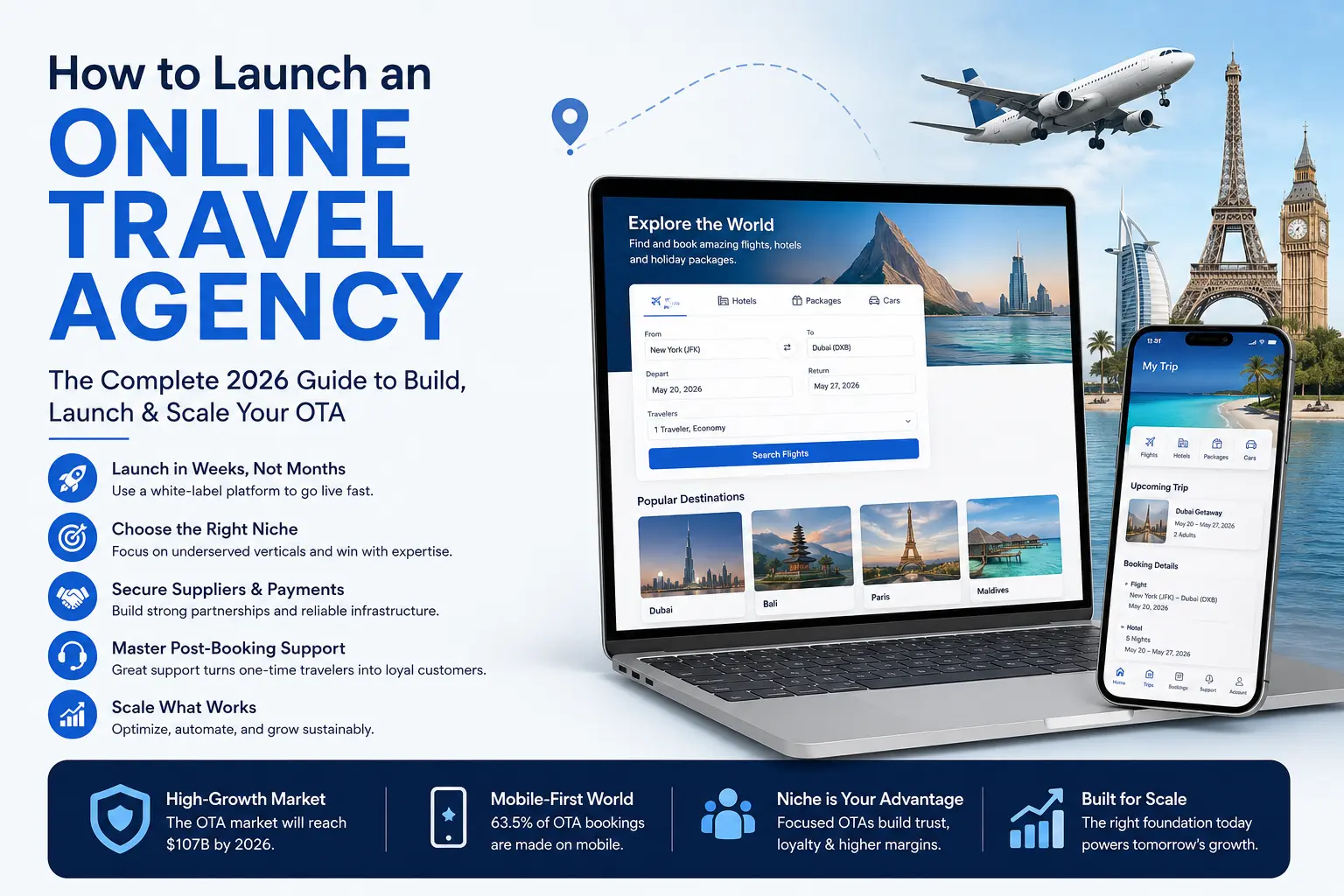
Skift Research projects the global online travel agency market will reach $107 billion by 2026, growing at a steady 7% year-over-year. Mobile has already taken over as the dominant booking channel. Mordor Intelligence confirms that mobile captured 63.5% of all OTA bookings in 2025, with that share continuing to rise through 2031.
This isn't a niche. It's infrastructure-level commerce.
The Gap the Giants Can't Fill
Here's the part the market reports won't tell you: Expedia and Booking.com don't own most of the inventory they sell. Their real competitive advantage isn't product access; it's distribution efficiency, brand trust, and a customer acquisition machine built over two decades of investment.
That's actually your opening.
A focused online travel agency built around a specific vertical, such as corporate travel, religious tourism, multi-generational family packages, and B2B agent consolidation, doesn't need to compete on inventory breadth. It needs to compete on trust, expertise, and precision within a defined audience.
The online travel agency sector is growing fast. But it rewards focused operators, not imitation of giants.
Choosing the Right Niche for Your Online Travel Agency
The single highest-leverage decision you make before building anything is choosing who you serve and being specific enough that it actually means something.
"Everyone who wants to travel" is not a niche. It's a market that Expedia, Booking.com, and Google Flights already own. The profitable lane for a new online travel agency is always a vertical with underserved needs, justified premium pricing, or distribution inefficiency that a focused operator can exploit.
High-Opportunity OTA Niches in 2026
Corporate and MICE travel: Complex multi-traveler itineraries with strict policy compliance, approval workflows, and reporting requirements create genuine value for a B2B-focused online travel agency. Corporate buyers aren't primarily price-sensitive; they're efficiency-sensitive. If your platform makes your travel manager's life easier, you win contracts that renew automatically.
Religious and pilgrimage travel, Hajj, Umrah, and religious tourism represent a global market with very specific inventory, timing, and compliance requirements that generic OTAs handle poorly. An online travel agency purpose-built for this vertical commands premium pricing and generates strong word-of-mouth within tight community networks.
Multi-generational family travel Large groups with mixed ages, mixed mobility requirements, and complex logistics that require genuine advisory expertise rather than just a booking engine. These packages carry far higher margins than point-to-point flight bookings and generate repeat business as families return for anniversaries, reunions, and milestones.
Halal and Muslim-friendly travel One of the fastest-growing segments in global tourism, with specific hospitality, dining, and activity requirements underserved by mainstream platforms. Agencies that build authentic supplier relationships in this vertical create switching costs that commodity OTAs can't replicate.
B2B consolidator and agent portal Rather than selling to end travelers, an online travel agency in this model sells to other travel agents, providing wholesale inventory access, markup tools, agent wallets, and credit management in exchange for volume. The unit economics are fundamentally different from B2C: lower acquisition costs, higher booking volumes per account, and stronger retention driven by operational dependency rather than price.
The Niche Selection Test
Before you commit to a vertical, answer three questions:
- Do people in this market trust generic OTAs? If not, there's a trust gap you can own.
- Does this vertical require expertise that a booking engine can't replace? If yes, your knowledge is a defensible margin.
- Is the customer acquisition cost lower within this niche than in the general market? Community networks, word-of-mouth, and existing professional relationships reduce CAC dramatically in tight verticals.
If you can answer yes to at least two of those three, you've found a niche worth building an online travel agency around.
What Nobody Tells You First (And Should)
The biggest mistake first-time online travel agency founders make is believing that search results are the hard part. In reality, supplier reconciliation, ticketing failures, and refund workflows create far more operational risk once real bookings start arriving. Before we get into architecture or launch steps, let's deal with what actually determines whether your online travel agency survives the first year.
Search Isn't the Hard Part, Supplier Data Normalization Is
Aggregating flight inventory sounds straightforward. It isn't.
Different GDS providers, Amadeus, Sabre, and Travelport, return different data formats, different pricing structures, and different availability models. Add NDC airline direct connections through aggregators like Duffel or AirGateway, and you're now normalizing multiple technical "dialects" of the same data into one consistent booking flow.
As the AcquaintSoft OTA architecture team documents from building over 1,300 software products, founders building OTA platforms often underestimate the integration layer. They usually plan the UI and booking flow well, but later face complex GDS APIs, hotel aggregator integrations, and real-time pricing sync challenges that expand the project scope.
This is the engineering reality most online travel agency guides don't mention. Build your timelines and your budget around it from day one.
Most OTA projects fail before the first booking
The pre-launch phase kills more online travel agency businesses than competitive pressure ever will. The failure modes aren't technical; they're operational.
The most common pre-launch failures we see:
- No confirmed supplier contracts before going live
- Payment gateways are rejected or misconfigured for travel merchant categories
- No formal customer support or dispute process in place
- Legal compliance gaps: IATA accreditation, travel seller licensing, and jurisdiction-specific requirements
- No reconciliation process for failed or partial bookings
Building a functional booking interface is genuinely the easy part. Securing the back-end relationships and processes that make bookings actually work consistently, at scale, under pressure, is where most online travel agency projects stall.
The Real Product Is Trust, Not Inventory
Here's the mindset shift that separates durable online travel agencies from platforms that launch and disappear:
Travelers don't buy flights. They buy:
- The certainty of a refund if plans change
- Support access when something goes wrong at 11 pm
- Reliability that the booking they made is confirmed and protected
- Confidence that the price they paid won't shift after purchase
An online travel agency that truly understands this positions itself differently in every dimension: marketing, technology investment, support staffing, and supplier relationships. The platforms that survive long-term treat post-booking operations as the core product, not an operational afterthought.
Your Three Paths to Launch: Build vs White Label vs SaaS OTA
There is no universal answer for how to build an online travel agency. There are only answers that match your current stage, capital position, and time-to-market requirements.
Here's the decision framework we use at TravelBookingPanel when working with founders across different launch scenarios:
| Path | Launch Time | Startup Cost | Control | Best For |
| White Label OTA | 2-4 weeks | $5K-$30K | Low-Medium | Fastest validation, brand-first launches |
| SaaS OTA Platform | 1-3 months | $20K-$80K | Medium | Growing agencies needing flexibility |
| Custom-Built OTA | 6-18 months | $180K-$300K+ | High | Enterprise builds, investors, consolidators |
When White Label Is the Smartest Move
White label is the right choice when your competitive advantage is distribution, branding, or customer relationships, not proprietary technology.
A white-label online travel agency gets you to market in weeks with GDS connectivity already built and tested, a booking engine ready to process live transactions, and a back office you can operate without an in-house engineering team. The trade-off is customization limits and dependence on your provider's roadmap.
If you're validating a niche, building a B2B agent network, or launching a brand where technology is the foundation rather than the product itself, white label gets you there faster and at a fraction of the cost of a custom build.
When SaaS OTA Platforms Make Sense
SaaS platforms sit between white label and custom builds. They give you more flexibility than a white-label template, configurable booking flows, more control over markups and agent hierarchy, and API access for extensions without requiring you to build core infrastructure from scratch.
For online travel agencies that have validated their model and are scaling toward a point where white-label constraints genuinely limit growth, SaaS is often the right intermediate step.
When Custom Build Is Justified
A custom-built online travel agency is the right call when proprietary product features, unique supplier contracts, or enterprise-scale automation create a real, defensible competitive moat.
But this needs to be said clearly: a custom build started too early is how most funded OTA projects lose their runway before finding product-market fit.
SilviGlobalTechnology's 2026 platform development analysis puts a production-ready GDS-based OTA platform with automated ticketing, cancellations, refund workflows, and a proper back office at $190,000 to $300,000+ before you've acquired your first customer. That's before marketing, supplier relationship development, or operational staffing.
Walk that road before validating that your target market actually converts, and you may be solving a problem that didn't need that level of engineering to solve. We cover this in detail in our guide on mastering online travel agency development without the $300K mistake, which is required reading before committing to a custom build path.
The Technical Architecture of an Online Travel Agency
You don't need to be an engineer to build an online travel agency. But you do need to understand the architecture well enough to make decisions that will shape your cost structure, your competitive positioning, and your operational risk for years.
GDS vs NDC: What They Are and Why It Matters
GDS (Global Distribution Systems), Amadeus, Sabre, and Travelport have dominated traditional travel distribution for decades. They aggregate airline inventory from thousands of carriers and deliver it through a single integration contract. For an early-stage online travel agency, GDS is the fastest path to broad, multi-airline content coverage.
NDC (New Distribution Capability) is the IATA standard for direct airline API connectivity. Instead of routing through a GDS middleman, NDC-connected platforms pull inventory directly from each airline's systems with richer fare content, real-time dynamic pricing, and ancillary products (seat upgrades, branded fares, and baggage bundling) that legacy GDS infrastructure can't carry.
According to HashStudioz's GDS vs NDC analysis, NDC bookings reached 34 million globally in 2023, just 2.3% of global air ticket sales, but are growing at a velocity that has prompted major carriers, including American Airlines, Lufthansa, and Singapore Airlines, to treat NDC as a primary distribution priority rather than an optional project.
The Practical Trade-Off Every OTA Founder Needs to Understand
GDS gives you breadth. One commercial contract, multi-airline inventory coverage, established fare rules infrastructure, and decades of operational reliability.
NDC gives you depth on specific routes, richer fare products, better ancillary revenue potential, and millisecond-level pricing updates. The cost is complexity: each airline implements NDC slightly differently, and each requires its own integration and commercial agreement.
Most production online travel agencies run both. GDS as the backbone for broad inventory coverage and NDC selectively on high-volume routes where direct airline content is commercially superior. The normalization layer that reconciles both sources into one consistent booking flow is where the real engineering investment lives.
The Five Non-Negotiable OTA Platform Modules
A platform missing any one of these five modules is not a production online travel agency. It's a prototype.
1. Search and Availability Engine
Receives traveler queries, sends them simultaneously to all connected supplier APIs, receives pricing and availability responses, and normalizes them into a ranked, comparable set of results in near-real time. The caching strategy is critical here. Too many live search calls against GDS APIs trigger rate limit penalties and incremental per-search charges that compound into real cost at volume.
2. Fare Rules Management
Every fare has attached conditions: minimum stay requirements, advance purchase windows, change fees, cancellation penalties, and blackout dates. Getting fare rules wrong doesn't just create customer disputes; it generates the kind of chargeback volume that gets your payment merchant account flagged or terminated.
3. Booking Processing
Captures the confirmed booking, transmits it to the supplier system, receives the PNR (Passenger Name Record), and stores everything with full session data. What sounds simple has real complexity: session timing, booking hold windows, and race conditions at the confirmation step cause silent failures that require manual intervention at exactly the highest-traffic moments.
4. Payment and Fraud Layer
Travel is one of the highest-risk merchant categories for card processors. Your payment infrastructure needs layered fraud screening, 3D Secure authentication, multi-currency settlement support, and a documented chargeback response process before you process your first live transaction. Configuring this after launch is too late.
5. Post-Booking Operations
Cancellations, refunds, ticket reissues, involuntary schedule change handling, settlement reconciliation, and BSP reporting. This is the module most online travel agency founders underinvest in and the one that determines whether customers return or dispute.
Most OTA content ends at the booking confirmation screen. That's where the operational complexity of running a real online travel agency actually begins.
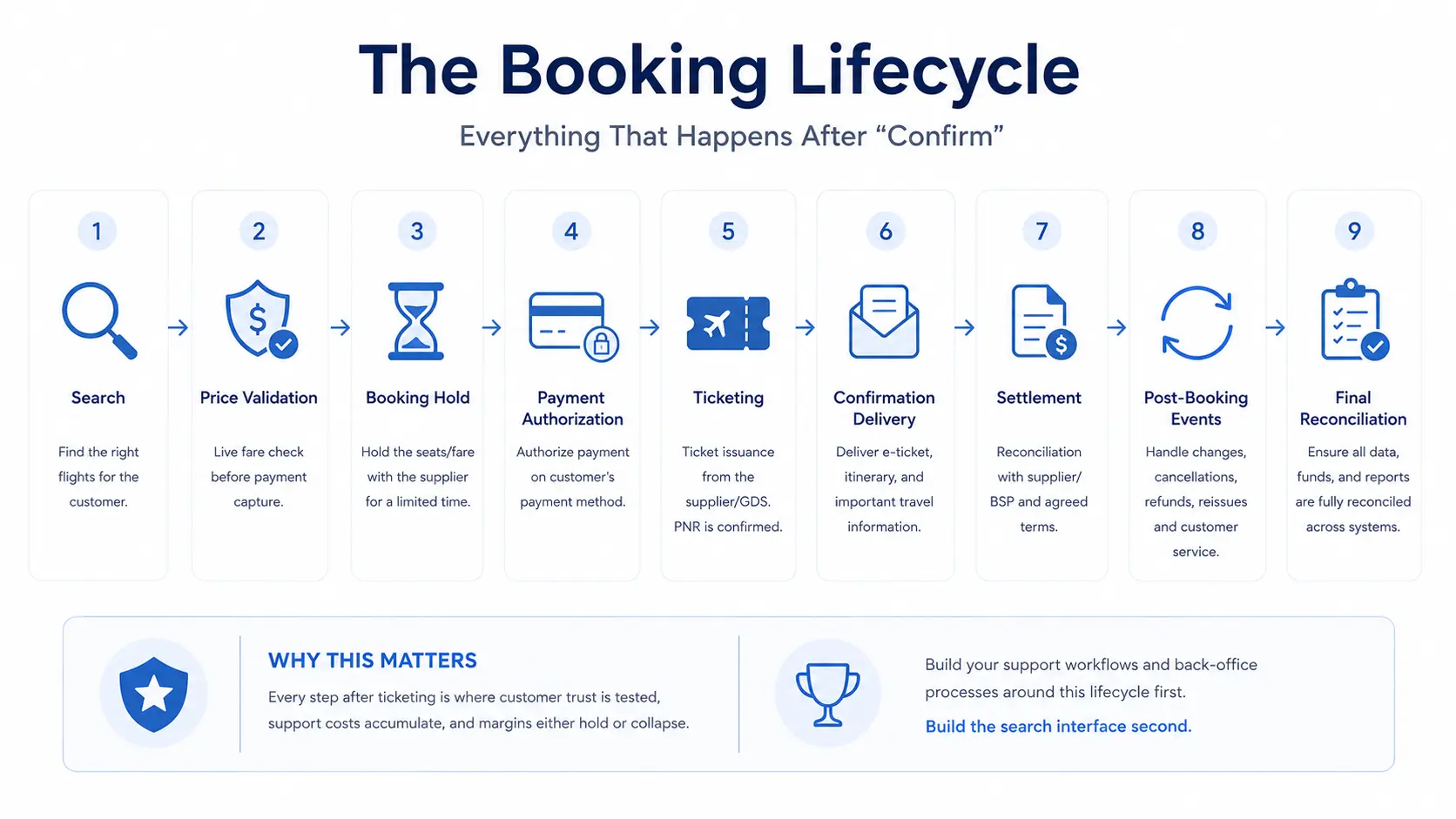
The Booking Lifecycle: Everything That Happens After "Confirm"
Here is the full lifecycle your platform and your team need to handle, not just the booking step:
OTA Unit Economics: The Numbers That Determine Everything
Here is the figure that most online travel agency content avoids publishing. A customer books a $500 flight through your platform.
| Line Item | Amount |
| OTA commission (3% net) | +$15.00 |
| Customer support cost | −$4.00 |
| Payment processing fees | −$3.00 |
| Marketing / customer acquisition cost | −$10.00 |
| Net margin per booking | −$2.00 |
On a single booking, at typical commission and cost structures, you are operating at a loss.
What These Numbers Actually Mean
This isn't an argument against building an online travel agency. It's an argument for understanding what makes OTA economics work because every business decision you make flows from this math.
Profitable online travel agencies generate margin through:
- Volume High throughput amortizes GDS platform fees, engineering costs, and support staffing across more transactions
- Ancillary seat upgrades, travel insurance, hotel bundling, and baggage add-ons carry margins that can be 3-8x higher than base flight commissions
- Repeat and loyalty Customer acquisition cost is front-loaded; every repeat booking from an existing customer dramatically improves your per-customer economics
- B2B and agent models: Agent portal businesses with markup control, wallet-based credit systems, and volume-based GDS rebates change the unit economics entirely
If your online travel agency plan is to compete on base fare price, the math will end the business before operations do. If you're entering with a loyalty-first, ancillary-rich, or B2B-weighted model, the economics become defensible at scale.
We break down exactly how to build toward that position in our piece on how your online travel agency can beat the big players.
Real OTA Failure Stories: What the Case Studies Leave Out
The online travel agency industry has a publishing problem: success stories are everywhere. Honest failure post-mortems are almost nowhere. These scenarios are drawn from patterns we've seen repeat across platforms that looked ready to launch.
Supplier Bankruptcy Mid-Season
One online travel agency built its hotel inventory around a single bedbank relationship. When that supplier entered administration during the mid-summer peak season, confirmed bookings became unconfirmed without warning. With no secondary supplier API, no contingency inventory, and no customer communication process, the resulting chargeback volume triggered a payment gateway review that froze the merchant account during the highest-revenue weeks of the year.
The fix isn't complicated multi-supplier redundancy for any inventory category driving more than 30% of your bookings, but it requires a decision at the architecture stage, not after the crisis.
The Payment Gateway Termination
Travel merchant accounts are scrutinized at a different level than standard e-commerce. Several online travel agency founders we've worked with launched using standard payment processor accounts that weren't configured for travel merchant category codes.
Within weeks of live operations, chargeback rates exceeded the processor's thresholds. Travel naturally generates more post-purchase disputes than physical goods. Accounts were terminated. The platform went dark for three weeks while replacement infrastructure was sourced and integrated. The revenue and customer trust lost in that window were unrecoverable.
The Fare Mismatch Incident
Fares expire. A customer searches, the browser session times out, they return and complete a booking, but the fare cached in the system is no longer the live price. The booking processes at the old rate, tickets at the current rate, and the online travel agency silently absorb the difference.
At low volume, this is a minor operational nuisance. At scale, particularly during flash sales or peak booking periods when fare movement is fastest, it becomes a margin crisis when reconciliation reports surface weeks after the damage is done.
Automated fare validation at the ticketing step is not optional. It's the difference between an audit finding and a sustainable operation.
What You Actually Need Before Your First Booking
This is the pre-launch checklist that most online travel agency content skips in favor of talking about marketing.
Legal and Licensing Essentials
- Business registration in your operating jurisdiction (LLC, Ltd., or equivalent).
- IATA/ARC accreditation or access to airline ticketing through a white-label provider or host agency.
- Travel seller license where required; California, Florida, Hawaii, Iowa, and Washington have specific registration requirements; many international markets have equivalent obligations.
- Terms of service and refund policy reviewed by travel-specialist legal counsel, not assembled from generic templates.
Supplier and Payment Partnerships
- GDS commercial agreement (Amadeus, Sabre, or Travelport) or white-label platform access with GDS connectivity included
- Hotel and ground inventory API (Hotelbeds, Expedia Partner Solutions, or a similar bed bank)
- Travel-specialist payment gateway with fraud screening, 3DS authentication, and chargeback management capability
- BSP (Billing and Settlement Plan) setup if your platform will issue airline tickets directly
- Secondary supplier relationship for your primary inventory category redundancy before launch, not after a crisis
Support Infrastructure
- 24/7 coverage protocol for flight disruptions, cancellations, and emergency rebooking. Travelers have problems at 2 am, not just during business hours
- Ticketing queue process for manual intervention when automated ticketing fails
- Refund and dispute workflow documented, assigned, and tested before you take your first live booking
- Agent escalation path for edge cases requiring GDS or supplier direct intervention
Technology Checklist
- Booking engine with search, booking, ticketing, and post-booking modules
- Admin and back-office panel for markup control, agent hierarchy, and booking management
- Reporting and reconciliation dashboard, you need real-time visibility into what's been sold, ticketed, and outstanding at any moment
Expert Perspective: What We've Learned at TravelBookingPanel
At TravelBookingPanel, we've worked with online travel agency founders across multiple market stages, from first-time travel entrepreneurs validating a niche to established operators rebuilding on modern infrastructure.
The most consistent pattern: founders underestimate post-booking operational complexity and overestimate how much the search experience affects initial conversion.
Why We Built a White-Label-First Model
Our white-label approach was built specifically for online travel agency founders who need to move fast without burning capital on infrastructure problems that are already solved.
GDS connectivity, booking engines, back-office architecture, multi-currency support, and agent hierarchy management don't need to be invented. The question isn't whether to build them from scratch. It's whether building them yourself creates a competitive advantage in your specific market at your current stage.
For the majority of online travel agency launches, it doesn't. What creates competitive advantage is the supplier relationships you develop, the customer trust you earn, the niche you own clearly, and the support experience you deliver consistently.
Technology should be the foundation. Not the focus.
The Most Common Architecture Mistake We See
The most expensive mistake we see online travel agency founders make at the architecture stage isn't choosing the wrong GDS or underestimating API complexity. It's building the customer-facing booking interface before defining the post-booking operational workflow.
Here's why that order of operations matters: the front-end booking flow determines what data you collect. The post-booking workflow determines what data you actually need. Build the UX first, and you'll spend the next six months retrofitting the back office to handle edge cases your search UI wasn't designed to capture.
The correct build order is:
- Define your post-booking operations workflow (refunds, cancellations, changes, reconciliation)
- Work backward to determine what data the booking step must capture
- Build the booking interface around those data requirements
- Build the search interface that feeds cleanly into the booking step
Most teams do this in reverse and pay for it in operational complexity later.
The Question Worth Asking Before You Commit
Before you choose a technology path, ask this honestly: if we replace our tech stack 24 months from now, do our customers come with us?
If the answer is yes because they stay for your expertise, your relationships, and your service experience, your technology decision is primarily about speed and capital efficiency, not a competitive moat. White label or SaaS is almost certainly the right starting point.
If the answer is no because the technology itself is the product, and switching costs are embedded in the platform, then proprietary development is genuinely justified. Most online travel agency businesses are in the first category. Know which one you're building before you spend.
Frequently Asked Questions
How much does it cost to start an online travel agency?
Startup costs span a wide range depending on your model and ambitions:
- Home-based agent via host agency: $500-$3,000 covers domain registration, website setup, legal registration, and basic tools. Most home-based operators are running for under $2,000 in year one.
- White-label online travel agency: $5,000-$30,000 depending on platform, GDS access tier, and customization requirements.
- SaaS OTA platform: $20,000-$80,000 for a mid-range build with booking engine, payment integration, agent management, and API connectivity.
- Custom-built online travel agency: $180,000-$300,000+ for a full GDS-integrated production platform with automated ticketing, post-booking workflows, and enterprise-grade back office.
The "start for free" question gets a direct answer: you can technically begin as a travel agent with zero upfront capital by joining a host agency that provides IATA access and booking infrastructure in exchange for a commission split (typically 10-30% of your earnings). At low volume, that trade-off is entirely reasonable. At scale, owning your own platform changes the economics significantly.
Can I run an online travel agency from home?
Yes, and in 2026, this is the norm rather than the exception.
According to MainStreet Travel Agency's research, 72% of travel advisors now operate from home. Modern booking platforms, cloud-based back-office systems, and GDS access through host agencies or white-label partners have made physical office space genuinely unnecessary for most online travel agency operations.
What a home setup requires: reliable, redundant internet connectivity for booking operations, a dedicated professional communication setup for client interactions, and, critically, a plan for 24/7 support coverage. Travel disruptions happen outside business hours, and a home-based online travel agency without an after-hours support protocol will generate the kind of reviews that stall growth.
The practical growth ceiling for home-based operations typically appears around booking volume. Once you're processing significant transaction numbers, reconciliation and ticketing queue management generally require a small dedicated team, even if they're entirely remote.
What do I need to start an online travel agency?
The six non-negotiables before taking your first live booking:
- Legal entity and registration: a formally registered business with a proper operating structure (LLC, Ltd., or equivalent), not a personal account.
- Supplier access confirmed GDS access directly or through a host agency or white-label provider. Without supplier connectivity, your booking interface has nothing to sell.
- Booking technology: a platform covering search, booking, ticketing, and post-booking operations. The right choice between white-label, SaaS, and custom depends entirely on your timeline, capital, and growth stage.
- Travel-specialist payment infrastructure, a gateway configured specifically for travel merchant category codes, with fraud screening and chargeback management built in. This is more complex than a standard e-commerce payment setup and needs to be confirmed before launch.
- A documented refund and dispute process is trained, assigned to a responsible owner, and ready before the first booking is taken. Customers who experience problems and receive an excellent resolution become your most loyal repeat travelers. Customers who experience problems and hit friction become chargeback filings.
- Support coverage protocol, at a minimum, a documented response path for urgent travel disruptions that occur outside normal business hours. This doesn't require a 24-hour call center, but it does require a plan.
Key Takeaways
The online travel agency market in 2026 is large, growing, and genuinely accessible to well-positioned new entrants. But the path to a durable, profitable online travel agency looks very different from what most content describes.
Here's what actually determines whether your online travel agency survives:
- Unit economics demand a volume or ancillary strategy from day one. A single booking rarely makes money. Sustainable OTA businesses are built on repeat customers, bundled products, and operational efficiency that compounds over time.
- Your build path sets the ceiling. White label to validate fast, SaaS to grow with flexibility, and custom to scale when you have proof. Rarely in reverse, starting with a custom build before validating the market is how OTA founders burn runway on solved problems.
- Most failures happen before launch, not after. Missing supplier contracts, unvetted payment gateways, and no post-booking support process are the most common causes of early online travel agency failure, not weak search interfaces or poor UX.
- Post-booking is the real product. Search is the front door. Refunds, support, reconciliation, and reliability are what travelers actually experience and what they tell others about.
- Trust is the durable competitive advantage. Not inventory breadth. Not price. The online travel agency that consistently delivers reliable, supported, refund-ready experiences wins regardless of size because it's building something Expedia can't buy it back once you own it.
Own Your Travel Platform. Forever.
Buy once, own forever. Full source code · No monthly fees · No hidden charges.