

Every year, thousands of entrepreneurs look at the travel industry and see the same thing: massive demand, thin margins for middlemen, and a handful of giants c...
Every year, thousands of entrepreneurs look at the travel industry and see the same thing: massive demand, thin margins for middlemen, and a handful of giants collecting most of the revenue. What they also see correctly is a market with real cracks in it. American travelers are increasingly skipping Expedia and Booking.com for niche platforms that actually understand their trip type.
B2B travel agents in Dallas and Miami are looking for booking portals that give them pricing control. Umrah operators in New York and Chicago are building online booking infrastructure from scratch. The opportunity for a new online travel agency in the US market is real. The gap is knowing how to build one that doesn't collapse under its own weight by month six.
Let's cover exactly what an online travel agency is, how the US market is structured, how OTAs generate revenue, what the technology actually has to do, and where most builds fall apart before they ever find a customer.
What Is an Online Travel Agency?
An online travel agency is a digital platform that aggregates travel inventory from multiple suppliers, airlines, hotels, car rentals, tour operators, and transfer services and sells that inventory to consumers or business agents through a single, self-service booking interface.
The traveler searches, selects, pays, and receives a confirmation without ever leaving the platform. That end-to-end transaction ownership is what defines an online travel agency. It's also what separates it from every related model that gets confused with it.
OTA vs Metasearch Engine
A metasearch engine, such as Google Flights, Kayak, and Hopper, shows you prices from multiple sources and then sends you somewhere else to actually book. An online travel agency owns the booking flow.
The payment, the PNR, and the confirmation email, all of it happens inside the OTA's platform. This distinction matters because the business model, the tech stack, and the regulatory requirements are entirely different between the two.
OTA vs Traditional Travel Agent
A traditional travel agent in, say, Orlando or Phoenix provides human-assisted trip planning. They're on the phone, building itineraries, and negotiating rates manually. An online travel agency automates that entire process digitally. Customers in Los Angeles, Houston, or Atlanta can book a flight and hotel in under five minutes without speaking to anyone.
That said, many modern OTAs serve both segments, a consumer-facing B2C portal and a B2B agent dashboard in the same platform, each with different markup rules and inventory access.
OTA vs Tour Operator
A tour operator creates and packages their own proprietary travel products, a 7-day Costa Rica eco-tour and a New England fall foliage package, and sells those directly. An online travel agency resells third-party inventory. It doesn't manufacture the product.
It curates, marks up, and delivers it. Some platforms blur this line by offering both, which is where dynamic packaging comes in. More on that in the revenue section.
The US Online Travel Market in 2026
Before building an online travel agency for the US market, it helps to understand exactly what you're entering.
Market Size and Growth
The global online travel agency market was valued at USD 663.70 billion in 2025 and is projected to reach USD 1.31 trillion by 2033, growing at a CAGR of 9.0%. OTAs specifically hold the dominant share of that market. The OTA segment commanded 56% of the global travel market in 2025 and is projected to expand at 7.6% annually through 2035.
The United States is the largest single national market, with US-based OTA bookings generating approximately USD 203.2 billion in 2025. That figure puts the US ahead of every other country in both volume and digital adoption rate.
Who's Booking Online in America
American consumer behavior is decisively digital and mobile. Over 52% of all OTA bookings now happen through mobile apps, driven by biometric checkout, real-time price alerts, and loyalty integration.
By 2026, online bookings are expected to account for 65% of all travel reservations worldwide, up from 61% in 2023. Critically for niche OTA builders: 47% of Americans under age 35 now turn to travel agents, including OTAs, for holiday travel bookings. That's a generation that's comfortable with digital booking but wants curation, not just price comparison.
The Business Travel Layer
Global business travel spending reached USD 1.5 trillion in 2025, with a significant portion shifting to digital platforms that can enforce corporate policy while simplifying booking for the traveler.
For an online travel agency targeting the US business travel segment, corporate teams in New York, tech companies in San Francisco, and consulting firms in Chicago, the addressable market is substantial and underserved by the consumer-first giants.
How Online Travel Agencies Make Money
Revenue in the OTA model doesn't come from one source. Most successful platforms run multiple streams simultaneously, with the mix shifting as the business scales.
The Merchant Model
In the merchant model, the online travel agency acts as the merchant of record. The platform purchases inventory at contracted net rates, hotel room allotments, and airline seat blocks, applies a markup, and displays the customer-facing sell price. Payment is collected at booking. The supplier is paid after service delivery.
Margin potential here is the highest of any OTA model. Expedia's merchant model contributed approximately 64% of its total revenue in a recent fiscal year. The trade-off is inventory risk. If allotted rooms don't sell, the OTA absorbs the cost. Rate management and demand forecasting become operational necessities, not nice-to-haves.
For a regional US operator with established supplier relationships, say, a platform focused on Caribbean resort travel out of Miami or Florida-based charter tour packages, the merchant model can be profitable from the first year.
The Agency (Commission) Model
In the agency model, the online travel agency acts as a pure intermediary. The supplier controls pricing. Commission is collected after the transaction completes, typically 8-15% for hotels, varying by supplier for flights.
This model carries minimal financial risk and was the architecture Booking Holdings used to rapidly scale its hotel inventory. Hotels preferred it because they retained pricing control and didn't need to offer wholesale rates upfront.
Most new OTAs entering the US market start here, then graduate to the merchant model as supplier relationships deepen, and volume justifies inventory commitments.
Ancillary Revenue Streams
Beyond the two core models, mature online travel agencies generate meaningful income from additional streams. Travel insurance upsells, offered at checkout, carry margins of 20-40% and require no additional supplier infrastructure. Advertising and featured listings let hotels and airlines pay for priority placement in search results. This mirrors what Google Hotels and TripAdvisor have monetized aggressively.
Subscription access for B2B agents, with a monthly or annual fee for access to wholesale pricing tiers, creates predictable recurring revenue on top of per-booking commission. Dynamic packaging bundles flights and hotels into a single transaction where the blended margin often exceeds what either component earns when sold separately.
The Technology Behind Every OTA
This is where most founders underestimate the scope of what they're building. The user interface is straightforward. The infrastructure underneath it is not.
Supplier Connectivity Layer
An online travel agency has nothing to sell without supplier connections. For flights, the three dominant GDS providers, Sabre, Amadeus, and Travelport, provide real-time fare data, seat availability, and reservation capability across thousands of airlines. NDC consolidators like Duffel and Mystifly offer an alternative with richer fare attributes and direct airline relationship data.
Most US-market OTAs serving both leisure and corporate segments need both GDS and NDC access. GDS provides depth and reliability. NDC provides differentiation. For hotels, the primary access points are Bedbanks, Hotelbeds, RateHawk, WebBeds, and Agoda. Each has different property coverage across US cities and international markets. Connecting to a single bedbank limits your inventory depth significantly.
Multi-bedbank setups require a rate normalization layer, a unified schema that maps different API response formats into a consistent internal data model. Getting this right at the architecture stage saves weeks of engineering later.
Booking Engine and PNR Management
The booking engine manages the sequence that looks simple to the traveler but involves several failure-prone transitions internally. A search request triggers a real-time availability call to connected suppliers. Rates are returned and displayed. A hold is placed on the selected option. A Passenger Name Record (PNR) is created in the supplier's system. Payment is processed. Confirmation is issued.
The most common failure point is between PNR creation and payment confirmation. If payment fails after the PNR is created and the webhook retry policy is weak, you get ghost bookings: confirmed in the supplier's system, unpaid in yours. Manual reconciliation has to catch and resolve those mismatches.
For an online travel agency processing bookings from customers in New York, Los Angeles, and Chicago simultaneously, this failure at scale is not a minor inconvenience. It's a financial liability.
Markup Engine and Pricing Rules
The markup engine sits between the net rate received from suppliers and the price displayed to customers or agents. A basic implementation applies a flat percentage. A production-grade engine layers rules: B2C consumers see different margins than B2B agents. US-market customers see different pricing from international customers. Promotional overrides apply time-limited discounts.
The edge case that causes silent revenue leakage is rule conflict. If a B2B agent markup rule (apply 12% over net) overlaps with a promotional rule (apply 8% over net this weekend) without a defined priority hierarchy, the lower-margin rule wins by default. No error. No alert. Just margin erosion that compounds over time. Define the rule priority hierarchy before the first pricing rule is written.
Back-Office Reconciliation
Reconciliation is the most underestimated operational burden in running an online travel agency. Every booking generates at least three records: the PNR in the supplier's system, the payment transaction in the gateway, and the booking record in your database. In a high-volume US operation, all three must match.
When they don't, due to cancellations, refunds, partial payments, or failed webhooks, the discrepancy has to be found, diagnosed, and corrected. As documented in ZealConnect's reconciliation analysis, a single booking can generate invoices from five different suppliers, each with different billing cycles, commission structures, and reference systems.
Add multi-currency transactions, dynamic currency conversions, and GDS BSP/ARC settlement requirements, and reconciliation becomes a continuous workload, not a monthly task. The pattern that works: automate PNR-level matching at booking creation. Run daily exception reports, flagging mismatches by booking ID. Resolve exceptions within 24-48 hours. Agencies that push reconciliation to month-end find the error volume too high to investigate meaningfully.
The Gap in the Market and Why Most OTA Builds Fail
Here's the honest reality of launching an online travel agency in the US in 2026. The technology decisions made in the first 30 days of the build determine whether you're scaling at month 12 or rebuilding from scratch.
The SaaS Problem
SaaS-based travel agency software platforms offer fast deployment. Most can be configured and launched in days. What they don't offer is ownership. You can't modify the checkout flow without filing a feature request. You can't add a US-specific payment method, such as Apple Pay, ACH transfer, or buy-now-pay-later, without waiting on the vendor roadmap. You can't run A/B tests on your pricing display because the pricing display isn't yours.
Booking abandonment across the travel sector sits around 85%. The agencies that convert better iterate on their checkout flows, search result pages, and pricing displays weekly. SaaS platforms make that cadence impossible. For an online travel agency trying to compete in the US market, where Expedia and Priceline have spent billions optimizing conversion, surrendering iteration speed to a vendor is a growth ceiling with no workaround.
The Custom Build Problem
Full custom development solves the ownership problem. It creates a different one. A production-grade custom OTA build for the US market with proper GDS connectivity, a multi-bedbank normalization layer, markup engine, agent portal, and reconciliation system costs USD 80,000-200,000 and takes 9-18 months.
Most founders don't have that runway. And even those who do frequently underestimate the supplier integration scope, resulting in overruns that push the launch timeline back further. The gap in the market is real: there's nothing between "fast to launch, impossible to own" and "fully ownable, impossible to afford."
TravelBookingPanel: Built for Founders Who Want to Own
TravelBookingPanel is a white-label travel agency software platform that closes that gap. The model is simple: one-time payment, full source code delivered, no ongoing licensing fees, no subscription, no vendor dependency.
What's Included
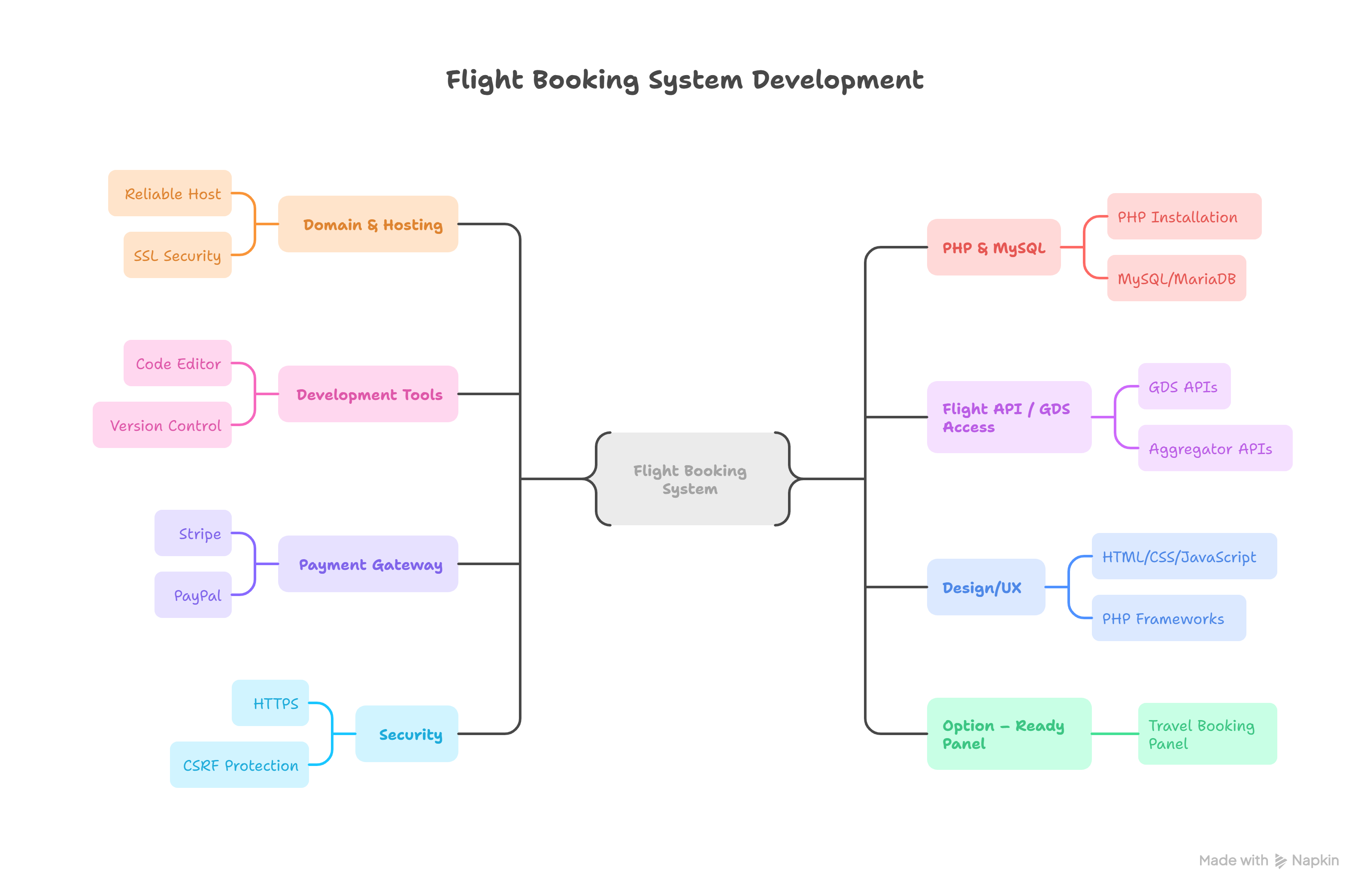
The platform ships with the infrastructure layers that take custom builds 6-12 months to build. GDS and NDC supplier connectivity. Multi-bedbank hotel aggregation with a normalized rate layer. A multi-tier markup engine with configurable rule hierarchies. A B2B agent portal with tiered pricing access. Back-office reconciliation tooling. SEO-ready technical architecture out of the box.
Deployment takes 15 minutes. Supplier onboarding and market-specific customization follow at the buyer's pace, not a vendor's. The platform has been deployed across 500+ agency configurations globally, including B2C travel portals, B2B agent systems, Umrah booking platforms, and multi-supplier hotel search engines.
Who It's For
TravelBookingPanel is built for three buyer profiles.
- The first is the travel entrepreneur entering the US market who needs production-grade infrastructure without a 12-month build timeline. Getting to market in weeks instead of months is the difference between capturing a seasonal opportunity and missing it.
- The second is the existing travel agency or operator in New York or Atlanta running bookings manually or through a SaaS tool that needs a platform they can actually control, modify, and grow into.
- The third is the developer or agency building a travel product for a client. White-label, rebrandable, and fully owned.
Pricing That Makes Sense
The Starter plan (Launch Suite) is USD 1,599. The Agency Pro plan is USD 2,999. Enterprise Plus is USD 4,999. Compare that to 12 months of SaaS travel agency software at USD 400-800 per month, or USD 4,800-9,600 spent with nothing owned at the end of it.
The math is straightforward. The ownership is permanent.
How to Launch an Online Travel Agency That Wins in the US Market
Architecture is the foundation. But how you position and grow the platform determines whether anyone ever books through it.
Define Your Niche Before You Build
The US travel market is not one market. It's hundreds of overlapping niches, most of them underserved by the incumbents. Corporate travel for mid-market companies in Chicago and Dallas, teams of 20-200 employees who need policy enforcement without enterprise pricing.
Niche leisure travel: ski packages out of Denver, all-inclusive Caribbean trips from Miami, and national park tours from Las Vegas. Religious travel: Hajj and Umrah packages for the large Muslim-American communities in New York, New Jersey, Michigan, and Texas.
Luxury travel for high-net-worth clients who want a curated, high-touch booking experience that neither Expedia nor American Express Travel delivers well. Pick the segment before you design the tech. The niche defines the supplier relationships, the markup model, the content strategy, and the acquisition channel.
Build for US Payment Methods and Mobile Checkout
American consumers expect specific payment options. Credit cards, Apple Pay, Google Pay, and buy-now-pay-later (Affirm, Klarna) are table stakes for a US-market online travel agency.
Mobile bookings account for over 52% of all OTA transactions. A checkout flow that isn't optimized for a 375px screen is losing more than half its potential conversions before they start. Build the mobile checkout before the desktop checkout. Then optimize from there.
Drive Organic Traffic Through Programmatic SEO
Paid search for travel keywords in the US is one of the most expensive digital advertising environments on the planet. The alternative is a content infrastructure built for organic search and AI-generated results.
Programmatic SEO means thousands of indexable destination pages, "flights from New York to Cancun in March," "hotels near the Las Vegas Strip under $150," "3-day Chicago itinerary for families," each targeting a specific search intent.
No single page generates significant traffic. The aggregate of thousands does. Supporting content clusters, visa requirement guides, destination comparisons, and travel insurance explainers build topical authority that makes every other page on the site rank better.
Optimize for AI Search Distribution
Expedia's CEO stated publicly in 2025 earnings calls that consumer search behavior is shifting toward ChatGPT, Perplexity, and other AI platforms and that the strategic response is ensuring brand visibility in those channels.
For a new online travel agency, this means structuring content for AI extraction: direct answers to specific questions, named entities, and clear factual claims with cited sources. An AI overview or ChatGPT response that mentions your platform by name to someone asking, "What's the best online travel agency for corporate travel?” is worth more than a page-3 Google ranking.
Structure your content accordingly. Answer questions directly. Cite your sources. Name the entities, cities, supplier names, and price ranges that AI models use to verify factual accuracy.
Frequently Asked Questions
What does an online travel agency do?
An online travel agency aggregates flights, hotels, car rentals, and travel experiences from multiple suppliers into a single booking platform. Travelers search, compare, and book entirely within the platform. The OTA handles payment, confirmation, and post-booking support.
How much does it cost to start an online travel agency in the US?
Costs depend on the technology approach. Custom builds typically run USD 80,000-200,000 and take 9-18 months. SaaS platforms require no upfront investment but charge USD 400-800+ monthly with no code ownership. Source-code platforms like TravelBookingPanel offer a one-time investment starting at USD 1,599, with full ownership and no ongoing licensing fees.
What travel agency software do US OTAs use?
Larger OTAs use custom-built stacks combining GDS middleware, proprietary booking engines, payment gateways, and in-house back-office tools. Smaller and mid-market OTAs use white-label travel agency software platforms that bundle these components under one owned codebase, significantly reducing integration time and initial capital requirements.
Can a new online travel agency compete in the US market?
Not on bread against Expedia or Priceline; that's a USD 20 billion marketing problem. The viable path is niche authority: serving a customer segment the majors underserve. Corporate B2B portals with policy enforcement, Umrah platforms with visa integration, luxury travel with curated inventory, and regional operators with local payment methods all represent segments where a focused online travel agency outperforms the incumbents in conversion and customer satisfaction.
How long does it take to launch an OTA?
With a source-code platform, deployment takes days to weeks. Supplier API onboarding GDS, bedbanks, and payment gateways typically adds 2-6 weeks, depending on the provider's approval timeline. A full custom build takes 9-18 months. The time-to-market gap between approaches is typically 6-12 months, which can mean the difference between capturing a market window and missing it.
What is the difference between an OTA and a metasearch engine?
An online travel agency handles the entire transaction: search, booking, payment, and confirmation occur within the platform. A metasearch engine only surfaces prices and sends the user to an OTA or supplier to complete the booking. OTAs collect commission or margin. Metasearch platforms collect referral fees per click.
Own Your Travel Platform. Forever.
Buy once, own forever. Full source code · No monthly fees · No hidden charges.

.png)