An OTA platform development is a multi-layer digital infrastructure that aggregates real-time travel inventory from airlines, hotels, and ancillary suppliers, p...
An OTA platform development is a multi-layer digital infrastructure that aggregates real-time travel inventory from airlines, hotels, and ancillary suppliers, presents it through a unified search and booking interface, and processes end-to-end transactions from fare display to payment to confirmation. In 2026, building one means making high-stakes architectural decisions before you write a single line of code. Get them wrong, and no amount of marketing fixes it.
The travel tech market is no longer forgiving of "we'll fix it in v2" thinking. With global travel technology projected to exceed USD 22 billion by 2032, the gap between platforms that scale and platforms that buckle under traffic is now a business model question, not a technical one.
This guide breaks down what OTA platform development actually involves in 2026: the architecture, the integration reality, the white-label vs custom decision, and the mistakes that cost travel startups six figures before their first hundred bookings.
What Is an OTA Software Platform? (The Real Answer)
Most definitions stop at "a website where people book flights and hotels." That's like describing a bank as “a place that holds money.”
An OTA software platform is three interconnected systems running simultaneously:
- A front-end booking layer, the search interface, results display, cart, checkout, and confirmation flow that travelers see.
- A back-end booking engine, the logic that fires supplier queries, normalizes responses, enforces pricing rules, manages PNR (Passenger Name Records), handles cancellations, and issues vouchers.
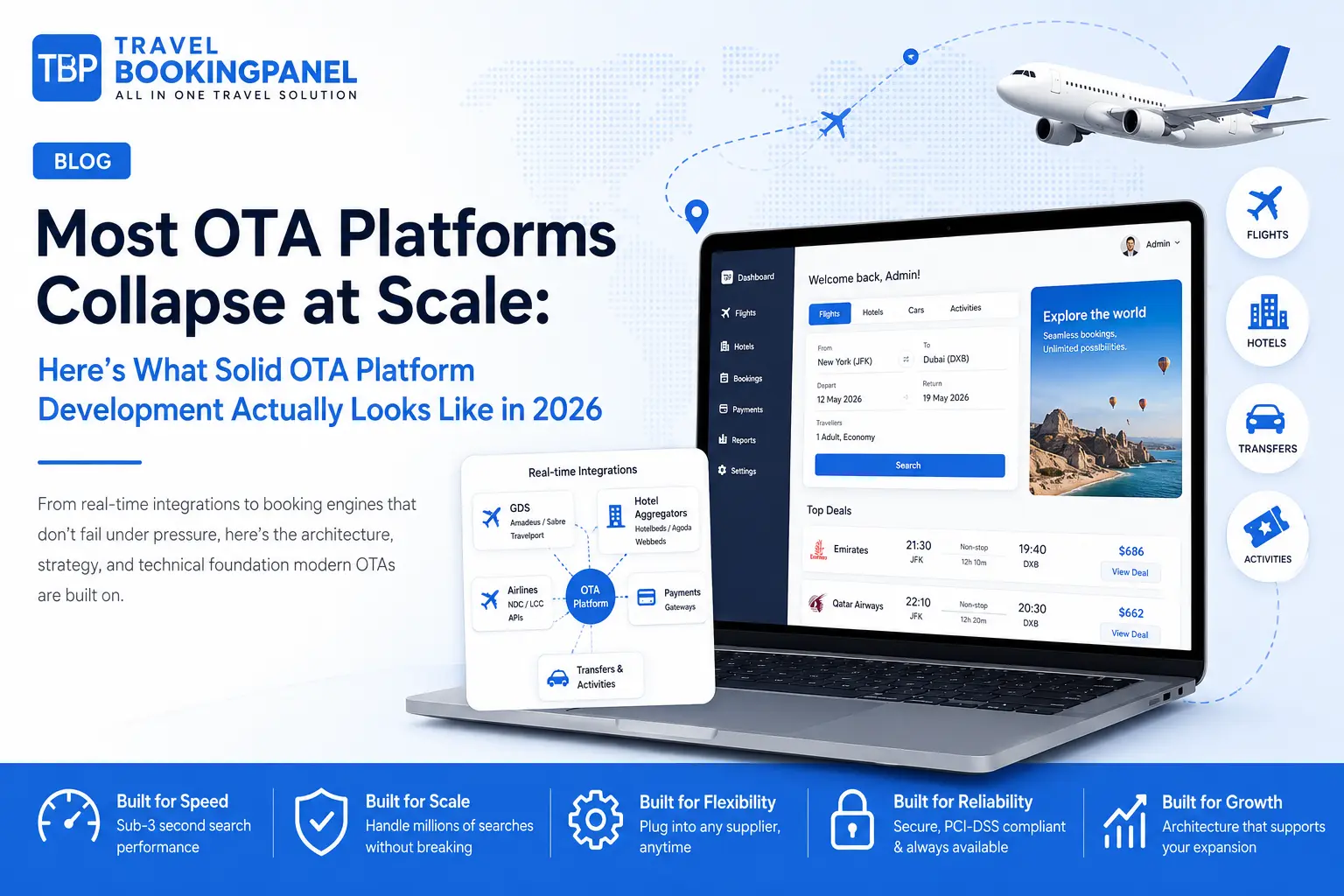
- A connectivity layer, the integration mesh connecting your platform to GDS systems (Amadeus, Sabre, Travelport), hotel aggregators (Hotelbeds, Agoda, Webbeds), low-cost carrier APIs (Duffel, airline-direct NDC feeds), payment gateways, and transfer or activity providers.
Remove any one layer, and you don't have a slightly incomplete OTA. You have a prototype that fails in production.
How an OTA Platform Actually Processes a Booking
Understanding the technical flow is what separates founders who make good architecture decisions from those who discover expensive problems six months post-launch.
Here's what happens in the roughly three seconds between a traveler clicking "Search" and results appearing on screen:
- The search module receives the query (origin, destination, travel dates, passenger count)
- It fires requests simultaneously to all connected supplier APIs, GDS for flights, aggregators for hotels, and direct connections, where available
- Each supplier returns availability and pricing data in its own format and schema
- A normalization engine maps all responses into a unified data structure
- A caching layer filters the response to avoid redundant live API calls (static data like routes cached for 24 hours; dynamic data like pricing cached for 5-15 minutes with background refresh)
- Filtered, normalized, and ranked results return to the front end
That three-second window is not a UX preference; it's a hard commercial threshold. According to architecture data from large-scale OTA builds, every additional second of search latency reduces booking conversion by 7% to 12%. At meaningful booking volumes, that's not a metric problem. It's a revenue problem.
The caching architecture alone is a week-long engineering decision. Bypass it, and your GDS rate limits get hit within hours of launch. Get it wrong, and travelers see stale prices that don't match what the supplier actually confirms, a failure state that triggers complaints, chargebacks, and supplier penalty clauses simultaneously. The connectivity layer is what separates the platforms that work from the ones that look like they work during a demo. It's also where OTA platform development budgets quietly double.
The Three Layers of an OTA Platform Development (And What Each One Demands)
A clean way to think about OTA platform development is through the three core layers every production platform needs: front end, back end, and connectivity.
The Front End: More Than a Booking Widget
The customer-facing layer handles search, results filtering, product display, upsell/cross-sell, checkout, and post-booking self-service. In 2026, "mobile-first" is not a feature; it's the default. Over 60% of room nights on major OTA platforms already come from mobile devices, and the gap is widening.
The front end must handle the following:
- Multi-currency display and real-time conversion
- Multi-language rendering (including RTL languages like Arabic, which require full layout restructuring, not just a translation toggle)
- Accessibility compliance
- Speed: Core Web Vitals scores directly affect organic search rankings on Google, making front-end performance an SEO lever, not just a UX one
What founders underestimate: Arabic RTL support is not cosmetic. It requires rearchitecting your data flow, UI component library, and PDF/voucher generation stack. Platforms that try to bolt it on post-launch consistently run into rendering failures in booking confirmations and PDF itineraries.
The Back End: The Booking Engine Is the Business
The booking engine is the most business-critical component of OTA platform development. It's the rule-enforcing, transaction-managing core that turns a search result into a confirmed booking.
It must handle:
- Pricing logic: base rate + markup + commission + tax + ancillaries, applied in the correct order
- A seat/room holds managing the window between a customer selecting inventory and completing payment before that inventory is released
- PNR creation and management, generating booking references that both your platform and the supplier can track
- Cancellation and amendment rules enforcing supplier fare conditions automatically, not manually
- Invoicing and voucher generation
One of the most consistent patterns seen in early-stage OTA platforms is that the booking engine gets built to handle the *expected* booking flow but breaks at edge cases, multi-room hotel bookings with different cancellation policies, flights with a combination of GDS and NDC segments, or package bundles where one component is non-refundable and another has free cancellation. These edge cases aren't rare in production. They're daily.
The Connectivity Layer: Where 40-60% of Your Build Time Goes
Here's what OTA platform development actually looks like when you're inside a real build: the booking interface gets scoped in week one. The supplier integrations are still being debugged in month seven.
Integration work accounts for 40-60% of total OTA development effort, not because suppliers are difficult to reach but because each one speaks a different language. Amadeus uses SOAP-based messaging with specific error code handling. Sabre has its own REST API layer, but with documented quirks around multi-city itinerary pricing. Hotelbeds returns property data with its own property identifiers. Webbeds and other wholesalers use entirely different mapping schemas for the same hotels.
This is where modular back-office architecture becomes a strategic decision rather than a technical preference. An open, modular back office where supplier integrations are discrete modules rather than hardcoded connections allows your team to add, swap, or update supplier feeds without touching the core booking engine. Platforms built without this discipline pay the price every time a supplier updates their API schema, which happens multiple times per year.
The Supplier Mapping Problem Nobody Warns You About
This is the section that doesn't appear in vendor brochures.
During OTA platform audits and platform launches across multiple markets, one issue appears more consistently than almost any other: supplier mapping inconsistency. Hotelbeds may return a property under one internal identifier. Webbeds uses a completely different identifier for the same hotel. If your platform doesn't have a normalization and deduplication layer, sometimes called a property mapping engine or a content aggregation layer, you'll display the same Marriott in Dubai as three separate listings with three different prices, none of which your inventory team will catch until a customer books two of them on the same stay.
The fix isn't complex; the problem is that most OTA platform development roadmaps don't include it because the specs were written by someone who hadn't seen it fail yet. The same issue exists for flight content. An Amadeus-sourced fare for a route may return under different fare basis codes than the same fare sourced through an NDC connection to the airline directly. Without a normalization ruleset, your platform shows duplicate options at different prices for the same flight, which destroys traveler trust faster than any UX problem.
At TravelBookingPanel, this supplier normalization layer is built into the platform architecture because we've seen what happens when it isn't across hundreds of live deployments spanning B2B travel agencies, online travel agencies, and corporate booking platforms.
White-Label OTA vs Custom OTA Platform Development: The Decision That Determines Everything
This is the highest-stakes decision in OTA platform development, and it gets made too early, with too little information, by founders who haven't shipped a live travel platform before.
Here's the honest framework:
When White-Label Is the Right Call
- Your supplier access is through standard commercial APIs at published rates (Amadeus, Sabre, Hotelbeds via standard tiers)
- Your revenue model is standard commission per booking.
- Your target market is B2C retail travel travelers searching and booking directly
- You need to be in the market in weeks, not quarters
- Your technical team isn't travel-domain specialists
A white-label OTA platform can get you live, transacting, and generating revenue while you validate your market and supplier relationships. The time-to-market advantage is real. What takes a custom build 9-12 months can be operational in weeks with the right platform.
When Custom OTA Platform Development Is Required
- You have negotiated net rates with a GDS or hotel wholesaler below standard commercial tiers. A white-label platform's markup logic will apply on top of those rates and erase your pricing advantage
- You need B2B sub-agent architecture commission tiers, agent-specific markups, credit limit management, and sub-agent reporting. Most white-label platforms either don't support this at all or support it in a form too limited for agent networks with more than 20-30 agencies
- Your revenue model is non-standard subscriptions, flat-fee corporate travel, and dynamic bundle pricing with algorithmic yield management
- You need regional supplier connections that no existing white-label platform has pre-built, Southeast Asian rail, Middle Eastern regional carriers, and Africa-specific accommodation aggregators.
The white-label choice eventually hits a ceiling for growing OTAs. White-label platforms are, by design, simplified to serve 80% of use cases. The 20% where your business lives, the pricing model, the agent hierarchy, and the market-specific supplier relationships, are exactly what they can't accommodate.
One real-world pattern worth understanding: an OTA launched on a white-label platform, went live fast, and started generating bookings, then discovered that the platform was displaying raw supplier rates without applying any markup. The tech partner's goal was a fast launch. The financial model was never wired in. Every booking made revenue for the supplier and zero for the OTA. This is a common mistake when launching without markup logic properly configured, and it's more common than anyone in the industry likes to admit.
White-Label vs Custom: Quick Reference
| Factor | White-Label OTA | Custom OTA Platform |
| Time to market | Days to weeks | 9-18 months |
| Upfront cost | Low (SaaS/license model) | $80,000-$300,000+ |
| B2B agent architecture | Limited or unavailable | Fully configurable |
| Custom pricing logic | Restricted | Unlimited |
| Supplier flexibility | Pre-built connections only | Any supplier, any schema |
| Scalability ceiling | Platform-defined | Architecture-defined |
| Best for | Startups, market validation | Funded OTAs, B2B networks |
APIs and GDS Integrations Your OTA Platform Needs in 2026
No OTA software platform exists without supplier connectivity. Here's the practical landscape of what that means in 2026:
Flight Inventory Sources
- Amadeus GDS is the dominant global distribution system for international air content and is used by most full-service carriers worldwide
- Sabre GDS is strong in North America and Latin America; essential for the US-market OTA builds
- Travelport (Galileo/Worldspan): offers solid European carrier coverage, often bundled with hotel content
- Duffel NDC aggregator API that provides modern REST-based access to airline direct content, including ancillaries (seats, bags, meals) without SOAP complexity
- Airline-direct NDC APIs: Emirates, British Airways, Lufthansa Group, and others increasingly offer direct NDC connections that provide richer content and lower distribution costs
Hotel and Accommodation Sources
- Hotelbeds is one of the largest B2B hotel aggregators globally, strong in Europe, MENA, and the Asia Pacific
- Agoda is strong in Southeast Asia; essential for any OTA with Asian market ambitions
- Webbeds (Lots of Hotels) is strong in independent properties and boutique inventory
- RateTiger / SiteMinder channel connections for direct hotel XML/API feeds
- Expedia TAAP / Booking.com affiliate API for startups needing fast inventory without wholesaler contracts
Ancillary and Vertical APIs
- Transfer APIs, Viator, GetTransfer, or direct DMC connections
- Activity and experiences: Viator, GetYourGuide, Musement
- Visa and travel insurance are increasingly expected as bundled upsells in 2026
- Umrah and pilgrimage packages are critical for any OTA targeting the GCC and South Asian Muslim traveler market
For OTAs targeting the Middle East and South Asia specifically, Umrah package integration and Arabic-language support aren't optional features; they're market entry requirements. Any OTA platform development roadmap for these markets that doesn't address these from day one is planning a costly retrofit.
What B2B OTA Architecture Actually Requires
If you're building for travel agents, sub-agents, or corporate clients rather than direct-to-consumer, the architecture requirements are fundamentally different, and this is where most white-label platforms fail their B2B clients.
A production B2B OTA platform requires the following:
Agent Management Layer
- Multi-tier agent hierarchy (master agent → sub-agent → corporate account)
- Role-based access and permissions per agent level
- Individual credit limits and payment terms per agent
Pricing and Markup Engine
- Agent-specific markup rules (percentage or fixed, per product type, per supplier)
- Commission calculation and automated settlement
- Overrides for promotional rates and contract-specific pricing
Reporting and Reconciliation
- Transaction-level reporting per agent and sub-agent
- Commission statement generation
- Integration with accounting systems (Xero, QuickBooks, SAP for enterprise)
White-label Sub-portals
- Branded booking interfaces per major agent or agency group
- Domain mapping to agent-owned URLs
The complexity here isn't conceptual, it's operational. An agent network of 50 agencies, each with slightly different commission terms, each potentially serving corporate accounts with negotiated fares, creates a pricing matrix that a standard booking engine simply isn't designed to evaluate per transaction.
For a deeper breakdown of how modern travel platforms compete against OTA giants even without a massive supplier budget, the piece on how your OTA can beat the big players covers the positioning and operational levers that matter most.
AI's Role in OTA Platform Development in 2026 (And Where It Actually Helps)
AI is being applied to travel platforms in 2026 in ways that range from genuinely impactful to marketing noise. Understanding which is which protects your roadmap.
Where AI Delivers Measurable ROI in OTA Builds
Dynamic Pricing and Yield Management
AI-based pricing engines analyze booking windows, competitor rates, demand signals, and traveler segments to adjust displayed prices in real time. For OTAs with sufficient booking volume (typically 10,000+ transactions per month), this delivers meaningful yield improvement. For early-stage platforms, it's over-engineering.
Personalized Search and Recommendation
Rather than showing all available results sorted by price, AI ranking models factor in a traveler's booking history, browsing behavior, loyalty tier, and trip purpose to surface options more likely to convert. Expedia and Booking.com have operated these systems for years; the competitive pressure to implement them is real for any OTA targeting repeat bookers.
AI Chatbots and Conversational Booking
In 2026, the traveler's expectation for instant response is higher than any human support team can meet at scale. AI chatbots handling FAQs, booking modifications, cancellation queries, and visa requirement lookups reduce support costs and response latency simultaneously. The critical implementation note: they need deep integration with your booking engine's live data. A chatbot that can't check real-time booking status creates more frustration than it solves.
Fraud Detection and Payment Risk Scoring
OTA platforms are high-value targets for payment fraud, stolen cards, chargeback schemes, and identity-spoofed bookings. AI-based transaction scoring flags anomalous booking patterns in real time, often catching fraud that rule-based filters miss. For any OTA platform development project handling card-not-present transactions, this is infrastructure, not a nice-to-have.
Where AI Adds Complexity Without ROI (At Early Stage)
AI-based demand forecasting for inventory caching. Algorithmic bundle optimization. LLM-generated itinerary suggestions. These are sophisticated capabilities that require large volumes of proprietary transaction data to train effectively. Implementing them before you have a stable booking engine and supplier feed is sequencing the wrong problem.
The 2026 framework for AI in OTA software development is simple: build the core platform right first, then layer AI onto the data you actually have. Personalization with zero transaction history produces generic results. Yield management with 200 bookings per month produces noise.
Common OTA Platform Development Mistakes (And What They Cost)
These aren't hypothetical edge cases. They're documented failure patterns from real platform builds.
Mistake 1: Designing for 5 Suppliers, Then Adding a 6th
The biggest OTA platform development error isn't choosing the wrong supplier. It's designing an architecture that works cleanly with five API connections but collapses when you add the sixth. Each new supplier introduces schema differences, error code handling, timeout behavior, and caching requirements that interact with every existing integration. An architecture that treats each supplier as an independent module rather than hardcoding integration logic absorbs new connections without regression risk.
Mistake 2: Going Live Without Testing the Cancellation Flow
Cancellation is where most booking engine bugs live. The happy path (search → book → confirm) gets tested exhaustively. The cancellation path, especially partial cancellations on multi-room or multi-segment bookings, gets tested once in staging and never again. In production, a cancellation bug doesn't just frustrate a traveler. It creates a pending refund that the payment gateway and the supplier handle differently, generating a reconciliation gap that your finance team finds three months later.
Mistake 3: Underpricing the Content Management Requirement
Every hotel on your platform needs a description, images, amenities, and location data. For a platform with 500,000 properties (a realistic scale for any serious hotel OTA), maintaining that content, sourcing it, deduplicating it across suppliers, and updating it when properties change is an ongoing operational function, not a one-time import. OTA platform development projects that don't allocate for content operations end up with stale hotel data, broken images, and mismatched room category names that confuse travelers and kill conversion.
Mistake 4: Building the Admin Panel Last
The internal admin interface where your operations team manages bookings, resolves supplier disputes, processes manual refunds, and manages agent accounts almost always gets scoped as a "phase 2" deliverable. Then the launch happens, and your ops team is running live bookings with no tooling. Admin panel quality directly determines how efficiently you can handle volume spikes, supplier failures, and customer escalations. Build it with the same priority as the consumer-facing platform.
Honest timelines, based on what actually happens in production builds
| Build Type | Timeline | Major Timeline Driver |
| White-label with standard config | 1-4 weeks | Supplier onboarding and DNS setup |
| White-label with custom integrations | 4-12 weeks | Custom supplier API work |
| Custom OTA (B2C, single vertical) | 6-9 months | Integration layer + booking engine QA |
| Custom OTA (B2B + B2C, multi-vertical) | 12-18 months | Agent hierarchy + multi-supplier normalization |
| Enterprise OTA with dynamic packaging | 18-36 months | Yield management + content aggregation + regulatory compliance |
The biggest variable in any OTA platform development timeline is supplier onboarding. GDS integrations involve technical certification processes that are outside your control. Amadeus and Sabre both require formal integration testing and sign-off before you can run live transactions. Budget three to four months for this process alone in any custom build.
Expert Insight: What 500+ Platform Deployments Actually Teach You
TravelBookingPanel has deployed and supported travel booking platforms across B2B travel agencies, OTA startups, and corporate travel managers in multiple markets. Across those deployments, the patterns that emerge aren't in the documentation:
Markup misconfiguration is the most expensive launch mistake
Platforms that go live without the pricing engine fully tested, specifically the markup-over-cost logic, show supplier net rates to end users. Every booking made in this state is a transaction where the platform earns zero margin. This has happened to funded OTAs. It happens because "going live" and "going live with correct pricing" are treated as the same milestone.
B2B complexity is always underestimated by half
A travel startup that says "we'll have maybe 20 agents" discovers on day 30 that each agent wants different markup rules, different booking permissions, and different branded interfaces. The agent management module that seemed like a checkbox feature on the initial spec became a six-week development sprint.
Arabic RTL is not a translation project
When TravelBookingPanel extended platform support for Arabic-speaking markets, it wasn't a language file swap. Voucher PDFs, itinerary formatting, right-to-left number rendering in financial summaries, and date formats all required separate handling. Platforms that attempt RTL as an afterthought consistently produce broken confirmation emails and illegible booking vouchers.
Duplicate inventory from mismatched supplier IDs is a silent conversion killer
Travelers searching for hotels in Istanbul see the same Hilton listed three times with three different prices. They assume the cheapest is somehow worse and exit. The property mapping normalization layer exists to solve this, but it doesn't get built until after someone sees the problem in production data.
Key Takeaways
- An OTA software platform comprises three systems running simultaneously: the front-end booking layer, the back-end booking engine, and the supplier connectivity layer. All three must be production-ready before launch.
- Search latency above three seconds costs 7-12% in conversion per additional second. The caching architecture is a revenue decision, not a technical preference.
- OTA platform development integration work with GDS, hotel aggregators, and payment gateways accounts for 40-60% of the total build effort and is the most common source of timeline overruns.
- White-label OTA platforms are the right choice for fast market entry with standard supplier access and B2C models. Custom builds are required when pricing models, B2B agent structures, or regional suppliers exceed what white-label platforms support.
- Supplier mapping inconsistencies (mismatched property IDs across aggregators like Hotelbeds and Webbeds) create duplicate inventory, undermining traveler trust and conversion rates. It requires a normalization layer, not a manual fix.
- Markup misconfiguration at launch is the single highest-risk failure mode. Pricing logic must be fully tested under production supplier rates before the first real transaction.
- Arabic RTL support, multi-currency architecture, and Umrah package integration are market-entry requirements for MENA-targeting OTAs, not features to add post-launch.
Ready to Build or Scale Your OTA Platform?
Whether you're evaluating white-label OTA software, planning a custom booking engine, or looking to add B2B agent architecture to an existing platform, the architecture decisions you make in the first 30 days determine your ceiling for the next three years.
TravelBookingPanel provides fully configurable OTA software for travel agencies, startups, and enterprise travel companies with built-in GDS connectivity, B2B agent management, Arabic RTL support, multi-currency pricing, and Umrah package modules.
Own Your Travel Platform. Forever.
Buy once, own forever. Full source code · No monthly fees · No hidden charges.