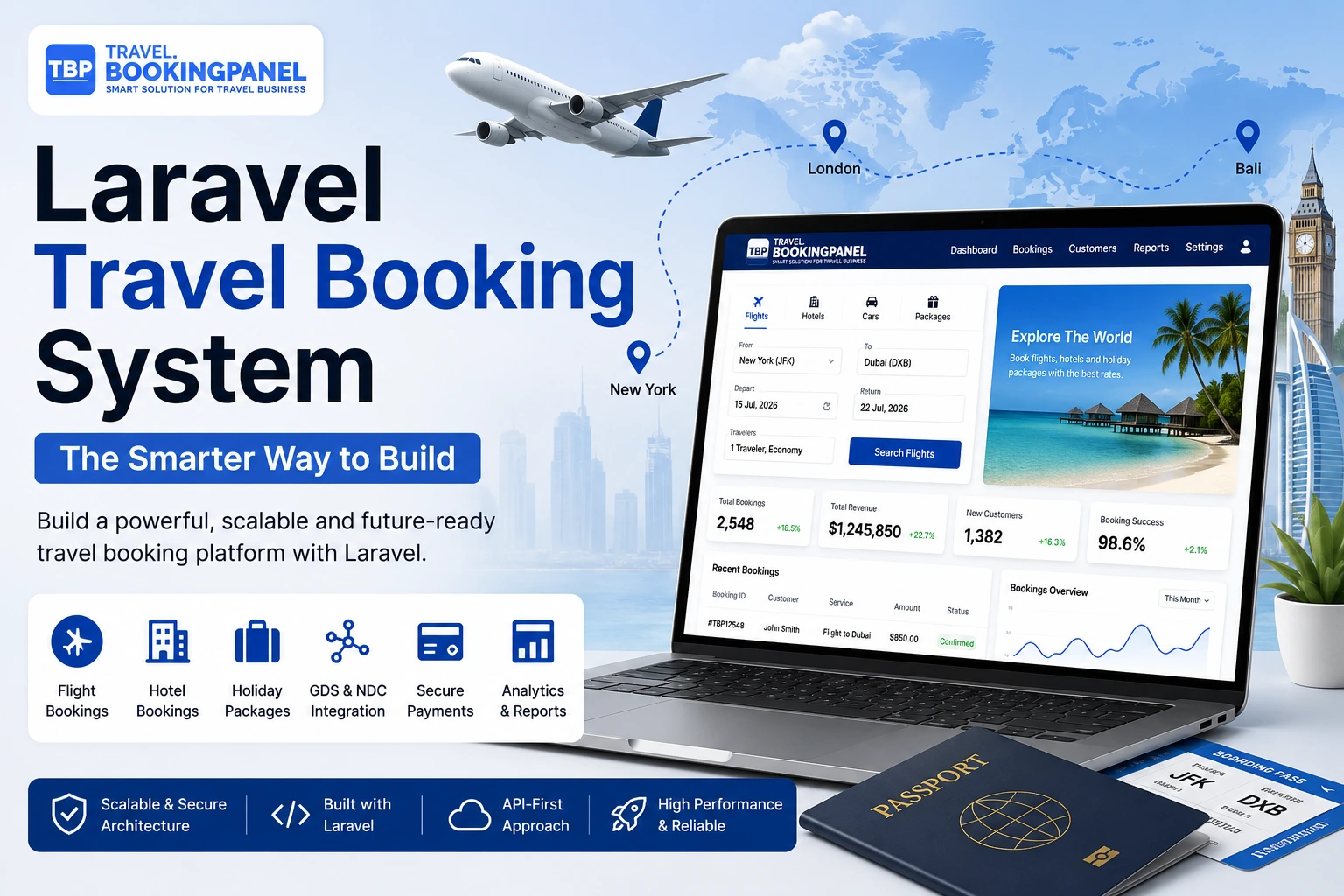
A production-ready Laravel travel booking system is not a CodeCanyon download. It's a custom-built platform that connects supplier APIs (GDS, NDC, and bed banks...
A production-ready Laravel travel booking system is not a CodeCanyon download. It's a custom-built platform that connects supplier APIs (GDS, NDC, and bed banks), validates pricing in real time, and survives reconciliation at scale. If you searched "Laravel travel booking system download" hoping for a shortcut, here's the honest answer: the shortcut and the real platform are two different products.
They lead to two very different outcomes. Let's break down what actually goes into building one. The cost, the architecture, and the operational flow that separates a platform that scales from one that quietly bleeds money through overselling and failed reconciliation.
Direct Answer: What "Laravel Travel Booking System Download" Actually Gets You
When founders type that phrase into Google, they're usually looking for one of two things.
Option 1: A Prebuilt Script
Something like BookingCore's MyTravel package on CodeCanyon. A Laravel-based admin panel with vendor dashboards, tour listings, and basic Stripe checkout already wired up.
Option 2: A Real OTA-Grade Platform
A system that can talk to Amadeus, Sabre, or Travelport. One that holds inventory correctly and reconciles bookings without losing money on edge cases. These are not interchangeable. A downloadable script can get a small tour operator's website online in a weekend.
It cannot handle live GDS connectivity, NDC content, multi-supplier price reconciliation, or the failure modes that show up the moment real transaction volume hits the system. At TravelBookingPanel, we build the second kind. Most founders who come to us started by downloading the first kind and hit a wall within a few months.
Why Laravel Specifically: Should You Build on Laravel?
Laravel keeps showing up in travel tech for practical reasons, not hype. Its eloquent ORM makes the relational complexity of travel data bookings, suppliers, passengers, fare rules, and payments far more manageable than raw SQL. Built-in queue support matters here, too. GDS calls, payment confirmations, and PNR issuance all need to happen asynchronously, so a user isn't staring at a spinner during a multi-second supplier round trip.
The Laravel travel booking system handles the unglamorous but critical jobs: rate refreshes, inventory syncs, abandoned-booking cleanup, and currency updates. None of that makes Laravel magic. It provides a solid foundation on which a competent team can build a real travel platform. That's different from claiming the framework alone solves travel-specific problems like fare caching or overselling prevention. Those still have to be engineered deliberately.
What a Download Gets You vs What You Actually Need
A CodeCanyon-style Laravel booking script typically ships with a vendor marketplace, basic search, a payment gateway, and a content management layer for tours or listings. What it rarely ships with: certified GDS/NDC connectivity, a price-recheck layer, queue-based booking holds, or reconciliation logic against supplier ledgers.
Those pieces are the actual hard part of a travel booking system. A template can't solve them because they depend entirely on which suppliers you integrate with and how your business operates.
How Much Will It Cost?
Cost is driven almost entirely by which supplier integrations you need, not by Laravel itself.
Cost by Platform Tier
Recent industry budgeting data gives a useful range. A startup using Amadeus Self-Service APIs can expect a first-year budget of $15,000 to $40,000. A mid-size OTA moving to direct GDS integration should plan for $50,000 to $120,000. Enterprise platforms with multi-GDS and NDC connectivity can exceed $350,000 in year one.
When budgeting for a Laravel travel booking system, those figures typically cover licensing, setup, development, certification, and a contingency buffer. The same source recommends padding any estimate by 20-30%, since certification timelines and NDC edge cases routinely run long.
A Deadline That Affects Your Budget Right Now
There's also a timing pressure worth knowing. Amadeus is phasing out its Self-Service API portal in July 2026. This pushes smaller platforms toward either Amadeus Enterprise or NDC-first alternatives like Duffel. If you're scoping a build right now, that deadline should be part of your architecture decision, not an afterthought.
It's worth being blunt about what drives the spread between $15K and $350K. It is never the Laravel codebase itself. It's the number of suppliers, the certification cycles each one requires, and how much of the booking flow below has to be built versus configured.
Which Modules Are Required?
A real travel booking system needs more than “search, book, pay.”
At a minimum, it requires:
- A supplier integration layer (GDS/NDC/bed bank adapters)
- An availability and price-validation engine
- A booking-hold and queueing system
- A payment processing module with multi-currency support
- PNR/ticketing issuance
- A confirmation and notification layer
- A reconciliation engine matching charges against supplier confirmations
Most blog content stops at "booking engine, payments, hotels, flights." That describes the front door, not the building.
Is Laravel Scalable Enough?
The honest answer: a Laravel travel booking system isn't usually the bottleneck. Your architecture decisions are. A local travel agency booking 200 trips a month and a Laravel travel booking platform serving 100,000 monthly users need fundamentally different infrastructure, scaling strategies, and deployment setups, even when running on nearly identical codebases.
Architecture for Small-Volume Platforms
For a small-volume agency platform, a single application server, a managed MySQL instance, and Laravel's built-in queue worker running on the same box are usually fine. Supplier calls can hit the GDS directly on most searches without meaningful latency problems.
Architecture for Scale
For a platform serving tens of thousands of monthly users, that setup falls apart fast. GDS search APIs typically respond in 1-5 seconds, depending on itinerary complexity. That's unacceptable for a live search UI if every search hits the supplier directly.
At this tier, you need a layered approach:
- Redis-backed short-TTL caching (typically 5-10 minutes) for search result sets, keyed by route/date/passenger combination
- Separate, horizontally-scaled queue workers handling booking holds and PNR issuance independently from the web tier
- A pre-search warming strategy for high-volume routes during peak booking windows
Critically, cached search results are never bookable directly. Every booking attempt re-confirms price and availability against the live supplier endpoint via the Price API first. Skipping that step is how platforms oversell inventory.
Failover Changes at Scale Too
Beyond caching, scaling a Laravel travel booking system changes your failover posture. A platform of meaningful size needs redundant queue workers, so a stalled GDS call doesn't block every other booking in flight. It also needs database read replicas to handle growing search volumes and maintain performance during peak booking periods.
Once you're integrating multiple GDS providers and NDC airlines independently, you'll want service separation so a Sabre outage doesn't take down your Amadeus bookings. None of this requires abandoning Laravel. It requires not treating Laravel's defaults as a finished architecture.
What APIs Can Integrate?
The Three Major GDS Providers
Amadeus, Sabre, and Travelport each have distinct regional strengths and API styles. Amadeus leans toward Europe, the Middle East, and global coverage, with the most mature developer tooling of the three. Sabre is the stronger choice for North American and Latin American airline-heavy platforms.
It offers orchestrated APIs that can search, validate, and book in a single request. Travelport's Universal API unifies Galileo, Apollo, and Worldspan content. It tends to fit platforms with a Middle Eastern, UK, or Australian market focus.
Where NDC Fits
NDC is IATA's modern XML/JSON standard. It lets airlines distribute richer content, branded fares, ancillaries, and seat selection directly, bypassing some content limitations of traditional GDS channels.
Each airline implements NDC independently. That's why planning NDC strategy alongside GDS integration from the start is far more efficient than retrofitting it later.
Beyond Flights
A complete Laravel travel booking system typically also connects to bed banks like Hotelbeds or RateHawk for hotel inventory, along with car rental and transfer APIs, depending on the platform's product scope.
How Do Expedia, Booking.com, and Yatra-Like Systems Actually Work?
Big OTA platforms aren't a single monolithic "booking engine." They're a layered architecture: content sources flow into an API integration layer, which feeds the booking engine, which feeds a mid-office layer, which feeds back-office and payments.
Breaking Down the Layers
- Content sources are the GDS/NDC/bedbank connections.
- The integration layer normalizes that content into a consistent internal format.
- The booking engine is the customer-facing search-and-book interface.
- Mid-office handles agent workflows, markups, and B2B portal logic.
- Back-office handles invoicing, commission tracking, and financial reconciliation.
This layered separation is exactly why "build a booking engine" undersells the actual project. The booking engine is one layer in a five-layer system. Skipping the mid-office or back-office is precisely how platforms end up unable to reconcile what suppliers billed against what customers were charged.
Buy vs Build?
A prebuilt Laravel script gets a basic site live fast and cheap. That's fine for a single-property tour operator with no GDS needs. The moment you need certified GDS connectivity, NDC content, multi-supplier reconciliation, or a B2B agent portal, a template becomes a liability rather than a shortcut. None of those capabilities can be bolted onto a script architecture without effectively rebuilding it.
For platforms with real OTA ambitions, a custom Laravel build designed around the supplier integration layer from day one is the only path that doesn't require a second rebuild eighteen months in. This is the exact decision we walk founders through at TravelBookingPanel. It's almost always a question of how much you're trying to scale, not which framework looks nicer in a sales deck.
Expert Insight: The Real Travel Booking Flow Nobody Explains
Most content about Laravel travel booking systems stops at features. Search, payments, hotels, flights. That's the storefront. It's not the operation.
The part that actually determines whether your platform survives real transaction volume is the sequence between a customer hitting "search" and a confirmed, reconciled booking landing in your back office:
Customer searches flight → Supplier API call → Availability validation → Price recheck → Booking hold → Payment → PNR issuance → Confirmation → Reconciliation.
Why Each Step Exists
Availability validation exists because cached search results go stale within minutes. Booking against a stale result without re-checking is how you oversell a seat that's no longer there. Price recheck exists separately from availability because GDS fares can shift between search and booking, sometimes by the second. Booking at a stale price either loses you margin or breaks the customer's expectation at checkout.
The booking hold step typically involves a short TTL lock on the inventory item, which prevents two simultaneous customers from both completing payment for the same seat or room. PNR issuance is the actual supplier-side confirmation. Until this is completed, you don't have a real booking. You have a payment with no fulfilled product behind it, which is a dangerous state to be in.
Reconciliation is the step almost nobody talks about publicly: matching what the supplier actually billed you against what you charged the customer, catching discrepancies before they become a six-figure accounting problem at quarter-end. This sequence is where the real engineering work lives. It's also where the real fears live.
What Founders Are Actually Worried About
Anyone searching for "Laravel travel booking system" is rarely thinking purely about a framework.
They're thinking, I want to launch a travel platform without making a technical mistake that costs me six figures. That fear shows up differently depending on who's asking.
The Founder's Fear
Building the wrong platform entirely. Investing months into a system that can't actually support the business model once real customers show up.
The CTO's Fear
Scale. Whether the architecture decisions made in month one will hold up at month eighteen, or whether they're signing up for a painful re-platform.
The Travel Agency Owner's Fear
Inventory synchronization is silently breaking a room or seat showing as available when it isn't and the resulting customer service fallout.
The Investor's Fear
Timeline risk. An 18-month build with no revenue-generating product is a very different bet than a 4-6 month build with a working booking flow.
The Common Solution
The honest answer to all four fears is the same. They're solved by getting the supplier-integration architecture right from the start. Caching correctly, validating price and availability at the right steps. Building reconciliation in from day one rather than bolting it on after the first accounting discrepancy. That's the work that actually de-risks a build, far more than the choice of PHP framework does.
Key Takeaways
| Build Path | Best Fit | Typical First-Year Cost | Realistic Timeline |
| Prebuilt Laravel script | Single-property tour operator, no GDS needs | Under $5,000 | Days to weeks |
| Custom Laravel + Amadeus Self-Service | Early-stage OTA startup | $15,000-$40,000 | 3-6 months |
| Custom Laravel + direct GDS integration | Mid-size OTA scaling supplier coverage | $50,000-$120,000 | 6-9 months |
| Custom Laravel + multi-GDS + NDC | Enterprise platform, multi-market | $350,000+ | 9-16 months |
The framework was never the hard part. The hard part is the architecture between search and reconciliation. That's true whether you're booking 200 trips a month or 100,000.
FAQs
Is there a free Laravel travel booking system I can download and use directly?
Prebuilt Laravel travel scripts exist on marketplaces like CodeCanyon, but they generally lack certified GDS/NDC connectivity, price-recheck logic, and reconciliation. They work for basic listing sites, not for platforms that need live airline or hotel inventory.
How long does a Laravel travel booking system take to build?
Typically 3 to 16 months, depending on the supplier's scope. A single-GDS startup build can land in 3-6 months, while a multi-GDS, NDC-integrated enterprise platform often takes 9-16 months once certification cycles are included.
Can Laravel handle real-time GDS and NDC integrations?
Yes, but it requires deliberate architecture: queue-based job processing for supplier calls, Redis caching for search results, and a dedicated price/availability recheck step before booking confirmation. Laravel doesn't solve this automatically; it provides the tooling to build it correctly.
What's the biggest mistake founders make when building a travel booking platform?
Treating the booking engine as the entire system. The booking engine is one layer; skipping mid-office and back-office reconciliation is the most common reason platforms run into unexplained financial discrepancies after launch.
Should a small travel agency build a custom Laravel system or buy a template?
If there's no need for live GDS/NDC connectivity, a single-destination tour operator, for example, a template is reasonable. Once multi-supplier inventory, real-time pricing, or a B2B agent portal is required, a custom build is the only option that scales without a rebuild.
Tags
Own Your Travel Platform. Forever.
Buy once, own forever. Full source code · No monthly fees · No hidden charges.