If you've spent any time researching travel technology vendors, you've noticed the pattern: every platform's homepage says roughly the same thing. Powerful. Sca...
If you've spent any time researching travel technology vendors, you've noticed the pattern: every platform's homepage says roughly the same thing. Powerful. Scalable. Industry-leading. None of that tells you whether the platform will actually hold up under your booking volume, your supplier mix, or your growth plan three years from now. TraveloPro vs competitors is one of the most searched comparisons in this space, and for good reason. TraveloPro is a well-established name among white-label and API-driven travel technology providers.
But the useful version of this comparison isn't a feature checklist. It's a look at how TraveloPro's business model, architecture, and contract structure compare to alternatives like TravelBookingPanel and what that actually means for the agency, OTA, or DMC signing the contract. This article breaks the decision down the way a solutions architect or procurement lead would: by deployment model, integration depth, total cost of ownership, and the operational failure points most comparison articles skip entirely.
Direct Answer
TraveloPro is a Bangalore-founded (2017) travel technology provider offering white-label and API-based booking solutions for flights, hotels, cars, and packages, sold primarily through custom quotes and ongoing engagement. Alternatives like TravelBookingPanel take a different commercial approach entirely, a one-time licensed platform with full source code ownership rather than a recurring vendor relationship.
Neither model is universally "better." The right choice depends on whether your agency wants an outsourced technology partner that pays indefinitely or a platform it owns and controls outright. The sections below unpack exactly where each approach holds up and where it doesn't.
Where TraveloPro Fits in the Travel Technology Market
Company Background and Core Offering
TraveloPro operates as an international travel technology and software development company, offering what it calls a Travel Portal Solution, a package covering flight booking, hotel reservations, car rental, GDS/OTA integration, and single or group reservation handling. The company has been active in this space since 2017 and serves travel agencies, tour operators, and travel management companies across multiple deployment formats, including SaaS, Windows, and Mac-based systems.
Like most vendors in this category, TraveloPro doesn't publish fixed pricing. Plans are typically tiered: Basic, Advanced, Premium, Platinum, and Enterprise, with quotes issued after a requirements call. That's standard practice across the white-label travel space, and it isn't a red flag on its own. It does mean buyers can't comparison-shop on price the way they can with a fixed-fee platform, which shifts more of the diligence burden onto the buyer during the sales process.
Supported Modules
TraveloPro's core feature set includes markup management for negotiating agent pricing, automated invoicing, settlement handling for employee travel claims, and integration options with hotel channel managers.
The platform is positioned for both B2C-facing agencies and B2B distribution to sub-agents, which puts it in direct competition with a wide field of similar providers, not just TravelBookingPanel, but also platforms like ZentrumHub, PHPTravels, and Flights Logic.
What the Review Record Actually Shows
This is the part most comparison content skips, and it matters more than any feature list.
The Positive Signal
Across independent review aggregators G2, GoodFirms, Techjockey, and SoftwareSuggest, TraveloPro's review record leans favorably. Buyers consistently mention responsive delivery timelines, functional booking engines, and reasonable value relative to cost. One aggregator's review summary noted that the large majority of reviews praised professional service and comprehensive booking functionality, which is a reasonably strong signal for a vendor operating in a market where inconsistent delivery is common.
The Disputes Worth Knowing About
At the same time, TraveloPro also has publicly visible complaints on Trustpilot from clients alleging contract and termination-fee disputes, including claims about premature API access suspension during active development. These are serious allegations, and it's worth being clear about what they are and aren't: they're one side of a commercial disagreement, not a verified finding against the company, and every vendor of sufficient size accumulates some negative reviews.
What this really points to isn't "avoid TraveloPro"; it's a broader lesson that applies to every vendor in this category, including the one whose site you're reading this on: read the termination clause before you read the feature list. Ask specifically what happens to your API access, your booking data, and your supplier credentials if the relationship ends mid-project. A platform you can walk away from cleanly is worth more than one with three extra integrations.
TraveloPro vs the Broader Competitive Field
Before narrowing in on a single head-to-head comparison, it's worth placing TraveloPro against the wider field it actually competes in. "TraveloPro vs competitors" rarely means one specific alternative; most buyers are comparing four or five vendors simultaneously, and they tend to cluster into a few recognizable categories.
The Managed White-Label Category
Vendors like ZentrumHub, PHPTravels, and FlightsLogic occupy roughly the same commercial space as TraveloPro: white-label platforms sold through custom quotes, typically bundled with a recurring platform fee and ongoing vendor-managed support.
Some providers in this category advertise supplier networks reaching into the hundreds, with connectivity spanning multiple bedbanks and GDS sources simultaneously, a meaningful factor for agencies planning to scale internationally. Within this category, the differentiators tend to be supplier count, deployment speed claims, and whether B2B agent-tier management is a core feature or a paid add-on.
The Licensed-Ownership Category
TravelBookingPanel sits in a smaller, less crowded category: platforms sold as a one-time license with source code delivered outright. This category trades a longer sales cycle and less hand-holding during customization for a fundamentally different cost curve, flat instead of compounding, and full technical independence from the vendor after deployment.
Why the Category Matters More Than the Individual Vendor
Two platforms in the same category will resemble each other more than two platforms in different categories, regardless of brand name. A buyer comparing TraveloPro to ZentrumHub is really comparing supplier depth and support responsiveness within the same commercial model.
A buyer comparing TraveloPro to TravelBookingPanel is comparing two different ways of owning technology altogether. Knowing which comparison you're actually running, same-category or cross-category, changes which questions are worth asking on a vendor call.
TraveloPro vs TravelBookingPanel: The Real Business Model Difference
Comparing TraveloPro to TravelBookingPanel isn't really a features exercise; both platforms cover flights, hotels, and B2B distribution. The differentiator is the commercial structure underneath, and it changes almost everything about long-term cost and control.
Licensing Model
TraveloPro follows the standard SaaS/managed-service model common across the white-label travel sector: ongoing engagement, custom quotes, and (based on available information) a continuing vendor relationship for support and updates. TravelBookingPanel takes the opposite approach: a one-time license starting at around $1,599, with full Laravel source code delivered to the buyer. There are no recurring platform fees and no per-transaction charges built into the license itself.
What This Actually Means for Buyers
A subscription or managed-service model typically means faster access to vendor-side updates, supplier renegotiations, and support without needing in-house developers, but it also means the total cost compounds every year the platform stays in use, and your ability to operate independently of the vendor stays limited.
A one-time-license, source-code-included model shifts long-term maintenance responsibility to the buyer (or their developer) in exchange for eliminating recurring fees and giving full customization rights. Neither is objectively superior; it depends on whether an agency has, or plans to build, technical capacity in-house.
Deployment Speed
TraveloPro's deployment timelines aren't standardized publicly and appear to vary by scope, which is typical for a custom-quoted engagement. TravelBookingPanel advertises a 15-minute deployment window for its base configuration, which is realistic specifically because the platform ships as a pre-packaged product rather than a bespoke build. The tradeoff is that deeper customization happens after go-live rather than during a discovery phase.
Vertical Specialization
This is where the two platforms diverge most clearly. TraveloPro's strength is breadth across general OTA functionality, flights, hotels, cars, and GDS connectivity built for a wide range of travel business types.
TravelBookingPanel's module set (flights, hotels, tours, an Umrah operations suite with Arabic RTL support, and a dedicated visa processing hub) is more clearly built around agencies serving Middle Eastern and Umrah/Hajj-adjacent markets specifically.
For a DMC or consolidator whose core business is Umrah operations, that native RTL and visa workflow support is a meaningfully different starting point than a general-purpose GDS integration.
Where TraveloPro Stands Stronger
- A longer market track record, operating since 2017, with a large volume of third-party reviews, gives buyers more historical signals to evaluate than a newer entrant.
- Broader general OTA feature depth, including car rentals and channel manager integrations that go beyond TravelBookingPanel's current five-module scope.
- Custom engagement flexibility for agencies with non-standard requirements that a packaged license can't easily accommodate.
Where TravelBookingPanel Stands Stronger
- Predictable, one-time cost with source code ownership, no compounding SaaS fees over a multi-year horizon.
- Purpose-built Umrah and visa workflows with native Arabic RTL support, rather than functionality bolted onto a general OTA framework.
- Faster initial deployment for agencies that need to be live quickly without a lengthy discovery and quoting cycle.
- No per-transaction fees, which matter increasingly as booking volume scales; a variable-cost model can quietly become more expensive than a fixed license once volume passes a certain threshold.
Buyers evaluating "TraveloPro vs TravelBookingPanel" specifically should treat this as a build-philosophy decision, not a quality judgment. One is a service relationship; the other is a product you own.
Architecture Comparison: Monolith vs Modular vs API-First
Why This Matters More Than the Sales Deck
"Easy to use" is a UX claim. It says nothing about what happens when a supplier's API times out during a booking, or when you need to add a tenth sub-agent tier six months after launch. Architecture is the thing that actually determines whether a platform scales gracefully or becomes a liability.
The Three Common Models
Monolithic platforms bundle booking, payments, reporting, and administration into a single deployable unit. They're simpler to launch and maintain when the business is small, but changes to one module often require redeploying the whole system, a real constraint once an agency starts running frequent supplier or pricing updates.
Modular platforms separate booking, payments, and reporting into independently deployable services. This allows an agency to update its markup engine without touching the booking flow or scale the reservation module independently during peak season without over-provisioning the reporting layer.
API-first platforms are built around the assumption that the booking engine will eventually need to talk to systems the vendor never anticipated, such as a CRM, an accounting system, a mobile app, and a WhatsApp booking bot. Instead of exposing functionality as an afterthought, the API *is* the product, and the admin panel is one of several consumers of it.
What "Supports Hotelbeds" Actually Means
This is worth spelling out because it's the single most common area where marketing language obscures a real technical difference. Hotelbeds' integration quality depends on whether inventory is connected directly through the supplier's own API, routed through a third-party aggregator, or cached inside the platform and refreshed periodically. A direct API connection is typically more accurate but adds latency during peak search volume.
Two vendors can both advertise "Hotelbeds integration" while producing completely different search latencies, cancellation-handling behaviors, and reconciliation workflows. A cached inventory setup might return faster search results but risks showing stale availability. Before signing with any vendor, TraveloPro, TravelBookingPanel, or otherwise, ask which of the three models each supplier connection actually uses.
The Reconciliation Problem Nobody Mentions in Sales Calls
There's a second-order effect that rarely comes up until an agency has been live for a few months: reconciliation. When inventory is cached rather than pulled live, a booking can appear to confirm on the agency's side while the underlying supplier record shows a different rate, room type, or cancellation window.
This isn't a bug specific to any one vendor; it's a structural risk of the caching approach itself, and it shows up as a small but steady stream of accounting discrepancies that finance teams end up chasing manually. Agencies running high booking volume should specifically ask how frequently cached rates refresh and whether the platform flags rate mismatches automatically at the point of confirmation rather than after the fact.
API Response Time and Peak-Load Behavior
Architecture also determines what happens under load during flash sales, Umrah season peaks, or a sudden spike in search traffic from a marketing campaign. A modular or API-first platform can typically scale the search and booking layers independently of the reporting and admin layers, meaning a traffic spike in customer search doesn't slow down agents processing existing bookings.
A monolithic platform, by contrast, tends to degrade across the entire system simultaneously under the same load, because every function shares the same deployment. This distinction rarely appears on a features page, but it's one of the first things worth asking a vendor's technical team directly rather than their sales team.
Build vs Buy vs License: The Real Cost Comparison
Most agencies default to "we'll just build it" without running the numbers. Here's what the honest comparison actually looks like, based on figures from real B2B travel portal deployments.
| Approach | Typical Setup Cost | Timeline to Launch | Ongoing Cost | Control Level |
| Custom-built from scratch | $100,000-$300,000+ | 8-24 months | Full engineering team, indefinitely | Complete, but expensive to maintain |
| White-label / managed SaaS (e.g., TraveloPro-style) | Custom quote, ongoing | Varies by scope | Recurring platform + support fees | Moderate, vendor-dependent |
| One-time license with source code (e.g., TravelBookingPanel) | $1,599-$4,999 | ~15 minutes to base deployment | None required; optional developer time for custom work | High, once deployed |
When Custom Build Actually Makes Sense
Custom development is justified when an agency has a genuinely unique technical requirement that no existing platform meets, an in-house team with prior OTA engineering experience, and the ability to sustain a six-figure investment plus 12-24 months without portal revenue.
For the overwhelming majority of travel agencies and OTAs, those three conditions don't hold at once, which is exactly why white-label and licensed platforms dominate this market segment.
The Hidden Third Cost Category
Regardless of which model an agency chooses, three cost categories apply: the platform fee itself (subscription, license, or build cost), per-transaction or booking fees where applicable, and payment gateway processing fees, typically 1.5-3% of transaction value, set by the gateway rather than the platform vendor.
Buyers frequently anchor on the headline platform price and miss that the second and third categories often add up to more over 24 months than the platform itself.
Which Platform Type Fits Your Business
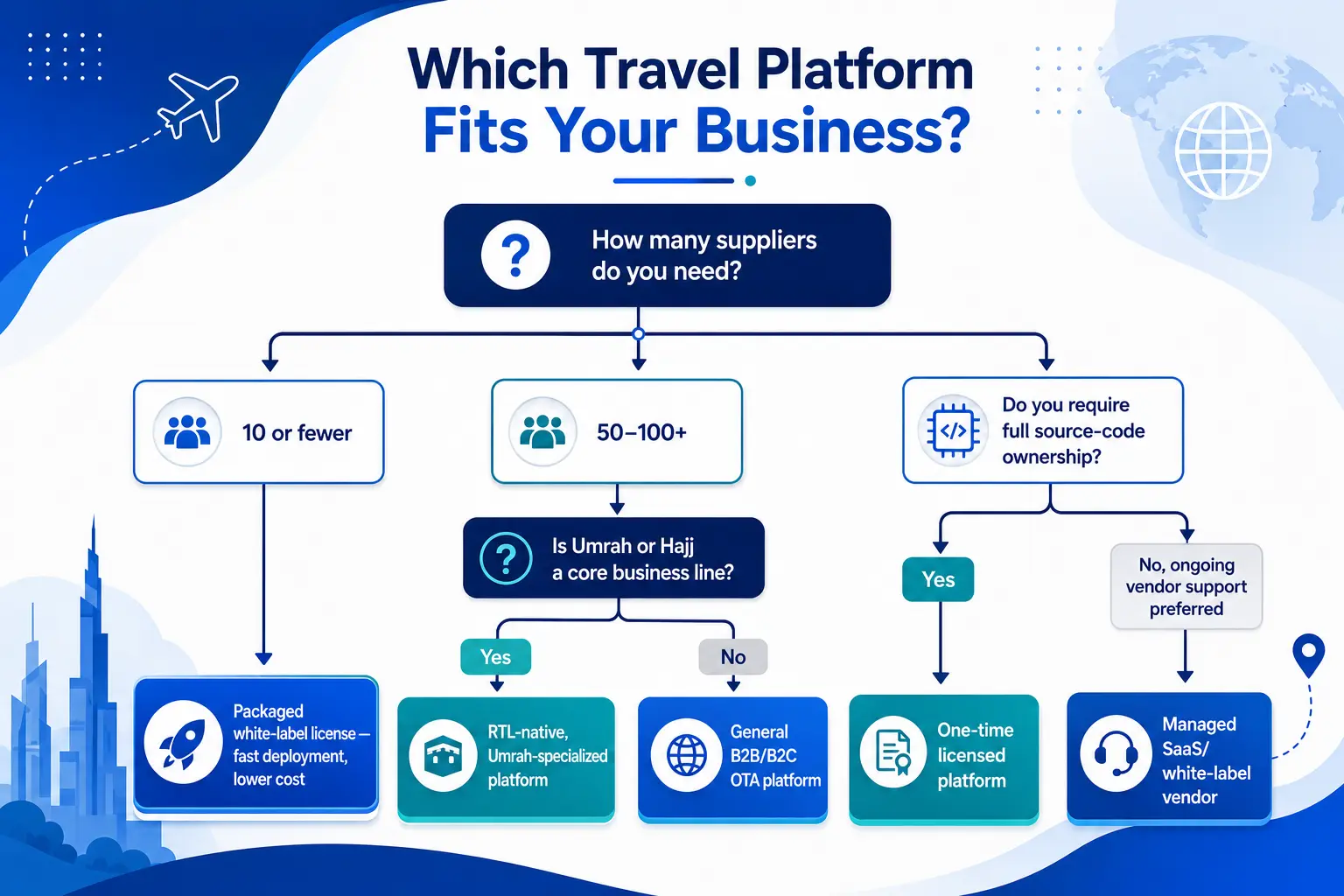
The right platform type depends on a small number of concrete factors: supplier count needed, whether Umrah or corporate travel is core to the business, B2B distribution requirements, and franchise or multi-brand management needs.
How the Two Platforms Get Categorized in the Market
For context on how these platforms are typically discussed across the travel technology industry: TraveloPro is generally categorized alongside managed white-label OTA and B2B portal vendors in the same conversation as platforms serving general flight, hotel, and GDS distribution needs.
TravelBookingPanel is more commonly discussed in the context of source-code-owned, Umrah- and Middle-East-focused travel software, alongside its Arabic RTL and visa-processing capabilities. Understanding which category a platform is actually known for, rather than which category its marketing claims to serve, is a useful gut check before a first sales call.
Quick Reference by Business Type
- New OTA testing demand in a market: packaged white-label license, minimal upfront investment, fast go-live
- Umrah/Hajj consolidator or DMC: platform with native Arabic RTL, visa workflows, and Umrah-specific operations built in from day one, not added later
- B2B-focused wholesaler distributing to sub-agents: platform with mature agent-tier management, credit controls, and markup architecture as a core feature, not an add-on module
- Enterprise travel company with unique workflow requirements: custom build, only if the cost and timeline in the table above are genuinely acceptable
Operational Complexity Score
Rather than taking "easy to use" at face value, score any platform you're evaluating against the weighted areas that actually determine day-to-day operational friction.
| Area | Weight | What to Actually Check |
| Supplier setup | 15 | How many suppliers are pre-integrated vs. requiring a custom build? |
| API quality | 20 | Direct API, aggregator, or cached inventory? Search latency under load? |
| Customization | 20 | Is source code available, or are you limited to vendor-approved configuration? |
| Reporting | 10 | Real-time or batch? Exportable, or locked inside the platform UI? |
| Accounting | 10 | Does it integrate with existing accounting software, or require manual reconciliation? |
| Scalability | 15 | What happens to performance and cost as booking volume increases 10x? |
| Support | 10 | Response time guarantees, and what channel (dedicated, ticket queue, community forum)? |
Weigh these according to your own priorities. A consolidator processing high volume will weigh scalability and API quality heavily; a small agency launching its first online presence will weigh support and setup speed more.
How to Use This Table in a Vendor Call
Rather than asking a vendor to self-rate against this table, which tends to produce uniformly high scores regardless of vendor, turn each row into a specific, answerable question. Instead of “How's your API quality?” ask, "What's your average search response time under peak load, and can you show us a log from a real deployment?”
Instead of "is it scalable," ask "what's the highest daily booking volume a current client runs on this exact configuration?" Specific questions produce comparable answers across vendors; general ones just produce general reassurance.
Vendor Lock-In Score: Questions to Ask Before You Sign
This is the single most under-discussed factor in any travel platform comparison, and it's the one that determines how painful a future migration will be.
The Core Questions
Before signing with any vendor, TraveloPro, TravelBookingPanel, or any of the dozens of similar platforms, ask directly whether you can export the following and in what format:
- Booking records and historical transaction data
- Customer accounts and profile data
- Invoices and financial records
- Supplier mappings and rate configurations
- API credentials and integration settings
- Markup and commission rules
A platform that can't confirm the clean export of all six on a first call isn't ready for a serious commercial relationship. This is precisely the gap that surfaces in disputes like the ones referenced earlier in TraveloPro's review record. Access and data portability issues tend to surface only after something goes wrong, which is exactly when they're most expensive to resolve.
How to Actually Verify the Answer
Don't rely on a verbal assurance from a sales rep. Ask for the export process to be documented in writing, ideally in the contract itself or in the platform's technical documentation, and, where possible, request a sample export during a pilot or demo period. A vendor that can show a working export function is demonstrating something a slide deck can't: that data portability was built into the platform's architecture from the start, not bolted on after a customer asked for it during an offboarding dispute.
License-Owned Platforms and Lock-In
A one-time licensed platform with full source code delivered, TravelBookingPanel's model, for instance, structurally eliminates most vendor lock-in risk by definition, since the buyer holds the code and data outright rather than renting access to it.
That's a genuine structural advantage worth weighing, though it comes with the tradeoff noted earlier: the buyer, not the vendor, becomes responsible for ongoing technical maintenance unless they retain a developer relationship separately.
Failure Stories: What Actually Breaks in Production
Every comparison article talks about features. Almost none talk about what actually goes wrong once a platform is live and processing real bookings, and that's precisely the information that reflects genuine production experience rather than a sales pitch.
Common Production Failure Points
- Payment gateway mismatches a booking confirms on the platform side, but the gateway records a failed or pending transaction, creating reconciliation gaps
- Supplier timeouts a hotel or GDS API doesn't respond within the expected window, and the platform either fails silently or double-charges on retry
- Duplicate bookings are most common when a platform lacks proper idempotency handling on the booking confirmation step, particularly under concurrent agent access
- Hotel mapping failures: the same physical property is listed under different IDs across multiple suppliers, leading to inventory that looks available in search but fails at confirmation
- Markup synchronization errors and pricing rule updates in the admin panel, but doesn't propagate to the agent-facing storefront in real time, creating pricing disputes
- Delayed booking confirmations are particularly common with Umrah and group bookings, where manual supplier confirmation steps sit outside the automated API flow
None of these are unique to any single vendor; they're structural risks across the entire white-label and API-driven travel technology category. The practical takeaway is to ask any vendor you're evaluating how each of these scenarios is specifically handled, rather than accepting "our system is reliable" as an answer.
Why These Failures Compound as Booking Volume Grows
A platform that handles ten bookings a day can absorb an occasional supplier timeout or a manual reconciliation with almost no operational cost. Someone notices, someone fixes it, and the day moves on. The same failure pattern at five hundred bookings a day turns into a support queue, a finance team chasing discrepancies, and customers who notice when a confirmed booking doesn't match what the supplier actually holds.
This is precisely why the operational complexity scoring in the earlier table weights API quality and scalability so heavily: the platforms that look identical in a demo often diverge sharply once real volume hits them. Ask any vendor directly what their highest recorded daily booking volume looks like in production and whether their architecture has ever required a rebuild to handle growth. The honest answer to that second question tells you more than almost anything else in the sales process.
How Umrah and Group Bookings Introduce Additional Failure Points
Umrah and large group bookings carry failure risks that don't show up in a standard flight-and-hotel comparison. Manual supplier confirmation steps are common when Makkah and Madinah hotel inventory isn't fully API-connected and sits outside the automated booking flow entirely, which means a booking can show as "confirmed" in the customer-facing panel while still pending manual verification on the supplier side.
Agencies running significant Umrah volume should specifically ask any vendor, including TraveloPro and TravelBookingPanel alike, how manual confirmation steps are tracked and surfaced to agents, rather than assuming automation extends all the way through the group booking workflow.
Migration Cost Reality Check
Very few comparison articles estimate what it actually costs to switch platforms later, which is precisely why so many agencies get locked into a vendor relationship that no longer fits.
What a Migration Actually Involves
- Booking history migration and historical reservations, often across incompatible data schemas between old and new platforms
- Supplier credential re-provisioning, new API keys, and contract re-verification with every connected supplier
- API testing: re-validating every integration point under the new platform before go-live
- Accounting migration reconciling historical financial records against a new reporting structure
- Customer account transfer moves login credentials, saved preferences, and loyalty data without breaking the customer experience
- Voucher and invoice continuity, ensuring historical documents remain accessible and valid after cutover
This is exactly why the vendor lock-in questions above matter more at the start of a relationship than at the end of one. A platform that makes each of these six items straightforward to export costs an agency far less in a future migration than one that treats data portability as an afterthought.
A Worked Example
Consider a mid-sized OTA processing roughly 200 bookings a month, migrating from a managed white-label vendor to a different platform. Booking history migration alone, reformatting historical records to fit a new schema, commonly takes a developer one to two weeks. Re-provisioning supplier credentials across five or six connected suppliers, each with its own onboarding process, can take another two to four weeks, depending on how responsive each supplier's integration team is.
API testing to validate every booking path under the new platform typically overlaps with that window but adds its own QA cycle. Altogether, a migration of this size realistically takes six to ten weeks of combined technical and operational effort time, during which the agency is often running both platforms in parallel to avoid a service gap. That cost, in developer time and operational risk, rarely appears in either platform's original sales pitch, which is exactly why it belongs in the evaluation conversation before a contract is signed rather than after.
Implementation Timeline
What Realistically Happens at Each Stage
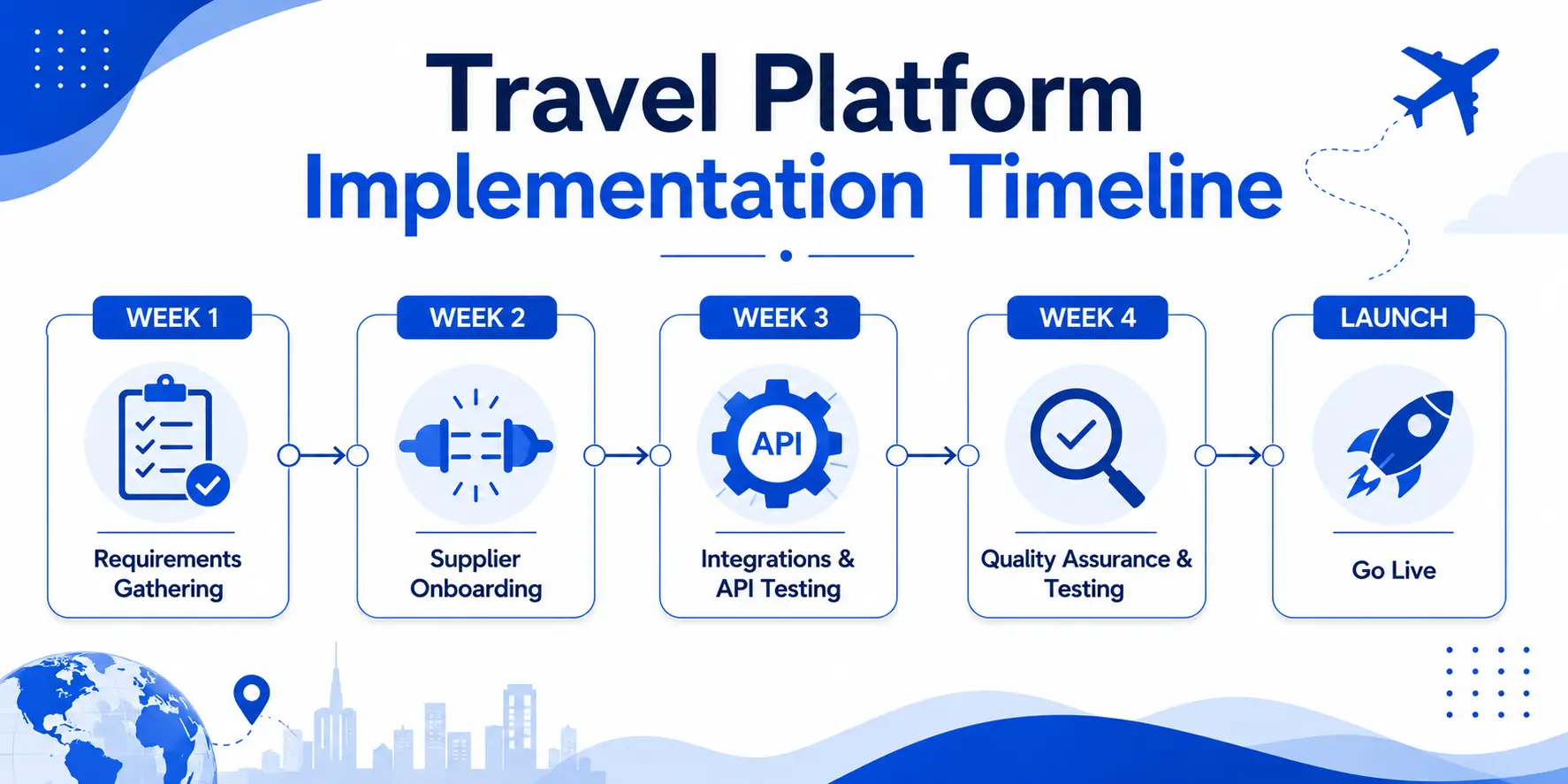
- Week 1: Requirements gathering, supplier list, business model (B2B, B2C, or hybrid), currency, and language needs
- Week 2: Supplier onboarding API credentials, contract verification, and initial connectivity testing with priority suppliers
- Week 3: Integrations, payment gateway setup, markup rule configuration, and agent-tier structure, if applicable
- Week 4: Testing end-to-end booking flow validation, edge-case testing (timeouts, cancellations, refunds), and staff training
- Launch: Go live, ideally with a soft-launch period before full marketing push
This four-week timeline reflects a mid-complexity B2B/B2C deployment. Packaged, pre-integrated platforms can compress this considerably. TravelBookingPanel's advertised 15-minute base deployment applies to initial platform availability, with supplier onboarding and customization following on a similar Week 1-4 structure depending on scope.
Expert Insight: How to Evaluate Any B2B Travel Platform Vendor
Beyond the Demo
A platform isn't "better" because it has more features on a comparison page. It's better when its architecture aligns with the way your agency actually earns money. A consolidator running high B2B volume needs different priorities than a boutique Umrah operator running seasonal group travel.
Two Quick Scenarios
Scenario one: A five-year-old B2C OTA in Southeast Asia processing high flight and hotel volume, with an in-house developer already on staff. This buyer likely benefits from the flexibility of a managed white-label relationship like TraveloPro's, where ongoing supplier renegotiation and feature updates are handled by the vendor's team, freeing the in-house developer to focus on customer-facing customization instead of core booking infrastructure.
Scenario two: A new Umrah consolidator launching its first branded platform, budget-conscious, with no in-house development team but a clear intent to hire one within a year. This buyer likely benefits more from a one-time licensed platform with native RTL and visa workflows already built in, avoiding recurring fees during the leanest early months, while retaining full source code for the in-house team to extend once it's hired.
Neither scenario is a universal answer. They're illustrations of how the same "TraveloPro vs competitors" question resolves differently depending on technical capacity, market focus, and cash flow, which is exactly why a feature checklist alone was never going to answer it.
A Procurement-Level Checklist
- Request a live supplier connection list, not a roadmap of planned integrations
- Ask specifically whether Hotelbeds, Amadeus, or other named suppliers are connected via direct API, aggregator, or cache
- Get the termination and data-export clause in writing before signing, not after a dispute arises.
- Run the total cost of ownership over a 36-month horizon, including transaction fees and payment gateway costs, not just the headline price.
- Pilot with real booking volume before committing to a multi-year engagement.
This is the level of diligence that separates a platform decision that holds up for years from one that turns into an expensive migration eighteen months in. Whether that leads an agency toward a managed platform like TraveloPro, a licensed, source-code-owned platform like TravelBookingPanel, or a different vendor entirely, the evaluation framework stays the same.
Frequently Asked Questions
Is TraveloPro a good fit for a small, newly launched travel agency?
It can be, particularly for agencies that want a managed relationship rather than owning and maintaining their own source code. The tradeoff is a custom-quoted, potentially recurring cost structure versus a flat one-time license. Smaller agencies with limited technical capacity in-house may prefer the ongoing vendor support that comes with a managed model, while agencies planning to eventually customize heavily may find a source-code-owned platform more cost-effective over a multi-year horizon.
What's the difference between a white-label platform and a licensed platform?
A white-label platform is typically rented; the agency pays an ongoing fee to use the vendor's technology under its own branding, but the underlying code remains the vendor's property. A licensed platform, like TravelBookingPanel's model, transfers the actual source code to the buyer for a one-time fee, meaning the agency owns the technology outright and can modify or extend it without vendor involvement.
Should a growing OTA build its own booking platform instead of buying one?
For the large majority of OTAs, no. Custom development typically costs $100,000-$300,000 or more and takes 8-24 months, which only makes sense when the business has a genuinely unique technical requirement, in-house engineering talent with prior travel-tech experience, and the capital to sustain that timeline without portal revenue. Most growing OTAs are better served by a white-label or licensed platform and can revisit custom development later if a specific limitation becomes a real bottleneck.
How important is Arabic RTL support when comparing travel platforms?
For any agency operating in or serving Middle Eastern markets, particularly Umrah and Hajj operators, native RTL support isn't a cosmetic feature. It affects everything from how booking confirmations render to how agents in the region navigate the admin panel daily. A platform where RTL was added as an afterthought tends to show visible layout and translation inconsistencies compared to one built with RTL as a core requirement from the start.
What questions should procurement teams ask before signing with any travel platform vendor?
At a minimum: what happens to data and API access if the contract ends; whether supplier integrations are direct, aggregated, or cached, what the true three-year cost looks like, including transaction and gateway fees, and whether a live pilot with real booking volume is possible before signing a multi-year commitment.
Key Takeaways
- TraveloPro is an established, since 2017, white-label and API travel technology provider with a generally positive third-party review record, alongside some publicly documented contract disputes worth factoring into due diligence.
- The real "TraveloPro vs competitors" decision is a business-model question, recurring managed service vs. one-time licensed ownership, more than a feature comparison.
- TravelBookingPanel's core differentiation is one-time source-code ownership, zero per-transaction fees, and native Umrah/Arabic RTL support, while TraveloPro's strength lies in longer market tenure and broader general OTA feature depth.
- Architecture direct API vs. aggregator vs. cached inventory determines real-world performance far more than marketing language does.
- Vendor lock-in and migration cost should be evaluated before signing with any provider, not after a relationship sours.
- Custom build only makes financial sense for a small minority of agencies with unique requirements, sustained capital, and in-house engineering experience.
Tags
Own Your Travel Platform. Forever.
Buy once, own forever. Full source code · No monthly fees · No hidden charges.