Most travel agents don't run on a single platform. Instead, they rely on travel booking software for agencies that operates across two distinct technology...
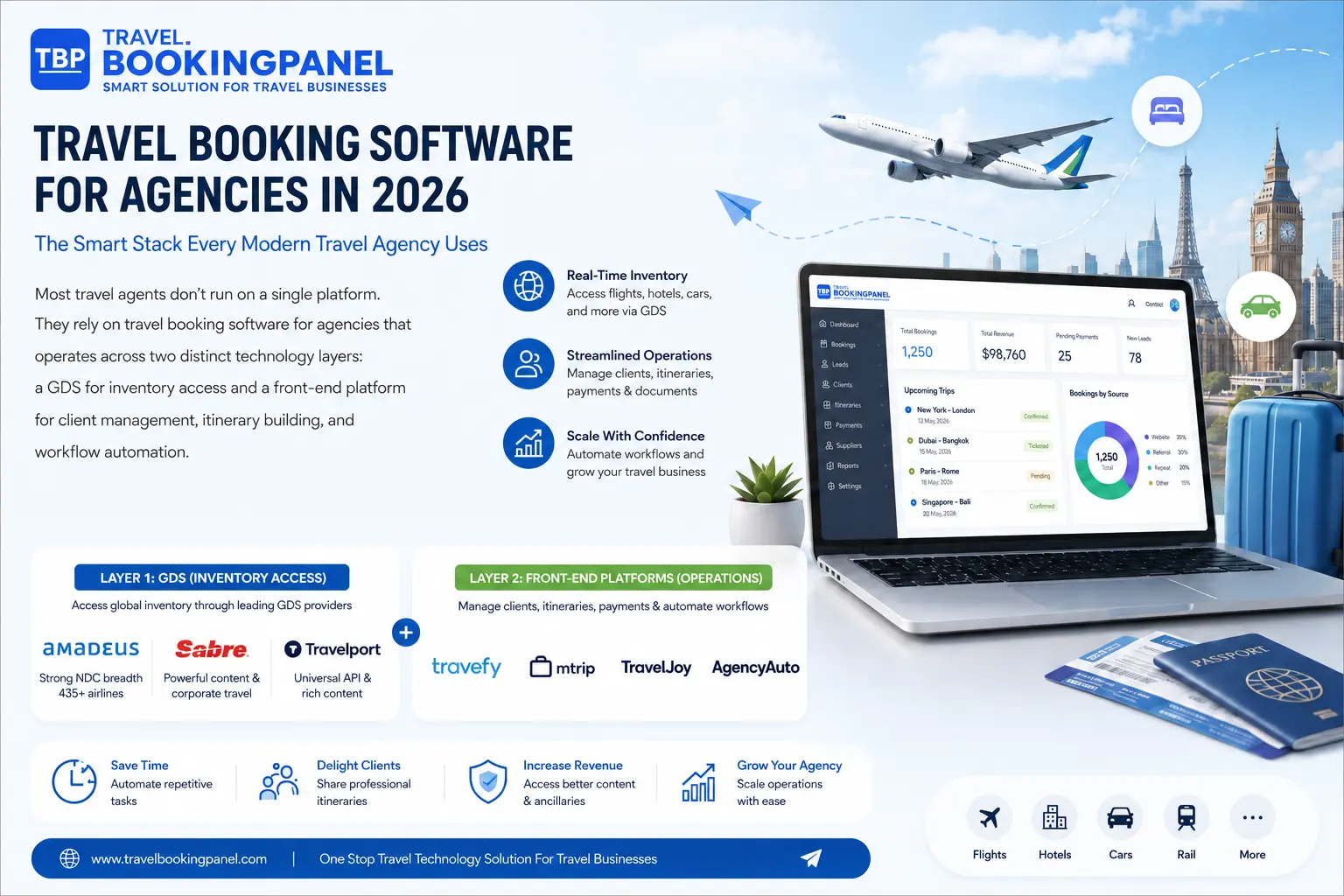
Most travel agents don't run on a single platform. Instead, they rely on travel booking software for agencies that operates across two distinct technology layers: a Global Distribution System (GDS) for inventory access and a front-end platform for client management, itinerary building, and workflow automation.
Understanding how modern travel booking software for agencies combines these layers and which tools belong in each one is one of the most important factors for agency owners and operations managers evaluating software in 2026. By choosing the right travel booking software for agencies, businesses can streamline operations, improve customer experiences, and scale more efficiently in an increasingly competitive travel market
Which Software Do Most Travel Agents Use?
The short answer: most agencies use travel booking software for agencies that combines a Global Distribution System (GDS), such as Amadeus, Sabre, or Travelport, for fare and inventory access with a front-end platform like Travefy, mTrip, TravelJoy, or AgencyAuto for day-to-day operations. Enterprise agencies and OTAs often add a custom mid-office or API layer on top of this stack to support advanced automation, reporting, and scalability
The longer answer is that the "right" software depends entirely on your agency's model, volume, and growth stage. A solo leisure advisor has fundamentally different needs from a 20-seat tour operator or a B2B OTA reseller. What follows is a structured breakdown of every layer of the stack with transparent comparisons and real limitations included.
The Two-Layer Reality: GDS vs Front-End Software
One of the most common mistakes agency owners make when evaluating travel booking software for agencies is treating all platforms as if they serve the same purpose. In reality, a GDS and a front-end platform are not interchangeable.
A GDS provides real-time access to airline seats, hotel rates, and car rental inventory, while the software used by agents focuses on client management, itinerary creation, and trip delivery. Understanding this distinction is essential because most professional agencies rely on both systems to operate efficiently and scale their business.
What is a GDS, and why do you still need it in 2026?
A Global Distribution System is a network that connects travel agencies to supplier inventory, such as airlines, hotels, car rentals, rail, and more, through a single interface. Think of it as a real-time B2B marketplace for travel content. The three dominant GDS providers, Amadeus, Sabre, and Travelport, collectively control approximately 65% of the global GDS market, with regional players and AI-native booking aggregators accounting for the remainder.
This concentration has remained stable, but what's changed dramatically in 2026 is how these systems deliver content. The defining shift: NDC is no longer a future initiative. New Distribution Capability, the IATA standard that allows airlines to sell richer, personalized offers directly through third-party systems, has formally moved from the adoption phase to the optimization phase. According to Sabre's 2026 industry outlook, the conversation is no longer about whether to support NDC; it's about how to use it efficiently within connected retailing workflows.
For agencies, this means GDS platforms now expose ancillaries, seat upgrades, and bundled fares in ways that were previously only available through airline direct channels.
What this means operationally: Agencies using a GDS in 2026 get access to richer fare content than at any point in the past decade. But it also means the technical configuration of your GDS connection, which NDC airlines are enabled, how caching is set up, and how your booking tool handles look-to-book ratios directly affects your costs and content quality. This is not plug-and-play infrastructure.
Front-End Platforms: The Operational Layer
The front-end platform is what your agents actually interact with every day. It typically handles:
- Client and lead management (CRM)
- Itinerary creation and sharing
- Proposal building and approval flows
- Payment collection and commission tracking
- Supplier communication and booking confirmations
- Automation of follow-ups and document delivery
These platforms sit above the GDS layer within a modern travel booking software for agencies stack. Rather than replacing the GDS, they pull inventory data through APIs or manual imports and transform it into structured, client-facing workflows.
In 2026, the most advanced platforms are also incorporating AI-powered automation for tasks such as document processing and itinerary generation, helping agencies reduce manual workloads, improve efficiency, and serve more clients without increasing operational complexity.
GDS Deep Dive: Amadeus vs Sabre vs Travelport
These three systems are the backbone of global travel distribution. Understanding their differences is not optional for any agency making a platform decision.
| Feature | Amadeus | Sabre | Travelport |
| Global Market Share | ~37% globally; ~40% in Europe | Significant second player; strong in the Americas | ~22% global (Galileo/Apollo/Worldspan) |
| Airline Inventory | 435+ airlines, 165 countries with NDC | 400+ airlines; exclusive NDC access to select carriers | 180+ countries; Universal API access |
| NDC Strength | Strongest NDC breadth: 35+ NDC airlines | Exclusive: Aeromexico, Turkish, ANA, LATAM group | Competitive; strong merchandising tools |
| Hotel Content | 770,000+ properties | Extensive SynXis integration for hoteliers | Strong aggregated content |
| AI/Tech Initiative | AI-powered analytics; ForwardKeys acquisition (2025) | SabreMosaic™ Cache-Powered Intelligent Shopping (Feb 2026) | AI fare management; NDC caching |
| Best Fit | European-focused agencies; high NDC demand | Americas-based agencies; corporate travel | Price-sensitive segments; UK/Australasia agencies |
| Limitations | Higher implementation complexity for small agencies | The legacy terminal interface is still common in the US | Smaller airline exclusive NDC roster |
A few things worth noting that most comparison guides omit:
Amadeus completed three strategic acquisitions between 2024 and early 2025: Vision-Box (biometrics), Voxel (payment tech), and ForwardKeys (travel intelligence data). This signals a move beyond pure distribution toward integrated analytics and traveler data products. For agencies that need demand forecasting or marketing intelligence, Amadeus is increasingly a platform, not just a GDS.
Sabre launched SabreMosaic™ Cache-Powered Intelligent Shopping in February 2026, unifying traditional EDIFACT fares, NDC content, and LCC inventory into a single intelligent search layer. This directly addresses one of the biggest operational pain points agencies face: fragmented content from multiple sources requiring manual reconciliation. It is a meaningful product development, though rollout maturity varies by market.
Travelport continues to invest in API-first connectivity. Its Universal API provides SOAP XML-based access to aggregated air, hotel, car, and NDC content, useful for agencies building custom booking flows rather than using off-the-shelf front ends.
The practical guidance: unless you are a large agency with a dedicated technical team, the choice of GDS is often determined by your host agency, consortium, or primary supplier relationships rather than by direct selection. For independent agencies building from scratch, Amadeus is the stronger default for non-US markets; Sabre remains dominant in North America.
Front-End Platforms by Agency Type
For Independent Advisors and Small Agencies (1-5 agents)
TravelJoy is the entry point for independent advisors who need a clean CRM, proposal templates, and payment collection without steep onboarding. It includes a hotel and cruise content library, Faye travel insurance integration, and basic automation. Pricing starts at $19/month, which makes it accessible for solo consultants.
The limitation that matters: TravelJoy has no GDS integration and no white-label mobile app. It is optimized for leisure-focused solo advisors with straightforward books. If your clients expect branded digital delivery or you handle complex multi-supplier itineraries, you will outgrow it.
Travefy serves a broader range of small agencies and has earned its reputation as the most polished itinerary builder in the category; it was voted #1 in itinerary building, CRM, and website building by hosted advisors in the 2025 Host Agency Review survey.
Its drag-and-drop builder pulls from 200+ supplier content sources and 625 city guides covering nearly 50,000 points of interest. For agencies where client-facing presentation quality is a competitive differentiator, Travefy consistently outperforms alternatives in this price range.
One important caveat: Travefy's mobile app is multi-tenant, meaning travelers see the Travefy brand rather than your agency's. For agencies where brand identity is a priority, this is a real limitation. Pricing starts at $25/month, scaling to $99/user/month at the Business tier.
For Tour Operators and Activity Providers
Rezdy is the standard for tour and activity operators who need real-time inventory management and OTA channel distribution. It integrates with major booking channels, including Viator, GetYourGuide, and Expedia, and handles multi-channel booking with its built-in channel manager.
Pricing starts at $59/month for the Essentials plan, with an approximate 1% transaction fee layered on. Rezdy does not attempt to be a full-service agency platform; it is purpose-built for the tours and activities segment, and that focus shows in the depth of its feature set.
Lemax targets mid-size tour operators and DMCs that need package creation, dynamic pricing, and back-office automation under one roof. It is a more complex implementation than Rezdy and better suited to operators building multi-day packages with multiple supplier components.
For Mid-Sized and Multi-Agent Agencies
AgencyAuto has emerged as one of the more complete platforms for multi-agent operations, offering bookings, accounting, and sub-agent management in a unified interface. It handles commission tracking and supplier payment functions that smaller platforms typically omit or handle poorly.
mTrip has made arguably the most significant product development move in the front-end platform category in early 2026: its AI Import Wizard, launched in February 2026, allows agents to drop booking confirmations, emails, or PDF documents directly into the platform and receive a fully structured itinerary in seconds, without manual data entry. For high-volume agencies processing dozens of bookings per week, this is the kind of automation that meaningfully changes staffing economics.
mTrip also delivers itineraries across mobile, web, and PDF simultaneously, with your agency branding intact, addressing the white-label gap that limits Travefy for brand-conscious agencies. It is designed to sit on top of a GDS like Sabre rather than replace it, and that explicit architecture makes it a more honest product positioning in the market.
For Enterprise and OTA Operations
Agencies operating at enterprise scale within the travel booking software for agencies ecosystem, such as those handling B2B OTA reselling, multi-brand operations, or proprietary platform development, typically require a custom mid-office layer connected directly to GDS APIs. At this level, off-the-shelf front-end tools are no longer sufficient because operational demands like white-label architecture, dynamic packaging, API rate management, and advanced reporting go beyond what standard SaaS products are designed to support.
The relevant technical context: integrating directly with GDS APIs requires your team to understand how to normalize response schemas across systems (Amadeus and Sabre return data in different formats), handle look-to-book ratio limits, and manage NDC caching to reduce latency on fare searches. Per industry guidance for hiring travel tech partners, if a vendor cannot explain the difference between normalizing Amadeus versus Sabre response schemas, they are learning on your budget.
Real Workflow Breakdown: Before and After Systemization
Consider a four-person leisure agency handling roughly 80 bookings per month. Before implementing a proper travel booking software for agencies stack, their workflow looked like this:
Before systemization, flight and hotel searches were split across the GDS terminal, supplier extranets, and browser tabs. Client itineraries were built manually in Word or PDF. Booking confirmations were copied and pasted into an email.
Commission tracking lived in a shared spreadsheet updated inconsistently. Suppliers were occasionally double-booked due to no real-time inventory sync. Follow-up emails were written from scratch each time. A single complex itinerary took 3-4 hours to produce.
After implementing an integrated stack (GDS + Travefy/mTrip + accounting integration):
- Fare searches run through the GDS terminal or a connected booking tool, with NDC content visible alongside traditional fares
- Confirmed bookings are imported directly into the front-end platform either manually or, in mTrip's case, via AI document import
- Itineraries are generated from structured booking data and shared with clients via a branded mobile/web link, no PDF attachment, no Word template
- CRM tracks each client's travel history, preferences, and open proposals automatically
- Commission reconciliation happens against a live ledger rather than a retrospective spreadsheet
- Follow-up sequences (pre-departure, post-trip review request) trigger automatically based on booking dates
The result in this scenario: itinerary production time drops from 3-4 hours to under 45 minutes. Double-booking incidents go to zero. Client-facing presentation quality improves, which directly affects referral rates. The agency can handle 30-40% more volume without adding headcount.
This is the operational case for proper software investment. It is not about having the most sophisticated stack, it is about eliminating the manual friction points that cap your capacity and introduce error.
Related Questions Answered
Do travel agents still need a GDS in 2026?
For agencies selling flights, especially international itineraries within a travel booking software for agencies, the answer is yes, but with nuance. Airlines are increasingly pushing NDC and direct booking channels, with some content only available outside GDS. Still, GDS remains the most efficient way to access and compare fares across airlines, plus handle essential servicing like ticketing, changes, and queue management. In 2026, the best approach is to use GDS as a core system while selectively adding NDC or direct content where it offers clear advantages.
What is the difference between a booking engine and a reservation system?
A booking engine is the client- or agent-facing interface used to search and display available inventory like flights, hotels, and tours within a travel booking software for agencies setup. A reservation system (often part of a mid-office) is the back-end layer that stores booking records, manages supplier connections, handles ticketing, and processes payments. Many modern platforms combine both functions, but the distinction still matters when evaluating whether a system can support full post-booking servicing or only the initial transaction.
Can small agencies afford proper travel software?
Yes. In a typical travel booking software for agencies stack, entry-level front-end platforms usually cost between $19 and $59 per month. GDS access, on the other hand, often comes through a host agency or requires minimum booking commitments rather than direct monthly licensing fees for smaller operators. The real cost consideration is less about software pricing and more about setup time, training, and whether the productivity gains justify the transition. For agencies handling 20–30+ bookings per month, the economics generally favor adopting a full, structured stack.
What CRM do travel agents use?
Most travel-specific CRMs are embedded within the travel booking software for agencies front-end platforms mentioned earlier. Tools like Travefy, mTrip, TravelJoy, and AgencyAuto include CRM functionality built around travel-specific data such as traveler preferences, passport details, booking history, and insurance status. Generic CRMs like Salesforce or HubSpot are sometimes used by larger travel companies, but they require heavy customization to support travel workflows. For most independent and mid-size agencies, a travel-native CRM within the main operational platform is the more practical option.
What is agentic AI, and does it matter for travel agencies right now?
Agentic AI refers to systems that can independently handle multi-step tasks like searching, comparing, and booking. IDC’s 2026 analysis shows it is moving into real-world use across travel and hospitality, with AI increasingly shaping how bookings are discovered. For agencies using travel booking software for agencies, the impact is mainly augmentation, not replacement. Travelers still verify AI suggestions, so human input remains key. The biggest advantage will go to agencies with structured data that can integrate with AI, while those relying on spreadsheets and email will struggle to keep up.
Key Takeaways
- Your travel booking software for agencies architecture (GDS + front-end platform + accounting integration) is not just a back-office choice; it directly impacts capacity, error rates, client experience, and scalability.
- In 2026, agencies not configured for NDC on their GDS within their travel booking software for agencies stack are missing out on ancillary revenue and exclusive fare content; it is now baseline infrastructure, not an advanced feature.
- Choose your front-end system based on your agency model, not feature lists. Solo advisors, tour operators, multi-agent teams, and OTA resellers all require different setups, and the wrong fit can limit growth.
- Tools like mTrip’s AI Import Wizard, Sabre’s Intelligent Shopping layer, and emerging automation assistants inside travel booking software for agencies are reducing manual workload, but only agencies with clean, structured data benefit fully.
- Many vendors highlight what their systems do but not what they lack: some platforms have no GDS integration, others offer white-labeled apps tied to their brand, and most require separate accounting tools for proper commission tracking, so understanding these gaps is critical before committing.
Conclusion
The question “Which software do most travel agents use?” does not have a single answer, and within travel booking software for agencies, that ambiguity is itself meaningful. The most effective agencies in 2026 make intentional architectural decisions: they understand which GDS they use and why, choose a front-end platform that fits their business model rather than its popularity, and clearly define how each layer of their stack integrates to support operations.
The travel software market is evolving quickly. NDC content access is now standard, AI-assisted workflows are moving into production, and client expectations around branded itineraries, real-time updates, and instant proposals have risen sharply. Agencies still relying on manual processes are increasingly uncompetitive, making the real decision not whether to adopt travel booking software for agencies, but which configuration best fits their model, volume, and growth plans.
Platform Quick-Reference Comparison
| Platform | Best For | GDS Integration | AI Features | Starting Price | Key Limitation |
| Travefy | Independent advisors, small agencies | No direct | Content suggestions | $25/month | Non-white-label mobile app |
| TravelJoy | Solo advisors, new agencies | No | Basic automation | $19/month | No GDS, no enterprise tools |
| mTrip | Mid-to-large agencies, brand-focused | Sabre (layered) | AI Import Wizard, itinerary AI | Contact vendor | Higher complexity, cost |
| AgencyAuto | Multi-agent agencies, sub-agent ops | Yes | Moderate | Contact vendor | Less polished client UX |
| Rezdy | Tour/activity operators | No (channel manager) | Basic | $59/month | Not built for flight booking |
| Amadeus SPC | Professional agents, global inventory | Native GDS | AI analytics | Usage-based | Steep learning curve |
| Sabre Red 360 | Americas-focused agencies, corporate | Native GDS | SabreMosaic AI | Usage-based | Legacy UI is still present |
| Travelport Universal API | Tech-savvy teams, custom builds | Native GDS | AI fare management | Developer access | Not an out-of-the-box solution |
Tags
Own Your Travel Platform. Forever.
Buy once, own forever. Full source code · No monthly fees · No hidden charges.