If you're reading this, you're probably not looking for a definition of an API. You're looking at a $30,000-$300,000 decision, and you need to know which platfo...
If you're reading this, you're probably not looking for a definition of an API. You're looking at a $30,000-$300,000 decision, and you need to know which platform survives contact with ZATCA, Hajj season traffic, and three different GDS contracts.
If you're researching travel software for Saudi Arabia, you don't need another introduction to booking engines or travel APIs. This guide goes straight to the architectural decisions, technical considerations, and trade-offs that determine whether your platform scales successfully or requires an expensive rebuild within 18 months.
The Saudi Travel Software Market in 2026: Why the Timing Matters
Investing in travel software for Saudi Arabia is no longer about preparing for a distant opportunity. The market is evolving now, and the infrastructure decisions agencies make this year will shape their ability to scale, compete, and adapt over the years ahead.
The Numbers Behind the Opportunity
Saudi Arabia welcomed 123 million tourists by the end of 2025, generating more than SAR 300 billion in tourism spending, already closing in on the Kingdom's revised 150 million annual visitor target for 2030. Tourism now contributes roughly 5% of GDP, and the Kingdom led G20 nations in international visitor growth. Vision 2030 Tourism Tracker.
| Metric | 2025 Figure | 2030 Target |
| Total annual visitors | 123 million | 150 million |
| International visitors | Growing share | 70 million |
| Domestic tourists | Growing share | 80 million |
| Annual Umrah pilgrims | ~16.9 million | 30 million |
| Tourism spend | SAR 300B+ | Rising |
| Tourism % of GDP | ~5% | ~10% (targeted) |
What This Means for Software Buyers
Growth at this scale doesn't just mean more bookings; it means more transaction complexity. Business travel has become the single largest contributor to Middle East tourism growth as of 2025, a structural shift from a market historically defined by pilgrimage and connecting traffic.
That shift alone changes what "good" travel software looks like: agencies now need to serve leisure, religious, and corporate segments simultaneously, often through the same platform. A system sized for 2023-era transaction volume, or architected around a single traveler segment, is already behind where the market is heading.
Direct Answer: Which Software Is Best for a Travel Agency in Saudi Arabia?
There isn't a single "best" platform; there's a best fit for your transaction mix, compliance exposure, and seasonality. The right answer depends on three things: how much of your volume runs through GDS, NDC, or low-cost carrier APIs; how exposed you are to ZATCA's Phase 2 integration deadlines; and whether your traffic spikes around Hajj and Umrah or stays flat year-round.
What separates travel software for Saudi Arabia that survives from software that gets ripped out in 18 months isn't the logo on the homepage. It's about whether the architecture was built specifically for Saudi Arabia or retrofitted from a template originally designed for India, the Philippines, or the US market.
The Real Evaluation Criteria
Most vendor comparisons focus on the wrong things: UI polish, generic "24/7 support" claims, and feature counts. Here's what actually determines whether a platform holds up in production.
| Criterion | Why It Matters | What to Ask the Vendor |
| ZATCA Phase 2 readiness | Non-compliance carries fines starting at SAR 5,000 per violation | "Is this native integration or a bolt-on middleware layer?" |
| NDC + GDS + LCC aggregation | Single-source content (GDS-only) misses growing NDC volume | "How many NDC-certified airlines do you support today?" |
| Hajj/Umrah load handling | Traffic spikes 5-10x during peak religious travel windows | "Show me load test results, not uptime percentages" |
| API latency architecture | Directly tied to abandoned bookings at checkout | "What's your p95 response time for fare search?" |
| Arabic RTL as core, not overlay | Bolted-on RTL breaks under real Arabic content and numerals | Was this built RTL-first or translated after launch?" |
Why "Best Travel Software" Is the Wrong First Question
The better question is build-versus-buy-versus-customize. A platform architected for the Saudi market from day one, ZATCA hooks, RTL layout, and SAR-native pricing will almost always beat a generic OTA template with a translation layer bolted on top, even if the generic option looks cheaper in the first year. A platform with a slow fare normalization layer isn't a UX inconvenience. It's a direct revenue leak.
Here's why that gap matters more than most buyers expect: booking systems live or die on response time at the moment of purchase intent. Research from Google and Deloitte found that in the travel sector, every 0.1-second improvement in load speed correlated with a 10.1% lift in conversions, a steeper curve than almost any other e-commerce vertical, because searchers are already anxious about price and availability the moment they hit "search."
The Booking Workflow: How Saudi Travel Software Actually Works
Most articles about travel software for Saudi Arabia stop at saying, "The software manages bookings," and move on. That's not useful when you're evaluating a platform that could cost $150,000 or more to build or customize. What actually matters is understanding everything that happens between a customer typing "Riyadh to Tokyo" into a search box and a confirmed ticket arriving in their inbox. That journey reveals whether the software is built for real-world operations or just looks impressive in a sales demo.
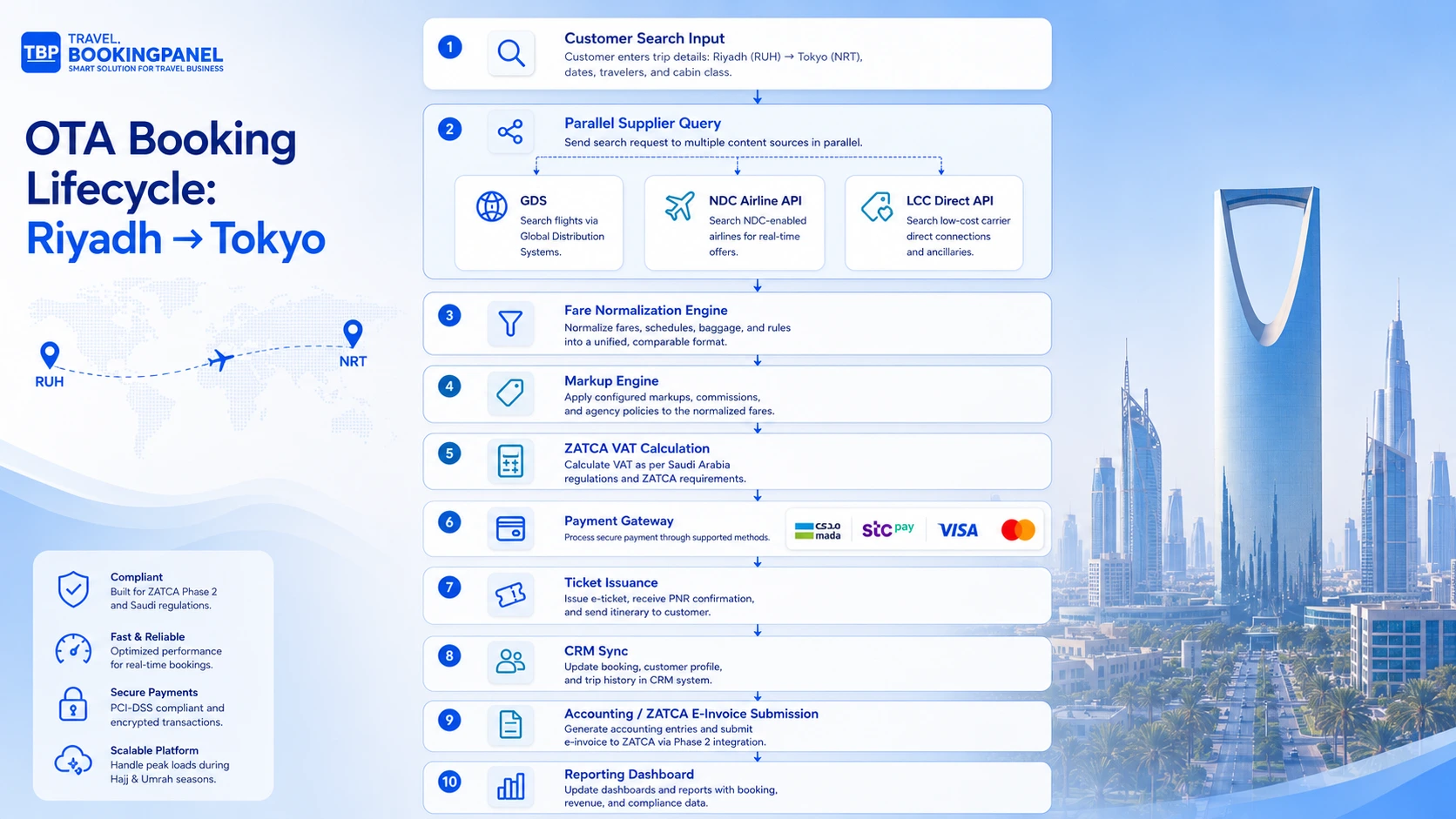
Stage-by-Stage Breakdown
Search and supplier query
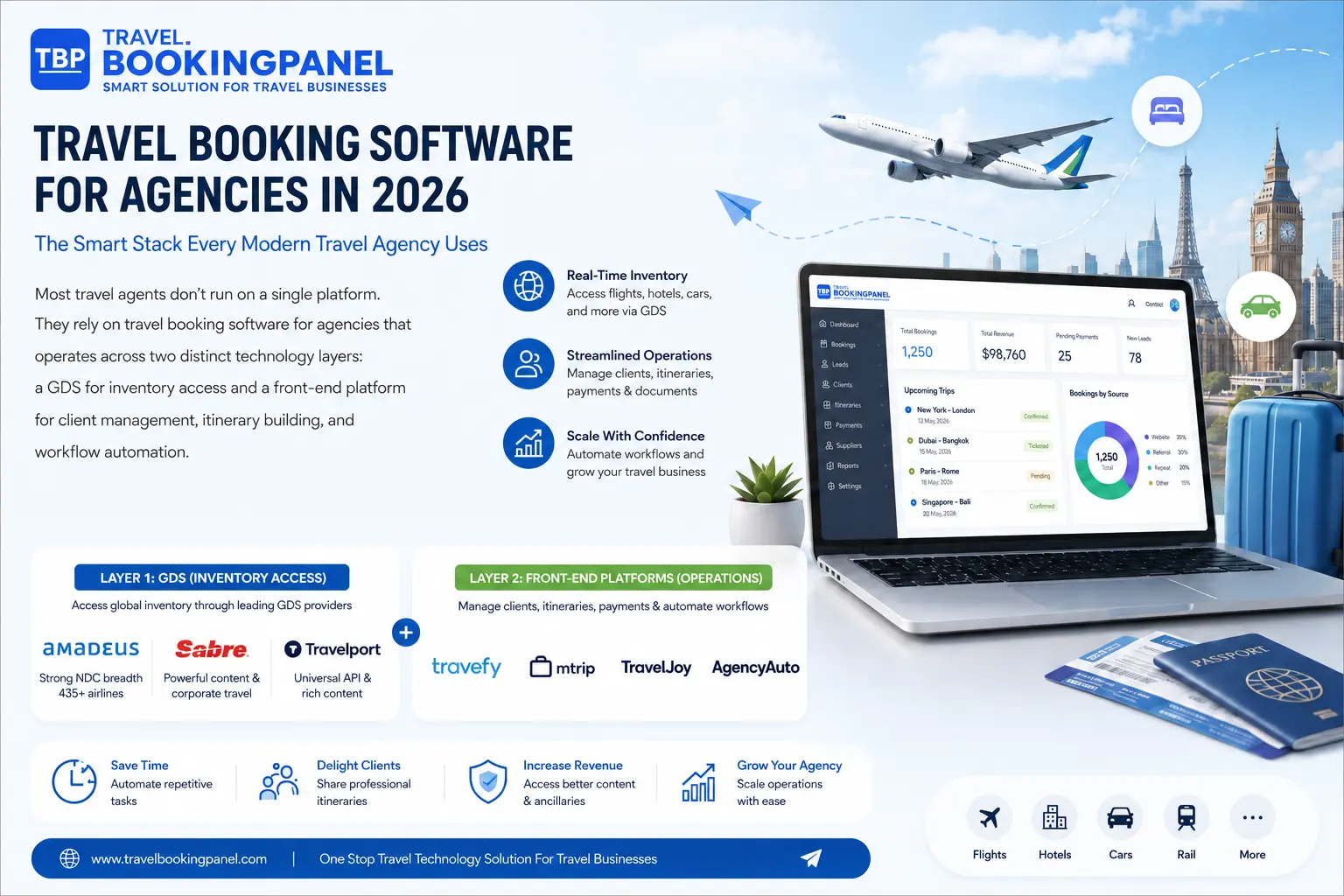
High-performance travel software for Saudi Arabia doesn't rely on a single inventory source. It queries legacy GDS platforms (Amadeus, Sabre, and Travelport), NDC-certified airline APIs, and direct LCC connections in parallel, allowing the platform to aggregate and normalize results before presenting them to the user.
Fare normalization
GDS returns EDIFACT-style pricing. NDC returns XML offers with bundled ancillaries. LCC APIs return their own proprietary formats. The normalization layer has to reconcile all three into one comparable price table. This is where most generic platforms choke, because they were built assuming a single content source.
Markup and VAT
Agency margin gets applied, then Saudi VAT calculation runs against the base fare per ZATCA rules, not a flat percentage tacked on at checkout.
Payment and ticketing
A well-designed travel software for Saudi Arabia platform ensures that payment authorization through gateways such as Mada, STC Pay, or regional acquiring banks is completed before IATA BSP ticketing is initiated. This sequencing minimizes failed ticket issuance, payment disputes, and back-office reconciliation errors.
CRM, accounting, reporting
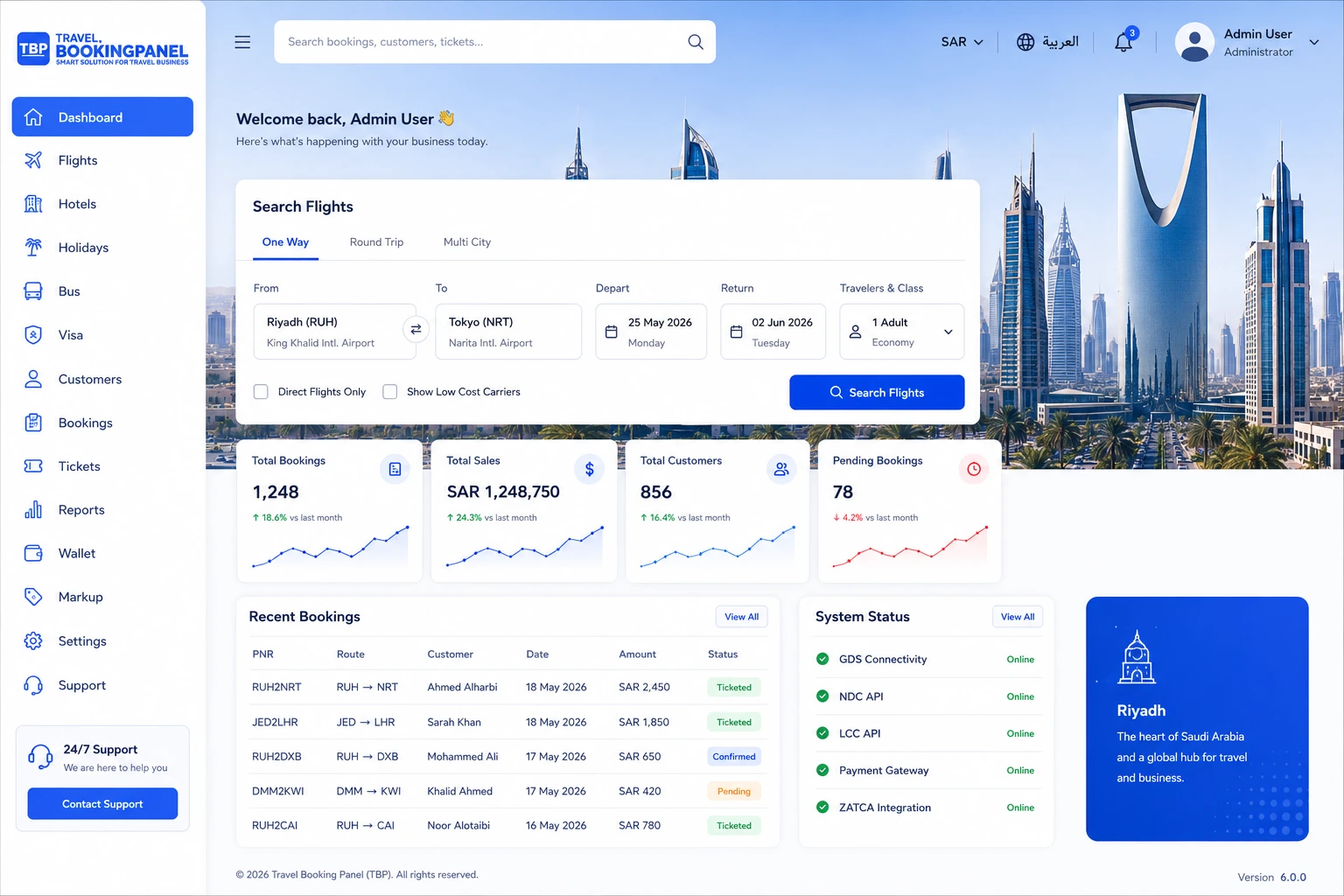
The booking record needs to sync to CRM for post-sale service, flow into accounting for BSP reconciliation, and generate a ZATCA-compliant e-invoice automatically, not as a manual export step.
Build vs Buy vs Customize: The Real Cost Comparison
Every agency owner in this budget range asks the same question eventually: do we build from scratch, buy an off-the-shelf platform, or customize an existing base? Here's how the trade-offs actually break down.
Option 1: Full Custom Build
Custom travel software for Saudi Arabia gives you complete ownership of the architecture. Every ZATCA integration, supplier connection, pricing rule, approval workflow, and operational process is designed around your business instead of being constrained by a generic platform. While this is the most expensive and time-intensive approach initially, it's also the only one that completely removes the "generic platform ceiling" that many growing agencies eventually encounter.
Option 2: Buy an Established OTA Platform
Faster to launch, lower upfront cost, and you inherit whatever compliance and integration work the vendor has already done if they've actually done it for the Saudi market specifically. This is where the earlier evaluation criteria matter most: a platform built for Southeast Asia or Europe with a Saudi "add-on" is not the same as one architected for ZATCA and RTL from the start. For agencies focused on rapid deployment, travel software for Saudi Arabia is often the right choice when business processes closely match standard OTA booking workflows.
Option 3: Customize a Base Platform
A hybrid approach to travel software for Saudi Arabia starts with an established platform or mature codebase that already provides core infrastructure, such as supplier integrations, booking engines, payment processing, and CRM capabilities. Instead of rebuilding these standard components, development focuses on customizing the compliance, localization, and operational workflow layers to meet Saudi-specific requirements. For many mid-sized agencies, this offers the best balance between cost, flexibility, and implementation speed.
Cost Bands and What They Actually Buy
| Budget Range | What's Realistic | Common Gaps at This Tier |
| $30,000-$75,000 | Customized base platform, single-language front end, core GDS integration | Limited NDC coverage, manual ZATCA workarounds, thin load capacity |
| $75,000-$150,000 | Multi-supplier aggregation (GDS + NDC + LCC), native ZATCA Phase 2 integration, RTL-first design | Custom Hajj/Umrah workflows may still need a second phase |
| $150,000-$300,000 | Full custom build, dedicated load architecture for seasonal spikes, multi-branch BSP reconciliation, dedicated Hajj/Umrah booking module | Requires ongoing engineering resources, not just a one-time build |
The pattern that matters: below roughly $75,000, most platforms are making a trade-off somewhere, usually ZATCA integration depth or NDC coverage. Knowing which trade-off you're making beats discovering it during a compliance audit.
NDC, GDS, and LCC: What Your Supplier Mix Should Actually Look Like
In travel software for Saudi Arabia, this is the layer most buyers overlook, even though it has the greatest impact on how future-proof the platform really is.
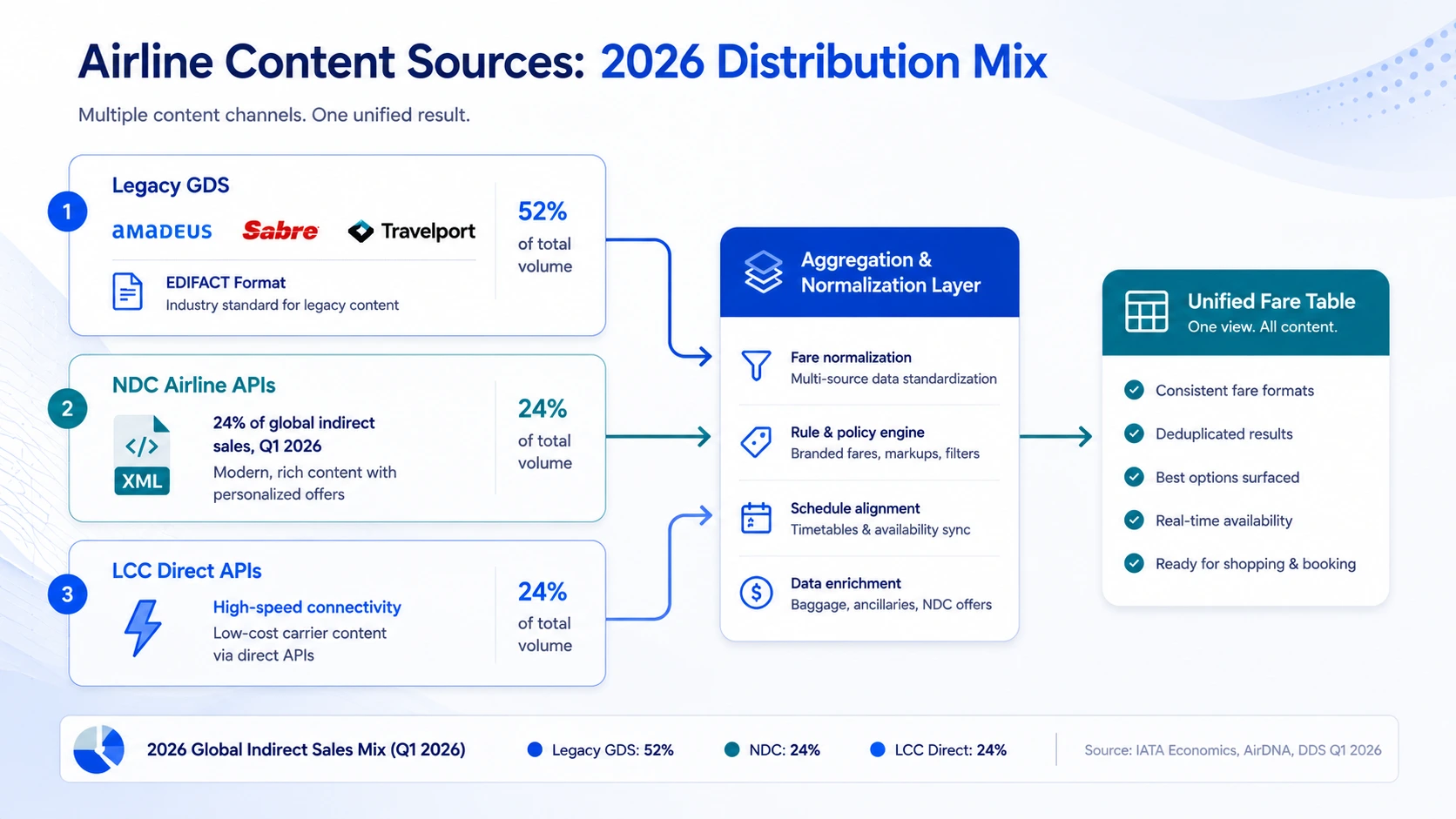
Why NDC Isn't Optional Anymore
NDC transaction volume has been climbing steadily. Global indirect airline ticket sales processed through NDC reached approximately 24% in Q1 2026, up from just 11% in 2023. That's more than doubled in three years. A platform with GDS-only integration is already missing a meaningful and growing share of available airline content, including richer ancillary bundles and often more competitive fares. NDC industry data via Navan.
The Trade-Off Nobody Mentions in Sales Demos
In travel software for Saudi Arabia, NDC isn't a drop-in replacement for GDS. Each airline implements its own variation of the standard, so aggregating content across multiple NDC providers requires sophisticated normalization, not just connecting to an API. That's why vendors claiming "NDC support" should be able to specify exactly which airlines they've certified with and how they manage multiple implementations.
A Practical Framework for Your Supplier Mix
| Supplier Type | Strength | Weakness | When to Prioritize |
| GDS (Amadeus, Sabre, Travelport) | Broad legacy coverage, mature tooling | Missing NDC-exclusive fares and ancillaries | Corporate travel, complex multi-city itineraries |
| NDC Airline APIs | Richer content, personalized offers, growing fare exclusivity | Fragmented "flavors" per airline, integration overhead | Leisure OTAs competing on price and ancillary upsell |
| LCC Direct APIs | Fastest response times, lowest-cost fares | No GDS/NDC standardization, one-off integrations per carrier | High-volume domestic and regional routes |
Saudi-Specific Requirements Most Vendors Skip
ZATCA Phase 2: What "Compliant" Actually Means
Phase 1 (Generation) just required electronic invoice storage; most systems cleared that bar years ago. Phase 2 (Integration) is a different standard entirely: invoices must be generated in UBL 2.1 XML format, cryptographically stamped, and cleared through ZATCA's Fatoora platform in real time for B2B transactions or reported within 24 hours for B2C.
The rollout has moved in waves by revenue threshold, and the compliance bar keeps tightening. The most recent wave covers taxpayers with VAT-subject revenue above SAR 375,000, with ZATCA's penalty-waiver window closing permanently on June 30, 2026. After that date, enforcement has no exceptions. If your vendor's "ZATCA-compliant" claim doesn't specify Phase 2 integration by name, ask a Phase 1-only system directly, as it will not clear the current requirements. ZATCA Wave 24 compliance guide, Flick Network.
Arabic RTL as Architecture, Not Translation
RTL done properly means the entire component structure, from fields, price tables, date pickers, and navigation mirrors, is set correctly, not just the text direction. Platforms that add RTL as a post-launch CSS patch tend to break on mixed-content pages (Arabic text next to Latin-script airline codes, SAR currency symbols, or English brand names), which is exactly the kind of content a Saudi OTA runs constantly.
The Technical Checklist Your Vendor Should Clear
Travel software for Saudi Arabia must treat Phase 2 compliance as more than a checkbox. It's a collection of interconnected technical requirements that should be verified individually during vendor evaluations. The checklist below provides a structured way to assess whether a platform is truly implementation-ready.
| Requirement | What It Means | Red Flag if Missing |
| UBL 2.1 XML generation | Invoices structured in the exact schema ZATCA requires | PDF-only invoicing, no structured XML |
| Cryptographic stamping | Each invoice is signed with a ZATCA-issued certificate | No CSID (Compliance Cryptographic Stamp Identifier) process |
| Real-time clearance (B2B) | Invoice sent to ZATCA and approved before reaching the buyer | Invoices sent to customers before ZATCA validation |
| 24-hour reporting (B2C) | Simplified invoices reported to ZATCA within a day of issuance | No automated reporting pipeline |
| TLV-encoded QR codes | Machine-readable QR code embedded per ZATCA's tag structure | QR code present but not properly encoded |
| Fatoora API integration | Direct, ongoing connection to ZATCA's platform | Manual upload workflows instead of live integration |
IATA BSP Reconciliation for Multi-Branch Agencies
Agencies running multiple branches need consolidated BSP reporting, not per-branch manual reconciliation. This is a back-office requirement that rarely shows up in a sales demo but becomes a daily operational cost if it's missing.
Hajj and Umrah: Different Booking Logic Entirely
Standard leisure booking flows assume flexible dates and price-driven decisions. Hajj and Umrah booking behavior is fundamentally different: fixed religious calendar windows, group booking patterns, visa-linked itineraries, and traffic that can spike 5-10x in short windows. It's the fastest-growing part of the market. Vision 2030 Tourism Tracker.
A platform architected only for standard leisure bookings will need custom workarounds for this workarounds that tend to break under load exactly when it matters most. Saudi Arabia's Vision 2030 plan targets 30 million annual Umrah pilgrims by 2030, up from a baseline of nearly 8 million, which means the seasonal load problem isn't shrinking.
Expert Insight: What This Looks Like in Production
The Cost-of-Rebuild Problem
The most expensive mistake in this category isn't picking the wrong vendor upfront; it's picking a platform that passes a sales demo but fails at scale, then discovering the rebuild costs more than starting over would have. Agencies that buy generic, retrofit-later platforms tend to hit this wall around 12-18 months in, right when transaction volume and ZATCA scrutiny both increase.
A Realistic Scenario Walkthrough
Consider a mid-sized agency that buys a $60,000 generic OTA platform with a Saudi "localization pack" added on top. In the first six months, the booking volume is modest, ZATCA hasn't flagged anything, and the RTL interface looks fine on the marketing pages. By month nine, NDC-sourced fares start appearing more often in competitor searches, and the agency's GDS-only integration means it's quietly losing price-sensitive bookings without an obvious cause.
By month twelve, the agency crosses the ZATCA revenue threshold that triggers Phase 2 enforcement, and the "localization pack" turns out to be a manual invoice upload workflow rather than a live Fatoora integration, creating a compliance backlog under a hard deadline.
By month fifteen, the first real Umrah season hits, and the platform's load architecture, never tested past steady-state traffic, starts timing out during peak search windows, right when booking intent (and potential revenue) is highest. None of these failures happened because the vendor was dishonest. They happened because the platform was built for a different market's assumptions, and each gap only became visible once real Saudi-specific conditions tested it. The rebuild that follows costs more than the original $60,000 build and costs the agency, which lost bookings during the gap.
What Breaks First
In practice, the failure sequence is predictable:
- ZATCA integration breaks first because it's the compliance requirement with the hardest deadline and the least flexibility.
- Fare normalization breaks the second time, once NDC volume grows past what a GDS-only integration was built to handle.
- Load capacity breaks third, usually during the first real Hajj or Umrah season the platform faces.
Building or buying with these three failure points addressed from day one costs more upfront. It costs dramatically less than a mid-life rebuild under regulatory or seasonal pressure.
Different Buyers, Different Requirements
Choosing travel software for Saudi Arabia isn't a one-size-fits-all decision. The right platform depends on whether you're building an OTA, a corporate travel platform, a tour operator system, or a Hajj and Umrah business. Here's how the requirements differ.
OTAs Launching in KSA
The priority is content breadth and checkout speed; you're competing on price and selection, so NDC/GDS/LCC aggregation and low-latency fare search matter more than almost anything else on this list.
Tour Operators
Package logic (hotel + flight + ground transport bundled pricing) matters more than raw airline content breadth. ZATCA compliance is still mandatory, but the architecture priority shifts toward multi-supplier package assembly rather than pure flight-search speed.
Corporate Travel Companies
Multi-branch reconciliation, staff-level permissions, and reporting depth matter most. Corporate clients also increasingly expect NDC-sourced fares with negotiated corporate rates, which means the platform needs mature NDC handling, not just basic GDS access.
Hajj and Umrah Operators
This segment has the most specialized requirements on the list: visa-linked itinerary logic, group booking workflows, and load architecture built for extreme seasonal spikes rather than steady-state traffic. Generic OTA platforms almost always need substantial custom work here; this is the segment where a full custom build is hardest to avoid.
| Buyer Type | Top Priority | Secondary Priority |
| OTA launching in KSA | NDC/GDS/LCC content breadth | Checkout speed and conversion |
| Tour operator | Multi-supplier package assembly | ZATCA compliance |
| Corporate travel company | Multi-branch reporting, NDC corporate rates | Staff permissioning |
| Hajj/Umrah operator | Seasonal load architecture | Visa-linked group booking logic |
What Changes in the Next 12-18 Months
The shelf life of travel software for Saudi Arabia is shrinking as new APIs, AI capabilities, payment technologies, and regulatory requirements emerge. Understanding what's coming next will help you choose a platform that can evolve instead of one you'll eventually have to replace.
ZATCA Enforcement Tightens Further
The penalty-waiver period that's given many businesses breathing room during the Phase 2 transition ends permanently on June 30, 2026. From that point, ZATCA moves into full enforcement with no exceptions. Penalties for non-issuance or non-archiving of e-invoices start at SAR 5,000, and deletion or amendment of issued invoices carries penalties starting at SAR 10,000, escalating with repeat violations.
Waves have continued rolling out by revenue threshold, and the trend is toward covering smaller and smaller agencies over time. If your platform's ZATCA integration is still a manual workaround, this is the window to fix it before enforcement removes the margin for error.
Airline Retailing Keeps Shifting Toward NDC
Industry analysis from IATA's 2025 Annual Review shows even leading airlines are still in early stages of full offers-and-orders adoption, with broader industry maturity not expected before 2028-2030. But the interim trend is unambiguous: NDC's share of indirect sales has been climbing steadily, and travel management companies have reported triple-digit year-over-year growth in NDC booking volume. Platforms that treat NDC as a "nice-to-have" integration today are building on assumptions that won't hold for the life of a five-year platform investment.
Vision 2030's Final Phase Accelerates Volume
As Vision 2030 enters its final phase running through 2030, tourism, hospitality, and events investments are expected to accelerate further, with several mega-projects reaching new milestones and the Kingdom's events calendar continuing to expand. For software buyers, this translates directly into rising transaction volume and rising expectations for platform reliability. The systems that struggle with today's traffic levels will struggle considerably more as that growth compounds.
The Practical Implication
None of this means the buying decision should wait. It means the platform chosen now needs headroom for compliance enforcement that's about to tighten, for a supplier landscape that's shifting toward NDC, and for visitor volume that's still climbing toward its 2030 target. A platform built only for today's requirements is, by definition, already behind schedule.
Vendor Red Flags Checklist
Before choosing travel software for Saudi Arabia, run every vendor conversation through the checklist below. Vague, incomplete, or evasive answers to any of these questions should be treated as warning signs rather than routine sales responses.
- They describe "ZATCA compliance" without specifying Phase 1 versus Phase 2.
- They can't name how many NDC-certified airlines they actually support.
- Load testing results are described in uptime percentages, not response times under simulated Hajj-season traffic.
- RTL support is demonstrated only on marketing pages, not inside the actual booking flow.
- Local payment gateway integration (Mada, STC Pay) is listed as "in progress" or “on request.”
- Multi-branch BSP reporting requires a manual export rather than native reconciliation.
Key Takeaways
- There's no universal "best" travel software; the right platform depends on your GDS/NDC/LCC mix, ZATCA exposure, and seasonal load pattern.
- ZATCA Phase 2 compliance (UBL 2.1 XML, real-time clearance, and cryptographic stamping) is non-negotiable, and enforcement has no exceptions after June 30, 2026.
- API latency isn't a technical nice-to-have; a 0.1-second improvement in travel booking flows has been linked to a 10.1% conversion lift.
- Arabic RTL, local payment gateways, and Hajj/Umrah load handling need to be architectural decisions, not features added after launch.
- The real cost comparison isn't sticker price; it's the sticker price versus the cost of a mid-life rebuild when a generic platform hits its ceiling.
Related Questions Buyers Actually Ask
Which Is the Best Travel Portal in Saudi Arabia?
This question conflates two different products. A "portal," a customer-facing booking website, is the visible layer. The infrastructure underneath it (supplier connections, fare engine, and compliance layer) is what actually determines whether the portal works.
A polished front end sitting on a weak backend will fail during Hajj season traffic spikes or the moment ZATCA flags a non-compliant invoice. Evaluate the infrastructure first, the portal design second.
What to Actually Compare When Evaluating Portals
- Search speed under load, not just search speed in a quiet demo environment.
- Content breadth: how many suppliers actually feed the portal's results.
- Mobile performance, since a majority of travel searches in the region now originate on mobile.
- Checkout completion rate, which ties directly back to the API latency issue covered earlier.
What Is the Saudi Arabia Flight Ticket App Landscape?
Consumer-facing flight apps (the kind travelers download) solve a different problem than agency infrastructure. They're built for individual searches, not multi-branch B2B operations with BSP reconciliation, staff-level permissions, and bulk ticketing. If you're a travel agency owner, the consumer app market isn't your competitive benchmark; your competitors are other B2B platforms with proper agency tooling.
The Distinction That Actually Matters
Consumer apps optimize for a single traveler completing a single transaction. Agency infrastructure needs to handle concurrent staff logins, branch-level permissions, commission tracking, and bulk group bookings, none of which a consumer app architecture was ever designed to support. Comparing your software shortlist against consumer flight apps is comparing the wrong category entirely.
Why Do Generic Travel Booking Systems Fail in Saudi Arabia?
Generic feature checklists don't tell the full story when evaluating travel software for Saudi Arabia. The real differentiators lie in architecture, compliance, localization, and supplier connectivity. These are the areas where off-the-shelf platforms most often break down.
| Failure Point | What Happens | Why Generic Platforms Miss It |
| ZATCA e-invoicing | Invoices rejected, penalties from SAR 5,000 | Built for VAT regimes without real-time clearance requirements |
| Hajj/Umrah traffic spikes | Site crashes or times out during peak booking windows | Load testing done for steady-state, not 5–10x seasonal spikes |
| Arabic RTL rendering | Layout breaks with real Arabic content, and numeral formatting fails | RTL added as a CSS overlay, not built into the component architecture |
| Local payment gateways | Failed transactions, abandoned checkouts | Only global card processors are integrated; no Mada/STC Pay support |
| Multi-branch reconciliation | Manual, error-prone BSP settlement | No native IATA BSP reporting module |
Tags
Own Your Travel Platform. Forever.
Buy once, own forever. Full source code · No monthly fees · No hidden charges.