A traveler clicks "Confirm Booking." The screen spins for two seconds. A confirmation number appears. Almost nobody, not the traveler, not the agency owner watc...
A traveler clicks "Confirm Booking." The screen spins for two seconds. A confirmation number appears. Almost nobody, not the traveler, not the agency owner watching the sale come through, sometimes not even the junior agent processing it, knows what just happened in those two seconds.
A fare got re-validated against a live supplier feed that may have changed price three times since the search results loaded. A reservation record was constructed in a format that some airlines still process in the way they did in the 1990s. A queue was created somewhere, waiting for a human or a script to notice if anything goes wrong.
Why This Gap Is the Whole Story
This gap between what travel agency software looks like and what it's actually doing is exactly why most buying decisions in this space go sideways. Agency owners get sold on dashboards and demo booking flows. Six months later, they're the ones fielding angry calls about a duplicate hotel booking or a fare that “worked in the demo.”
This guide is written for the people who have to live with that gap: agency owners, OTA founders, CTOs, and operations managers who need to choose or build software that survives contact with real bookings, real suppliers, and real refund requests. Not another feature checklist. The mechanics underneath it.
What Travel Agency Software Actually Is (And Why the Category Confuses Buyers)
Here's the part most vendor pages skip: "travel agency software" isn't one thing. It's a stack of distinct systems wearing a single marketing label: reservation engines, mid-and back-office tools, CRM, supplier connectivity, and financial reconciliation, all expected to behave like a single coherent product.
At the functional level, this software manages reservations, itinerary creation, customer records, invoicing, supplier integration, and commission tracking through a centralized digital platform, letting agencies reduce manual booking work and connect directly with airline and hotel inventory.
That's the textbook description. It's also the reason so many buying decisions go wrong because "manages reservations" and "connects with inventory" sound like a single checkbox, when in practice they're five separate engineering problems stacked on top of each other.
Why This Decision Carries Real Weight
The market backs up how consequential this decision has become. According to a travel agency software market report, the global market was valued at roughly $1.14 billion in 2026 and is projected to grow at an 8.9% CAGR to $2.47 billion by 2035, growth driven less by new agencies opening and more by existing agencies replacing spreadsheets and disconnected tools with platforms that can actually keep pace with booking volume.
So before comparing vendors, it's worth understanding what's actually happening under the hood every time someone clicks "book."
Why Feature Checklists Fail as a Buying Method
Most software comparisons on this topic follow the same template: a feature list, a pricing table, some screenshots, a pros-and-cons section, and a conclusion nudging toward whichever vendor is sponsoring the article. That format works fine for choosing a note-taking app. It fails badly for travel software because the features that look identical on a checklist behave completely differently under real booking pressure.
Two platforms can both claim "GDS integration" and "24/7 support." One handles a supplier outage by auto-queuing affected bookings and notifying agents within minutes; the other requires someone to notice the outage manually and start working the queue by hand. Both check the same box. Only one keeps a busy season from turning into a support crisis.
The Point of This Guide
That's the gap this guide is written to close, not by adding more features to compare, but by explaining what's actually happening underneath the ones that matter.
The Five Layers Hiding Inside One Product Category
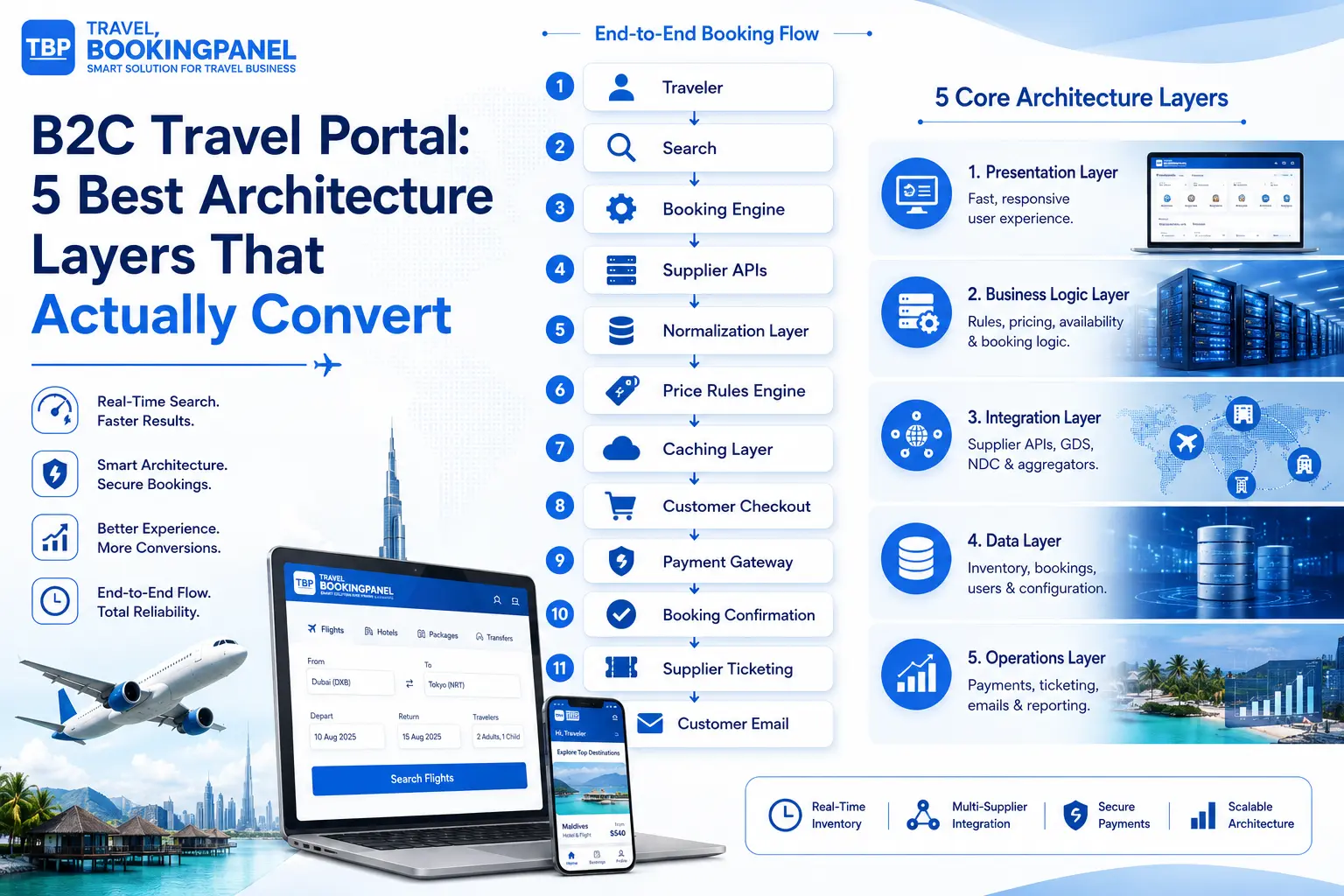
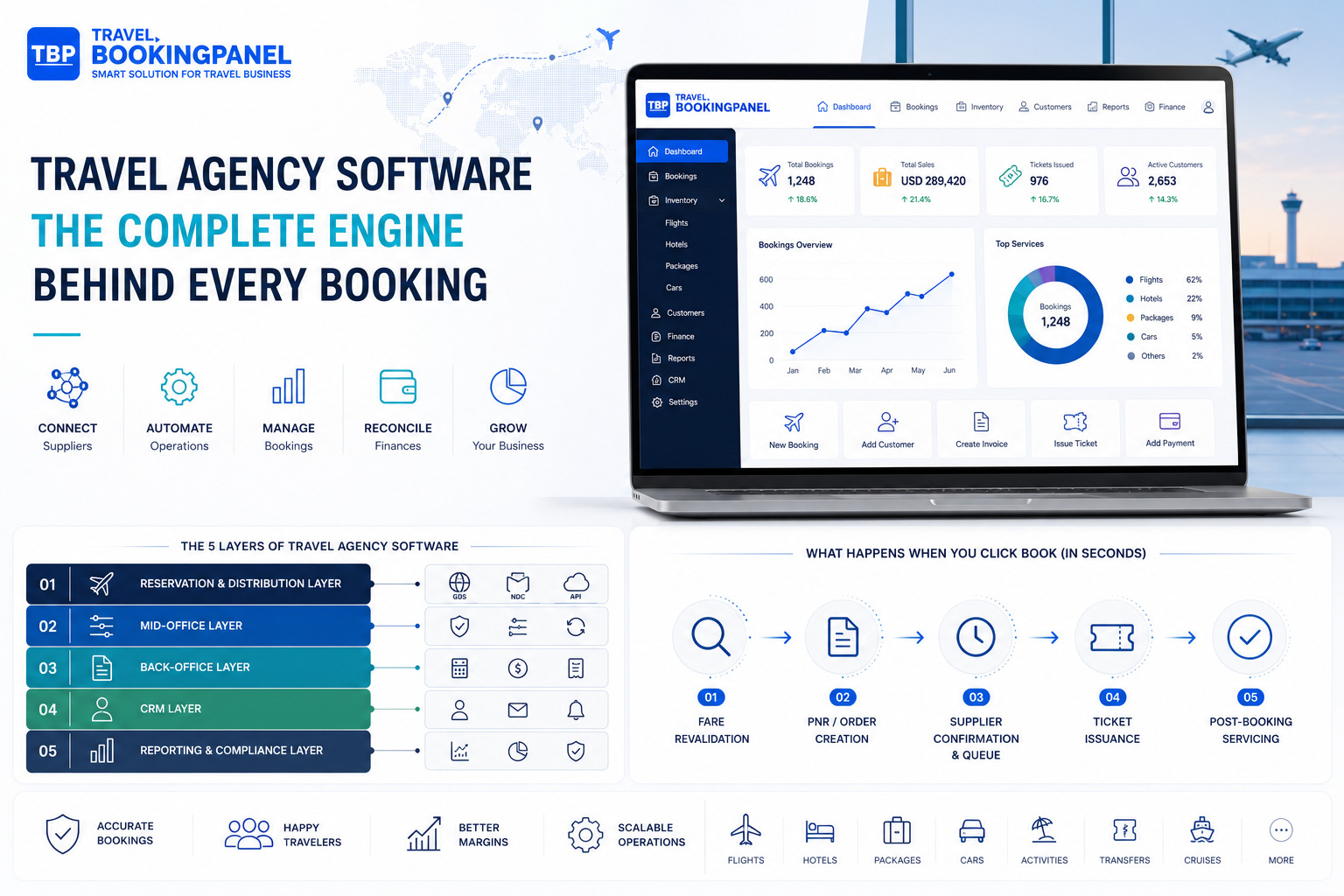
- The reservation and distribution layer connects to GDS, NDC, direct APIs, and bedbanks.
- The mid-office layer validates, queues, and reconciles what the distribution returns.
- Back-office layer: invoicing, commission tracking, accounting exports.
- CRM layer traveler profiles, preferences, and communication history.
- Reporting and compliance layer everything a CFO or regulator eventually asks for.
Vendors sell these as one product. Engineers build them as five. Buyers who understand that difference ask sharper questions, and that's where the real story starts: what happens the instant someone clicks "Book"?
The Direct Answer: What Happens the Instant Someone Clicks "Book"
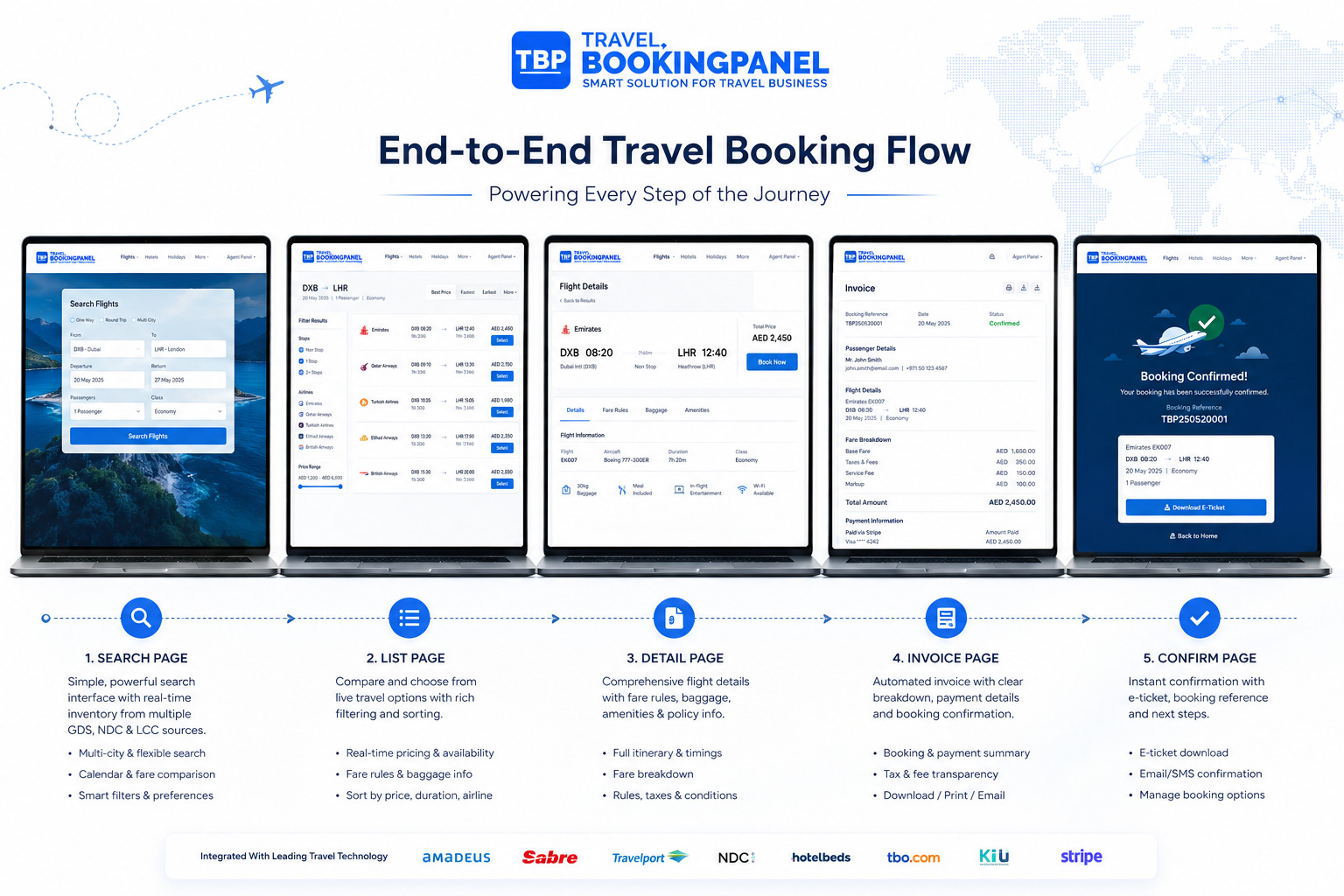
Most articles stop at "it supports GDS." That sentence is technically true and operationally useless. Here's what it actually means, step by step.
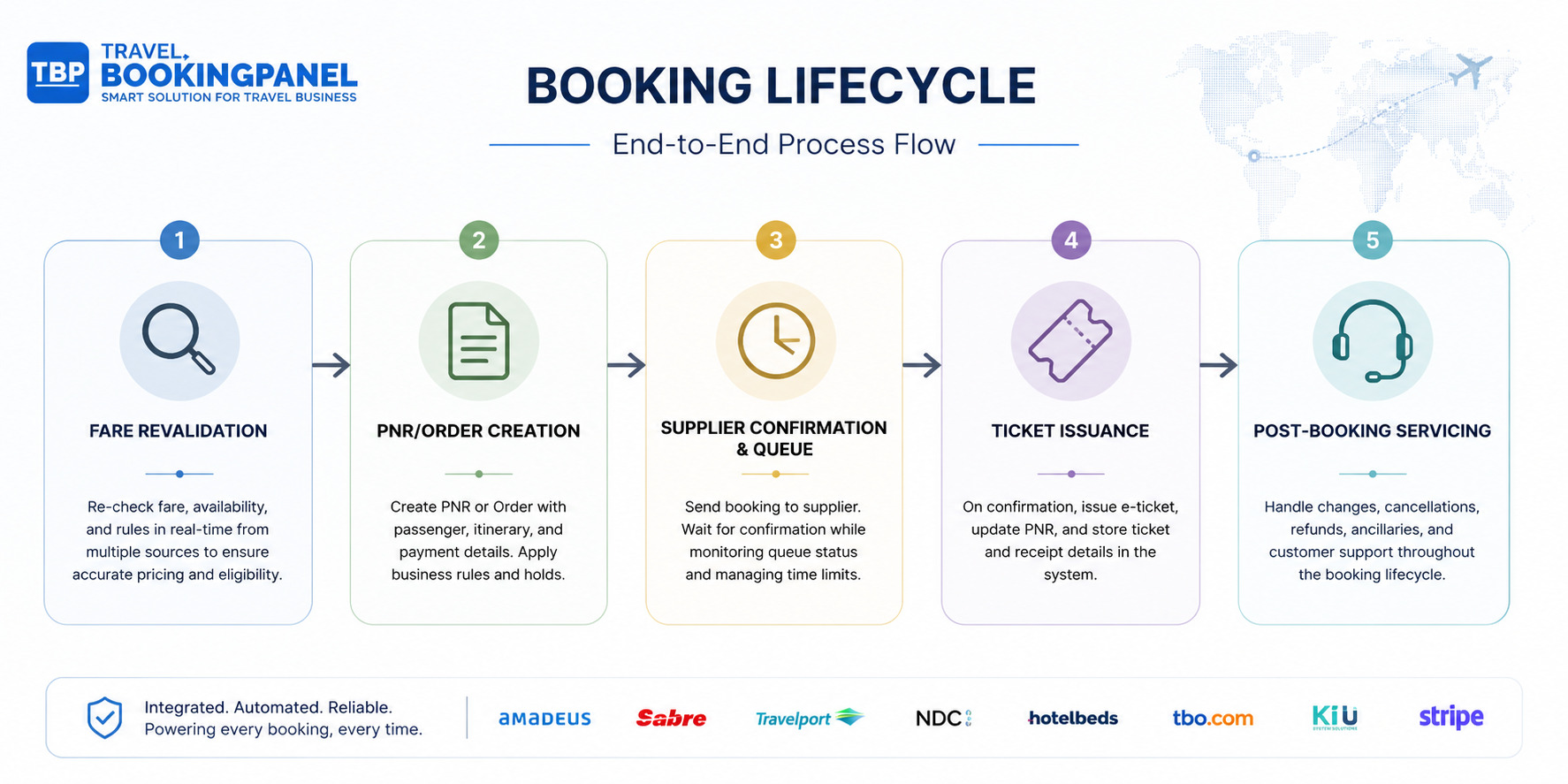
Step 1: Fare and Availability Revalidation
The price a traveler saw in search results is not guaranteed. Between search and booking, fares move, seat allotments shrink, and supplier caches go stale. So the system re-checks the fare and availability against the live supplier feed at the moment of booking, not the moment of search. This single step is why "the price changed at checkout" complaints exist, and why agencies that skip proper revalidation logic bleed margin on mismatched fares.
Step 2: PNR Creation
A Passenger Name Record (PNR) gets created, the master record tying together passenger details, itinerary, fare rules, and supplier references. For GDS bookings, this follows decades-old formatting conventions. For NDC bookings, it's an "Offer/Order" object instead, which behaves differently enough that the Offer/Order lifecycle requires entirely new workflows for servicing, refunds, and PNR handling, and legacy ticketing assumptions can break in the process. This is precisely why platforms that only handle GDS-style PNRs struggle the moment an agency wants to sell NDC content.
Step 3: Supplier Confirmation and Queuing
The supplier airline, hotel, or wholesaler confirms or rejects the request. If it confirms instantly, great. If it doesn't (a common occurrence with wholesalers and some hotel APIs), the booking sits in a queue waiting for confirmation, follow-up, or manual intervention. This queue is where a huge share of agency operational headaches actually live, and it's rarely mentioned in a sales demo.
Step 4: Ticket Issuance and Documentation
Once confirmed, the ticket (for flights) or voucher (for hotels/packages) gets issued. Schedule changes after this point trigger their own workflow re-validation, passenger notification, and sometimes re-ticketing.
Step 5: Post-Booking Servicing
This is the step vendors talk about the least, and agents deal with the most: cancellations, date changes, refunds, and seat modifications. Not every airline supports NDC servicing in the same way. One airline may support changes and refunds cleanly; another may require manual handling for the same request, meaning the "smooth booking experience" buyers see in a demo can fall apart entirely on the servicing side months after the sale.
Understanding these five steps changes how you evaluate software. You stop asking "Does it support GDS?" and start asking "How does it handle step 5 when the airline's NDC servicing is weak?" That question alone will filter out half the vendors in any comparison call.
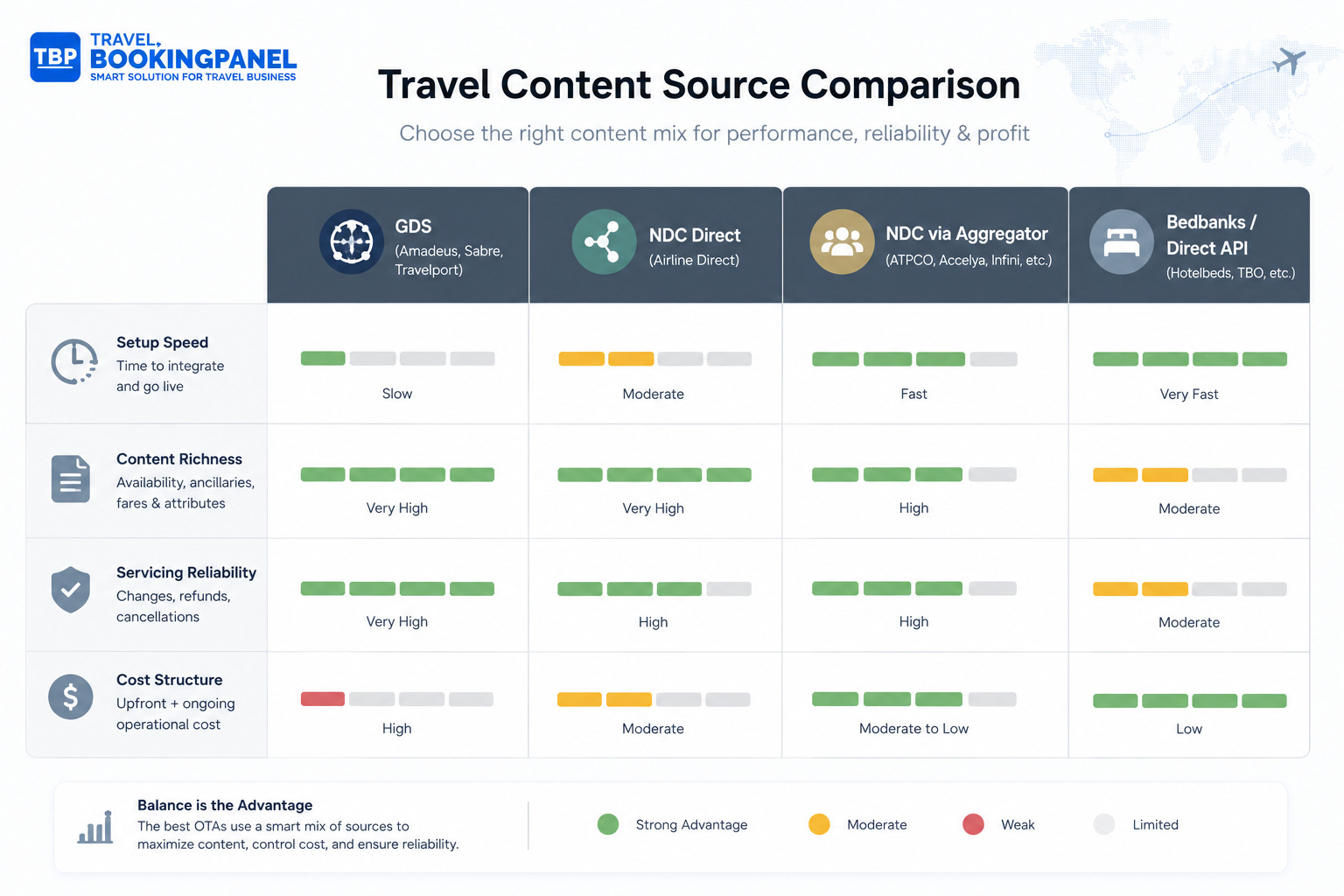
GDS, NDC, Direct APIs, and Bedbanks: What Each Model Actually Solves (and Where It Breaks)
Every agency eventually asks the same question: should we build on GDS, go direct to NDC, plug into wholesalers, or run all three? The honest answer is that these aren't competing options; they're different tools solving different problems, and most mature agencies end up running a blend.
GDS: The System Everyone Complains About, and Nobody Fully Replaces
GDS platforms (Amadeus, Sabre, Travelport) remain the backbone of corporate and complex-itinerary travel because of what they solve reliably: standardized ticketing, BSP/ARC clearing, and decades of accumulated fare rules across airlines. As one detailed NDC-versus-GDS comparison puts it, GDSs fit cleanly into corporate travel policies, reporting, and BSP/ARC clearing systems and offer stability through a long history of consistent booking flow, ticketing, and post-sale servicing, which is exactly why, despite years of "GDS is dying" predictions, it hasn't disappeared.
The trade-off is real too: GDS pricing structures are opaque, training staff on cryptic terminal commands takes time, and airlines increasingly reserve their best fares and ancillary bundles for NDC channels instead.
NDC: More Powerful, Also More Fragmented
NDC lets airlines sell richer, more e-commerce-like product bundles, dynamic pricing, and loyalty-integrated offers directly through modern APIs. The catch is that NDC maturity varies wildly by airline. One airline may support search and booking well, another may support ancillaries, another may have limited servicing, and another may require manual handling for changes or refunds entirely. That inconsistency is the single biggest reason agencies underestimate NDC integration timelines.
Why Aggregators Exist
Because building direct NDC connections airline-by-airline is prohibitively expensive for most agencies, a layer of aggregators (Verteil, AirGateway, TPConnects, and similar) has emerged to normalize this fragmentation. Rather than requiring every agency to build a direct NDC connection with every airline, a technically and commercially prohibitive undertaking, aggregators sit between the airline and the agent, normalizing content and presenting bookable inventory in a format that integrates with existing workflows. For a small or mid-size agency, this middle layer is often the difference between "NDC is a strategic advantage" and "NDC is a project that never ships."
Direct Airline APIs and Bedbanks: Depth Over Breadth
Direct airline APIs and hotel bedbanks (wholesaler inventory) trade breadth for depth, having fewer suppliers but often better margins, exclusive rates, or content GDS doesn't carry. They're rarely a full replacement for GDS or NDC on their own; they're usually a supplementary layer that expands margin or coverage for specific markets.
Quick Comparison
| Model | Best For | Main Limitation |
| GDS | Corporate travel, complex itineraries, and standardized ticketing | Opaque pricing, steep learning curve, shrinking airline content |
| NDC (direct) | Access to the richest airline content and ancillaries | Fragmented maturity across airlines, heavy integration cost |
| NDC (via aggregator) | Small/mid agencies wanting NDC content without full build cost | Per-transaction aggregator fees |
| Direct airline API | Specific high-volume routes/carriers | Limited to one supplier's inventory |
| Bedbanks/wholesalers | Hotel margin and exclusive rates | Inventory overlap and duplicate mapping issues |
None of these models is "correct." The right stack depends on agency size, booking volume, and which of these five failure points you're least equipped to absorb operationally. And that leads directly into the part of the stack that quietly costs agencies more engineering time than any supplier integration ever does.
The API Ecosystem Map: Who Actually Powers What You're Selling
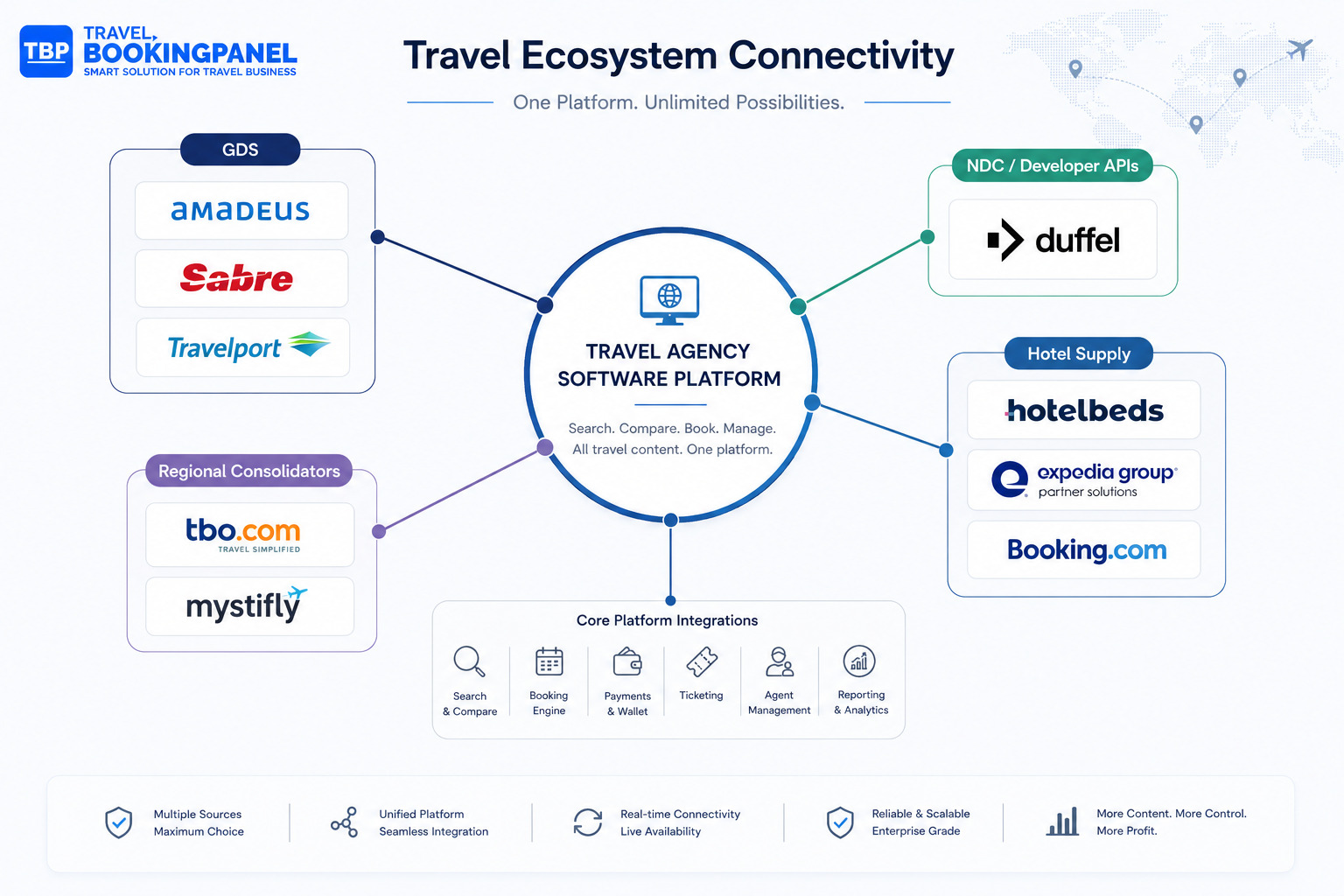
Every travel platform buyer eventually asks a version of the same question: "Whose inventory am I actually reselling?" The honest answer is that no single supplier covers everything, and understanding how these players relate to each other explains a lot about why integration timelines run long.
The Legacy Distribution Layer
Amadeus, Sabre, and Travelport remain the three GDS giants, each holding decades of airline contracts, fare rules, and BSP/ARC clearing relationships. They compete with each other, but functionally they solve the same problem in slightly different ways, which means a platform built for one doesn't port cleanly to another without real integration work.
The NDC and New-Distribution Layer
Duffel has positioned itself as a developer-first NDC layer, aiming to make airline API integration feel closer to a modern payments API than a legacy GDS terminal. It represents a broader shift: newer entrants competing less on supplier count and more on how fast a developer can actually ship an integration.
The Hotel Aggregation Layer
Hotelbeds and similar bedbanks supply wholesale hotel inventory at negotiated rates, often with better margins than direct contracts but with their own mapping and availability quirks. Booking.com and Expedia Partner Solutions operate on the opposite end, with directly contracted inventory with rich content and verified reviews but typically thinner margins and stricter distribution terms.
The Regional and Niche Layer
TBO and Mystifly serve as regional consolidators strong in specific geographies (South Asia and Middle East corridors) where global giants have thinner coverage. For agencies targeting Umrah, Hajj, or South Asian outbound travel specifically, these regional players often matter more to booking success than any global GDS relationship.
Why This Map Matters for Buyers
None of these suppliers talk to each other natively. A platform that claims broad "supplier coverage" is really claiming it has built and maintains individual integrations and normalization logic across some subset of this map. The bigger the claimed coverage, the more scrutiny the normalization layer deserves, for exactly the reasons covered next.
The Real Engineering Challenge Nobody Warns You About: The Normalization Layer
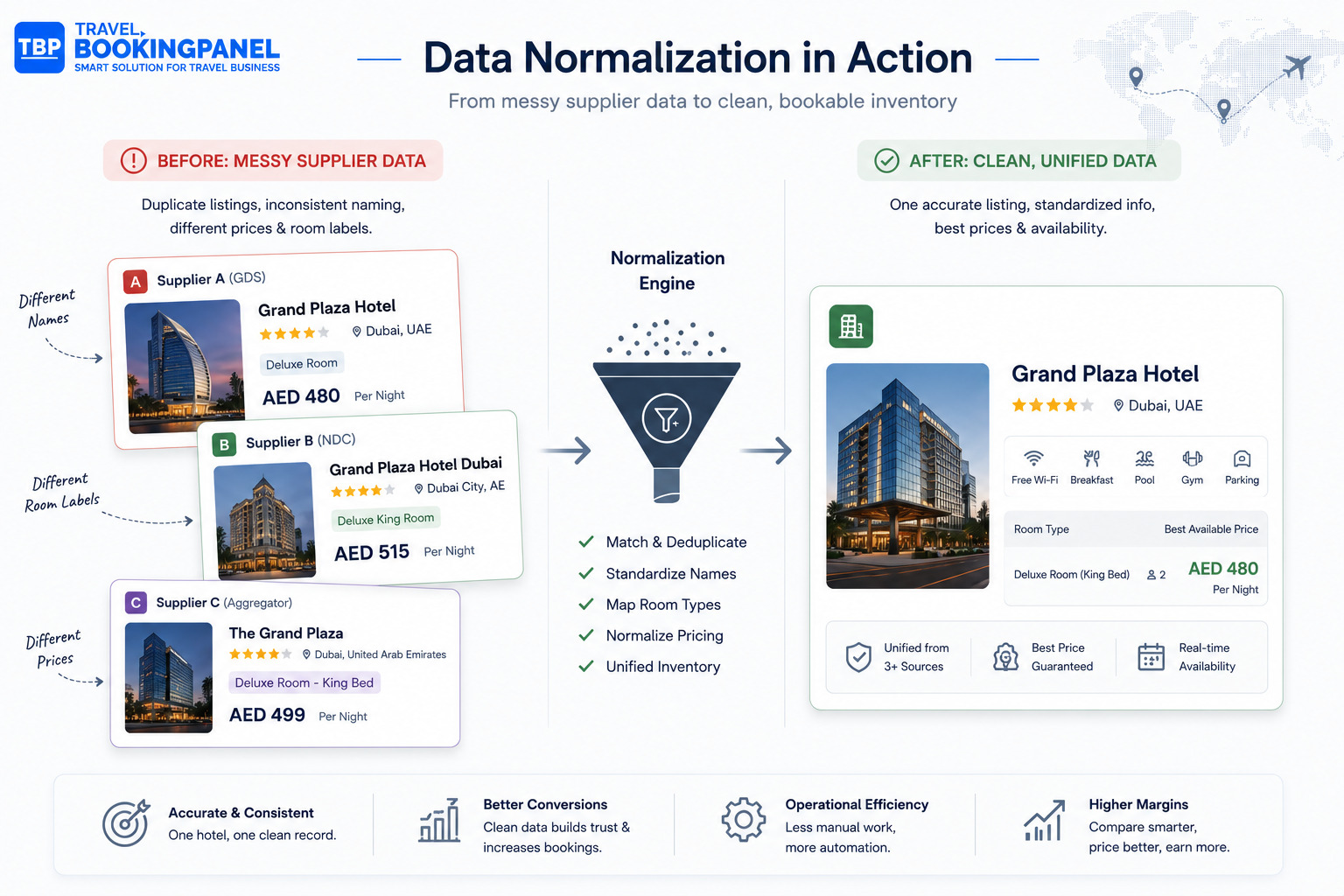
Here's an uncomfortable truth for anyone evaluating or building travel software: connecting to your first three or four suppliers is the easy part. The part that quietly consumes the most engineering time, the part that turns a six-month project into an eighteen-month one, is making all of that supplier data agree with itself.
Why the Same Hotel Has Five Different Names
As one detailed guide to hotel mapping tools explains, travel platforms aggregate hotel information from many sources, which often results in the same physical property being listed under different identification codes and names across suppliers. One supplier calls it "Midwest Ocean Resort"; another calls it "Midwest Resort & Spa," and to your booking engine, those look like two entirely different hotels unless something reconciles them.
Hotel and Room-Level Mapping
This reconciliation process hotel mapping has to work at two levels: the property level (is this the same building?) and the room level (is a "Deluxe King" on one supplier the same physical room as a "Superior Double" on another?). Modern mapping systems lean on algorithms, including AI-based matching, that compare names, addresses, and geo-coordinates to merge duplicate entries and ensure each hotel is uniquely represented. Skip this step, or do it poorly, and travelers end up seeing the same room offered twice at two different prices, which does nothing for trust or conversion.
Currency and Rate Reconciliation
Layering currency conversion on top of mapping compounds the complexity. A supplier quoting in local currency, converted at a slightly stale exchange rate, sitting next to a markup rule that was configured for a different currency baseline, creates exactly the kind of silent pricing error that shows up as a customer complaint three weeks later, not a system alert today.
Cancellation Policy Standardization
Every supplier writes cancellation policies differently, with different cutoff windows, different penalty structures, and different terminology for the same concept. Standardizing these into one consistent, customer-facing policy format is unglamorous work, and it's exactly the kind of work that determines whether a customer trusts your booking confirmation or calls support to double-check it.
Why This Matters More Than the Integration Count
A vendor pitch that leads with "we connect to 200+ suppliers" is answering the wrong question. The question that actually predicts whether a platform will hold up under real booking volume is, “How good is the normalization layer sitting behind those 200 suppliers?” Agencies that learn this the hard way usually learn it through a duplicate booking, a rate mismatch, or a refund dispute, never through a sales deck.
This is also where the hidden cost conversation begins, because normalization isn't a one-time build. It's ongoing maintenance, forever, for as long as suppliers keep changing their data formats.
The Bottlenecks That Never Make It Into a Sales Demo
Ask any operations manager who's run a travel platform for more than a year what actually eats their time, and you'll get a strikingly consistent list, one that rarely appears on a vendor's feature page.
Duplicate Hotels and Rate Parity Conflicts
Even with mapping in place, duplicates slip through, and rate parity disputes emerge when the same property shows different prices across channels, sometimes triggering supplier penalties, sometimes just customer confusion.
Booking Failures and Supplier Downtime
Suppliers go down. APIs time out. A "confirmed" booking occasionally reverts to "failed" after the fact, and someone has to notice, notify the customer, and rebook ideally before the customer notices first.
Currency Mismatches and Markup Conflicts
Multi-currency operations are where markup logic quietly breaks. A margin rule built for one currency context, applied without adjustment to another, can silently erode profit on an entire booking category before anyone catches it in a report.
Failed Payment Recovery
A declined payment on a confirmed reservation creates a race against supplier cancellation deadlines. Good systems automate the retry-and-notify sequence; weak ones leave an agent manually chasing a customer while a hold window closes.
Queue Management at Scale
Every unconfirmed, flagged, or exception booking lands in a queue somewhere. At low volume, a human can eyeball it. At real scale, queue management has to be systematized, or exceptions get lost, and a lost exception is usually a lost customer.
A Concrete Example of Why This Matters
Picture a mid-size agency processing 300 hotel bookings a day across a mix of GDS, a bed bank, and two direct hotel contracts. On a normal day, 95% confirm instantly. The remaining 15 bookings land in a queue, some waiting on supplier confirmation, some flagged for a rate mismatch, and a couple stuck because a currency conversion pushed the final price outside an approved tolerance.
If that queue is a shared inbox someone checks "when they get a chance," those 15 bookings sit unresolved for hours. Some resolve themselves. A few don't, and by the time anyone notices, a narrow window of opportunity has closed or a customer has already called asking why their confirmation email never arrived. Multiply that by a busy season, and the queue stops being a minor inconvenience and starts being the reason an agency loses repeat customers.
The Fix: Prioritized, Automated Queues
The fix isn't more staff watching the inbox harder. It's a system that prioritizes queue items by urgency (a closing hold window ranks above a routine rate-mismatch flag), assigns them automatically, and escalates anything unresolved past a threshold. That's the difference between "queue management" as a checkbox and queue management as something that actually holds up during a Saturday morning rush.
None of this is exciting to write about. It's also exactly the list an experienced CTO or agency owner will silently check off while reading this, nodding at each one because they've lived through it. That's the point; this is where trust in an article, or a vendor, actually gets built.
The Hidden Cost of Building This Yourself
Every few years, a well-funded agency decides to build its own booking platform instead of buying one. The pitch is usually the same: full control, no vendor lock-in, no per-transaction fees. What the pitch tends to leave out is that the build cost isn't the expensive part; the ownership cost is.
Ongoing Supplier Maintenance
Suppliers change their API contracts, deprecate old endpoints, and update data formats without much warning. An in-house platform needs a permanent engineering allocation just to keep existing integrations from silently breaking, not to add new ones.
Fraud Prevention Infrastructure
Payment fraud in travel bookings is a specialized problem: chargebacks on high-ticket items, stolen-card testing through low-cost fare searches, and account-takeover patterns specific to loyalty programs. Building this detection layer from scratch is a multi-month project on its own before it ever touches a real booking.
Support Staffing During Supplier Outages
When a major GDS or hotel supplier goes down, support volume spikes immediately. Agencies running their own platform need staffing depth to absorb that spike; agencies on a shared platform benefit from a vendor who's already built the incident-response playbook.
Compliance and Regulatory Overhead
PCI-DSS compliance, data residency requirements, and regional travel-industry regulations shift periodically and unevenly across markets. Each shift is a compliance review, sometimes a code change, and always a cost that doesn't show up in an initial build estimate.
Build vs buy isn't a wrong decision at any given size; some enterprise DMCs genuinely need the control that owning the stack provides. But it's a decision that should be made against these four ongoing cost categories, not against the upfront build quote alone.
An Evaluation Framework: How to Actually Score Travel Agency Software
Feature checklists are how vendors want to be evaluated because checklists favor whoever has the longest list. A better approach scores platforms across the dimensions that actually predict whether the software will hold up operationally.
The Ten Dimensions Worth Scoring
| Dimension | What to Actually Test |
| API quality | Documentation clarity, response consistency, and error handling |
| Uptime | Historical incident reports, not just an SLA number on a slide |
| Supplier ecosystem | Breadth and the normalization quality behind it |
| Booking speed | Time from search to confirmed PNR under real load |
| Scalability | Behavior at 10x current booking volume, not launch-day volume |
| Support | Response time during an active supplier outage, not a sales call |
| Documentation | Whether a developer can self-serve an integration without hand-holding |
| Reporting | Whether financial reconciliation actually matches supplier invoices |
| Automation | How much of the queue-management burden is actually automated |
| Security | PCI compliance, data handling, and access controls under audit |
Run any vendor through these ten dimensions instead of a feature list, and the conversation changes completely from "what does it do" to "what happens when it's under real pressure."
Where TravelBookingPanel Fits Into This Framework
TravelBookingPanel was built around exactly this operational lens rather than a features-first pitch. It's a B2B travel technology platform designed for OTAs, DMCs, and travel agencies that need supplier connectivity, mid/back-office tooling, and reporting to work together as one system rather than as bolted-together modules.
Where it tends to earn a serious look in evaluations: agencies dealing with a mixed GDS/NDC/wholesaler supplier stack who need the normalization and queue-management layer, as discussed earlier, as the real engineering bottleneck handled as a core capability rather than an afterthought.
Where it's worth pressure-testing like any vendor: run it through the ten-dimension framework above, specifically around your own supplier mix and booking volume, before assuming any platform is the right fit. You can review the platform directly at TravelBookingPanel and weigh it against the same criteria you'd apply to any other vendor on your shortlist.
Choosing Software by Agency Size and Business Model, Not a Generic "Top 10"
Software that's right for a five-person leisure agency is often wrong for a corporate TMC, and vice versa. The same travel agency software that feels effortless for one operating model can feel like a straitjacket for another. Matching the decision to your actual operating model matters more than any star rating.
Small Agencies and New OTAs
Priority: fast time-to-launch, low upfront cost, aggregator-based NDC, and hotel API access rather than direct integrations. Building your own normalization layer at this stage is rarely worth the engineering cost of buying into an existing one.
Growing Mid-Size Agencies
Priority: booking volume is enough that manual queue management starts breaking, and multi-currency or multi-market operations begin exposing markup and mapping issues. This is the stage where automation in queue handling and reporting starts paying for itself directly.
Enterprise DMCs and Corporate TMCs
Priority: deep GDS integration for policy compliance and BSP/ARC clearing, dual-source GDS/NDC strategies for cost savings on NDC-active carriers, and reporting that satisfies both finance and compliance teams simultaneously. For corporate travel programs with significant volume on NDC-active airlines, the cost savings from a dual-source GDS/NDC strategy alone can justify the investment, but only once the integration complexity is properly budgeted for, not underestimated.
The practical challenge is that NDC API connections require real technical investment, with implementation timelines that can run six months to a year per airline, a very different planning horizon than the "we'll add NDC next quarter" line that shows up in a lot of enterprise roadmaps.
The Regional Reality Check
Infrastructure maturity changes this calculus significantly by geography. A mid-size agency running on three staff members, a single GDS terminal, and a WhatsApp group for client communication cannot realistically manage GDS workflows, NDC API integrations, and divergent servicing processes across multiple airline implementations simultaneously, and treating that as a near-term transition plan, rather than a multi-year one, is where a lot of regional NDC rollouts stall.
Agencies operating in markets with thinner technical infrastructure or smaller support teams are usually better served by leaning harder on aggregators and pre-built platforms than on direct integration ambitions.
The Underestimated Cost Categories, Regardless of Size
Whatever the agency size, four cost categories get consistently underestimated at the buying stage: ongoing supplier maintenance as APIs change, fraud prevention tooling, support staffing during supplier outages, and compliance overhead as regulations shift. None of these show up in a demo. All of them show up in year two.
Key Takeaways
- Good travel agency software isn't one product; it's really five distinct systems: distribution, mid-office, back-office, CRM, and reporting, sold under one label.
- The booking process isn't a single click; it's fare revalidation, PNR/order creation, supplier confirmation, ticket issuance, and post-booking servicing, and servicing is where most operational pain lives.
- GDS, NDC, direct APIs, and bedbanks each solve different problems; most mature agencies run a blend rather than picking one model.
- The hardest engineering problem isn't connecting to suppliers; it's normalizing hotel mapping, currency, and cancellation policies across them.
- Evaluate vendors against ten operational dimensions (API quality, uptime, supplier ecosystem, booking speed, scalability, support, documentation, reporting, automation, security) instead of a feature checklist.
- The right software depends on agency size and business model; a small OTA and an enterprise TMC should not be shopping from the same shortlist.
Tags
Own Your Travel Platform. Forever.
Buy once, own forever. Full source code · No monthly fees · No hidden charges.