.png)
Integrating Amadeus GDS (Global Distribution System) into a PHP travel portal unlocks live flight, hotel, and car data for agencies and resellers. Developers ca...
Integrating Amadeus GDS (Global Distribution System) into a PHP travel portal unlocks live flight, hotel, and car data for agencies and resellers. Developers can use Amadeus’s APIs and PHP SDK to embed flight search & booking engine functionality directly into their site developers.amadeus.com. For non-technical users, white-label OTA platforms offer pre-built panels that plug into Amadeus behind the scenes, letting agencies sell tickets under their own brand. In this guide we’ll cover both approaches – coding a custom PHP integration vs. using a white-label solution – and highlight benefits like real-time inventory, automation, and scalability.
Integrating Amadeus via PHP
To start a GDS API integration, register on Amadeus for Developers to get an API key and secret. Then set up your PHP environment (PHP 7.4+) and install the official Amadeus PHP SDK (available via Composer) developers.amadeus.com. For example:
composer require amadeus4dev/amadeus-php
Using the SDK, your code can authenticate and fetch data with just a few lines. For instance, in PHP you might write:
use Amadeus\Amadeus; $amadeus = Amadeus::builder("YOUR_API_KEY", "YOUR_API_SECRET")->build(); $flightOffers = $amadeus->getShopping()->getFlightOffers()->get([ "originLocationCode" => "NYC", "destinationLocationCode" => "LON", "departureDate" => "2025-12-01", "adults" => 1 ]);
This calls the Amadeus Flight Offers API and returns live flight options developers.amadeus.com. The integration workflow generally looks like this:
Obtain API access. Create an Amadeus developer account and retrieve your client ID/secret.
Install and configure SDK. Use Composer to install amadeus4dev/amadeus-php, and load the autoloader.
Authenticate & request. Initialize the Amadeus client with your credentials and call endpoints (flights, hotels, etc.) via the SDK methods.
Handle responses. Parse the JSON responses to display flight/hotel results on your booking engine.
Image: Example workflow for a PHP-based Amadeus API integration (API key → PHP SDK call → Display flights).
As illustrated above, the PHP SDK hides most OAuth and HTTP details. You simply call methods like $amadeus->getShopping()->getFlightOffers()->get() developers.amadeus.com and then handle the response. Amadeus returns real-time data (flights, carriers, seats, fares) so your portal always shows up-to-date inventory. Common steps include testing in Amadeus’s sandbox environment and then coding the live integration once data flow is validated oneclickitconsultancy.medium.comoneclickitconsultancy.medium.com.
Key benefits of this custom integration approach include full control over the user interface and business logic. You can design your portal exactly as needed, integrate other APIs or payment gateways, and manage the data yourself. However, it requires strong PHP development skills and ongoing maintenance (monitoring API changes, uptime, etc.)oneclickitconsultancy.medium.comoneclickitconsultancy.medium.com.
White-Label GDS Panel: Simplifying with a Pre-Built Engine
A white-label GDS booking panel is a turnkey portal that connects to Amadeus (and often other GDS/LCC APIs) behind the scenes. Travel agencies can buy or license such a platform and rebrand it as their own online travel agency (OTA). The user interface, booking flow, and supplier connectivity are already built; the agency just customizes branding and content. According to experts, a white-label system “allows travel agencies to offer travel services under their own brand” by using a third-party GDS provider travelopro.com.
White-label platforms pack many features out of the box:
Multi-channel booking engine (flights, hotels, cars, tours)
Real-time inventory from Amadeus (and sometimes other GDS or LCCs)
Multi-currency, multi-lingual support for global customers travelopro.com
Agent/reseller management (B2B2C, sub-users, credit limits)
Commission and markup controls for pricing
Built-in payment gateway integration and accounting modules
Reporting dashboards and analytics
In short, the heavy lifting of integration is done for you. Travelopro notes that white-label GDS systems “support multilingual and multicurrency capabilities” and provide “real-time inventories” with built-in automation and analytics travelopro.comtravelopro.com. The platform effectively becomes a “one-stop travel store” where you can sell global content without coding everything yourself travelopro.com.
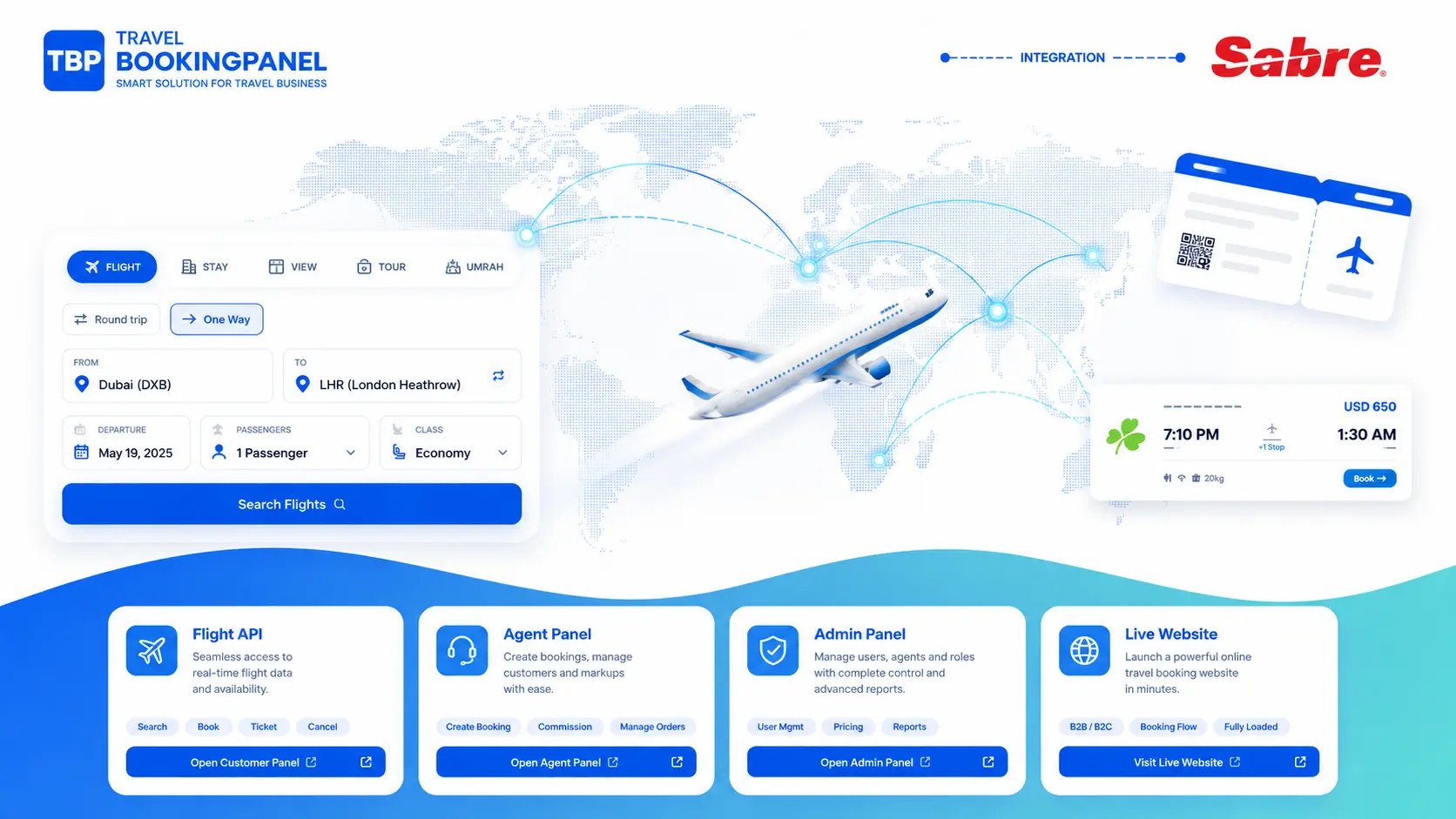
Image: Example checklist of features in an Amadeus-powered white-label travel panel (search, booking, payments, admin tools, etc.).
The checklist above highlights typical modules: flight/hotel search forms, booking engines, user dashboards, payment processing, and reporting. A good white-label panel offers centralized mid-office tools and the ability to plug into multiple GDS/LCC APIs simultaneously travelopro.comtravelopro.com. You can often add direct-contract rates or offline bookings too. Overall, the white-label solution is scalable and ready-made – agencies just focus on marketing their portal while the system handles the tech stack.
Comparing Custom PHP vs White-Label Panels
Image: Comparison of Custom PHP Integration vs White-Label OTA Platform (development effort, flexibility, features, etc.).
| Feature/Factor | Custom PHP Integration | White-Label OTA Platform |
|---|---|---|
| Development Effort | High – requires skilled developers and coding from scratch. You build UI and logic. | Low – most components are pre-built; mostly configuration and branding needed. |
| Time to Launch | Longer – design, code, and test every flow. | Shorter – platform is ready; just fill in keys and branding. |
| Customization | 100% – full control over every feature and design. | Limited to provided options (templates, settings). |
| Maintenance | Ongoing – you must update code for API changes/security. | Vendor or third party handles core updates (often included). |
| Features & Modules | You choose which to implement; everything must be built/integrated. | Rich built-in modules (flights, hotels, cars, etc.) as noted above travelopro.comtravelopro.com. |
| Cost | Potentially higher (dev time, infrastructure). | Generally lower up-front (one-time fee or subscription). |
| Scalability | Depends on your architecture; needs planning. | Usually cloud-based and ready to scale with usage. |
| Branding | Fully yours from the code up. | Fully brandable on UI and domain (the engine stays hidden) travelopro.comtravelopro.com. |
| Support & Compliance | You manage everything, including PCI/SSL. | Often built-in (white-label vendors handle security, updates). |
In summary, custom integration gives maximum flexibility but demands more technical investment. White-label platforms let non-developers launch a PHP travel portal quickly with all essential features included travelopro.comtravelopro.com. For example, Travelopro highlights that white-label solutions are “fully configurable” and let agents build a branded site in “B2C and B2B categories” without coding travelopro.com. Agencies profit from white-label’s flexibility and lower costs, since the system automates bookings and consolidates suppliers without additional development travelopro.com.
Benefits of Amadeus Integration
Whether custom or white-label, integrating Amadeus delivers critical advantages for travel businesses:
Real-Time Flight Data: Instant access to Amadeus’s global flight schedules and fares. Customers see live availability and pricing.
Automated Booking & Ticketing: APIs handle booking flows, PNR creation, and ticketing automatically, saving manual effort.
Huge Content Inventory: Tapping into Amadeus means millions of flights, multiple airlines, and partner content (hotels, cars) at your fingertips travelopro.com.
Scalability: Cloud APIs easily handle growth; you can add new services (more GDS, supplier APIs) as you expand.
Competitive Edge: Up-to-date search results and broad coverage help agencies stay competitive and boost client satisfaction travelopro.comtravelopro.com.
For example, Amadeus is used by 90,000+ travel agencies worldwide travelopro.com, reflecting its robust content and reliability. With automation, even small agencies can deliver sophisticated search engines, fare caches, and itinerary management with minimal staff overhead. And because the system is set up for white-label branding, all inventory appears under your logo – increasing your brand’s trust and reach.
Getting Started with TravelBookingPanel
If you prefer to skip the coding and launch faster, consider a ready-made Amadeus flight panel. TravelBookingPanel.com offers a turnkey White-Label Amadeus portal that comes fully integrated and customizable. This means you get a secure, scalable OTA platform with Amadeus PHP SDK baked in, along with booking engines, payment processing, and admin tools. Simply sign up, configure your API keys, apply your logo, and you’re live – transforming your travel agency into a branded online booking site without a developer.
In conclusion: Integrating the Amadeus API via PHP powers a modern travel portal with live data. While custom development gives technical freedom, white-label GDS panels deliver speed and convenience for non-coders. Both approaches tap into Amadeus’s rich content and automation. Ultimately, which path to choose depends on your resources and timeline – but the payoff (a flight booking engine that scales) is the same. Ready to launch? Explore the Amadeus flight panel at TravelBookingPanel.com and get up and running today.
FAQ
Q: What is the Amadeus PHP SDK?
A: It’s an open-source PHP library (amadeus4dev/amadeus-php) that simplifies API calls. After installing via Composer, you can authenticate with your API key/secret and make calls like $amadeus->getShopping()->getFlightOffers()->get([...])developers.amadeus.com. The SDK manages OAuth and JSON parsing for you.
Q: Do I need to code if I use a white-label panel?
A: No. White-label panels are pre-coded booking engines. You just configure API credentials and branding. The system handles technical details (APIs, hosting, security) behind the scenes travelopro.comtravelopro.com.
Q: Can a white-label travel portal handle B2B resellers or multi-agents?
A: Yes. Most professional panels include agent management modules and B2B/B2B2C features (sub-accounts, markups, credit limits). You can resell flights to partners via the same platform.
Q: What advantages does Amadeus have over other travel APIs?
A: Amadeus GDS offers a vast global inventory (airlines, hotels, etc.) and enterprise-level reliability. It’s widely recognized by travel professionals. By using it, your portal taps into the same data that major airlines and OTAs use, ensuring comprehensive options for customers.
Q: How do I maintain the integration long-term?
A: If you built custom code, plan to update it when Amadeus releases API changes or new endpoints. If you use a white-label solution, the vendor typically updates the system for you. Always monitor Amadeus developer announcements for updates.
Own Your Travel Platform. Forever.
Buy once, own forever. Full source code · No monthly fees · No hidden charges.