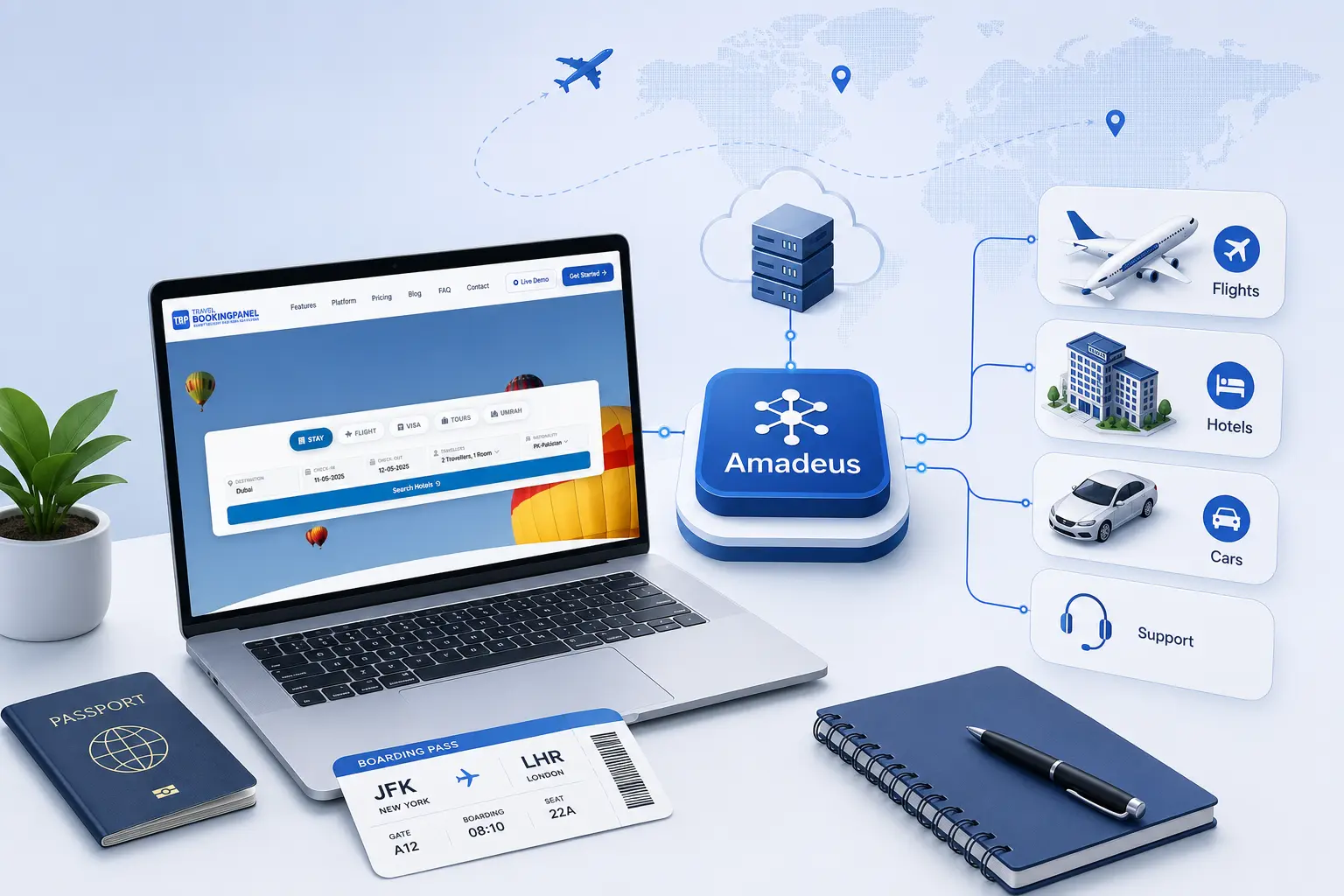
Practical Amadeus API integration guide covering architecture, booking lifecycle, and production challenges most docs skip.
What Is Amadeus API Integration?
Amadeus API integration is the process of connecting a travel platform, an OTA, booking engine, or enterprise travel system to Amadeus's GDS and NDC infrastructure to search, price, book, and manage flights, hotels, and cars in real time. If you're reading this, you probably already know that much.
What you're really trying to figure out is whether your team can build this correctly, how long it will actually take, and what's going to break in production that never showed up in the sandbox. That's what this guide covers. Not "what is Amadeus," but what it takes to run an Amadeus integration that survives real customer traffic.
How the Amadeus Ecosystem Works
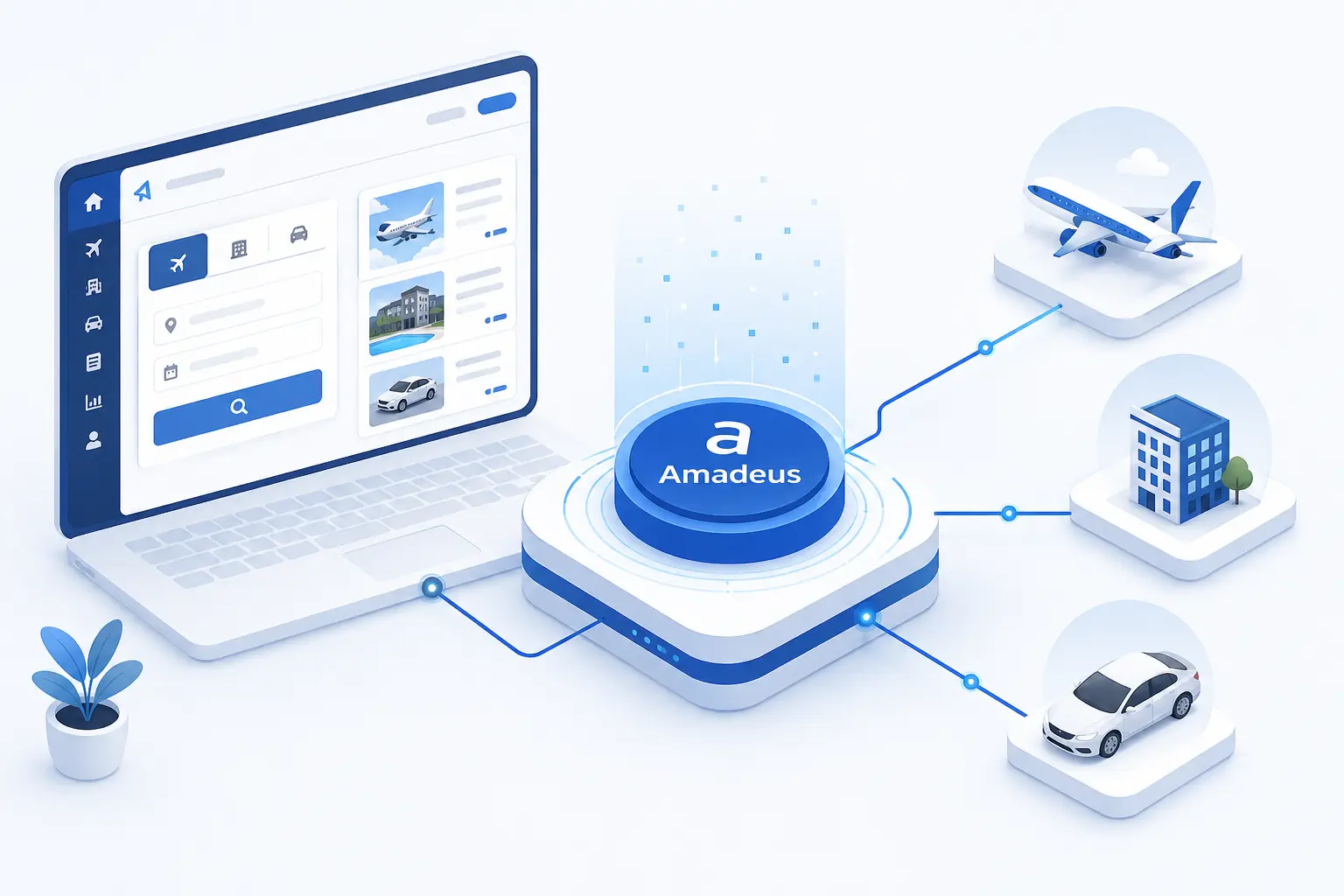
Amadeus isn't one API. It's a distribution layer that sits between airlines, hotel suppliers, and the travel platforms that sell their inventory.
GDS vs NDC: What's the Actual Difference
The traditional GDS (Global Distribution System) model standardizes how fare and availability data is formatted across airlines, which makes integration predictable but limits access to airline-specific pricing and ancillaries.
NDC (New Distribution Capability) is the airline industry's push to let carriers expose richer content, branded fares, bundles, and loyalty-linked pricing directly through XML-based APIs, bypassing some of the GDS's standardization.
For most new integrations, this matters less as a technical decision and more as a business one: NDC content typically requires separate agreements and content aggregation logic on top of what a Self-Service or Enterprise API key provides out of the box.
Where Amadeus Fits Among Travel APIs
Amadeus, Sabre, and Travelport are the three legacy GDS providers, each with comparable self-service tiers for smaller platforms and enterprise agreements for high-volume operations. Newer entrants like Duffel, Mystifly, and Verteil target the NDC-first and low-code segment, often trading some airline coverage for simpler onboarding. A full breakdown of how these compare on coverage, pricing model, and integration complexity is in the Amadeus vs. Other Travel APIs section further down.
Self-Service vs Enterprise APIs
This is the first real fork in the road, and most platforms get it wrong in one direction or the other, either overbuilding on enterprise access before they have transaction volume to justify it or hitting a wall on self-service limits mid-scale.
| Criteria | Self-Service APIs | Enterprise APIs |
| Best for | Startups, MVPs, low-to-mid volume OTAs | High-volume platforms, established travel businesses |
| Onboarding | Self-serve, developer portal signup | Managed onboarding, account manager assigned |
| Support model | Community + documentation | Dedicated technical support, SLAs |
| Catalog size | Core flight/hotel/car search and booking | Full catalog including advanced NDC content, ancillaries |
| Production access | Requires migration approval after testing | Built into contract terms |
| Pricing structure | Pay-per-call, published rate card | Negotiated volume pricing |
| Typical fit | Pre-seed to Series A travel platforms | Post-PMF OTAs, enterprise travel management companies |
The practical decision point: if you're still validating your booking flow and don't have predictable call volume, self-service gets you to production faster with less commercial overhead. Move to Enterprise once your rate-card costs at Self-Service pricing start exceeding what a negotiated Enterprise contract would cost; that crossover usually happens earlier than founders expect, often within the first 6-12 months of real traffic.
Complete Booking Workflow
Most competing guides stop after explaining Flight Search. That's a mistake, because Search is the easy part. The booking lifecycle is where integrations actually succeed or fail.
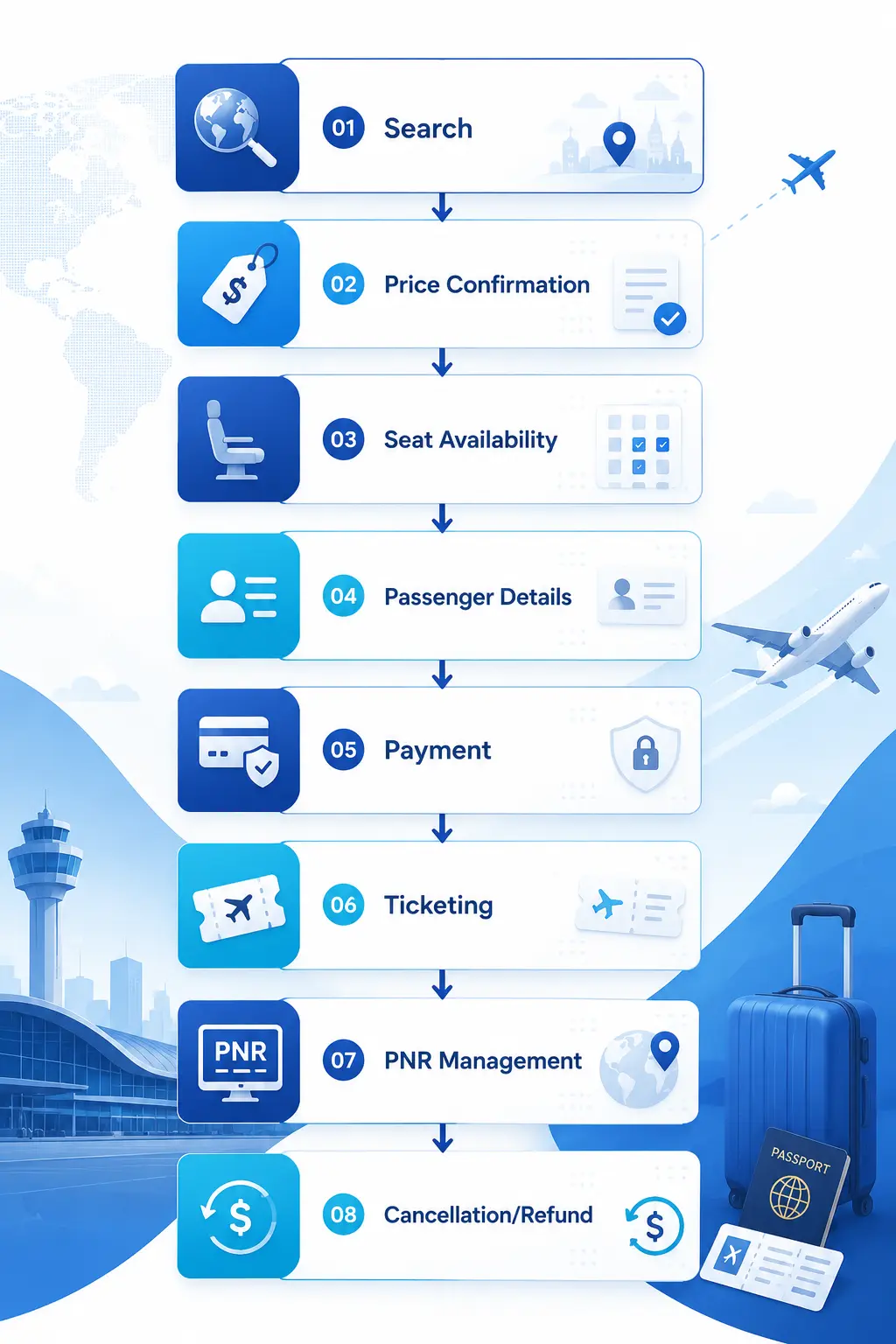
Here's why this sequence is harder to build than it looks:
- Search returns availability, but that availability is not guaranteed; it's a snapshot. Between search and booking, seats sell, fares change, and fare rules update.
- Price Confirmation revalidates the fare before booking. Skipping this step, or caching search results too aggressively, is the single most common cause of "price changed" errors that frustrate users at checkout.
- Seat availability checks aren't just about physical seats they confirm booking class availability, which can disappear even when the flight itself shows open seats.
- Passenger details collection seems trivial until you factor in document requirements for international travel, name-matching rules against passports, and special service requests (wheelchair, unaccompanied minor, dietary).
- Payment has to be sequenced correctly: ticketing charges a card before confirming ticket issuance, or vice versa, creating reconciliation problems that are painful to unwind manually.
- Ticketing is the point of no return. Once a ticket is issued, cancellation is a refund process, not a simple booking deletion.
- PNR Management covers everything that happens after booking: seat changes, schedule change notifications from the airline, and split PNRs for group bookings.
- Cancellation and refund logic has to account for fare rules, airline penalties, and critically, the difference between a voided ticket (same-day, no penalty) and a refunded ticket (penalty and processing time apply).
Most first-time OTA founders assume flight search is the difficult part. In reality, ticket issuance, re-pricing, and synchronization with supplier responses usually create the biggest engineering challenges because these are the stages where timing, state management, and error handling all have to work together correctly and where a mistake costs real money instead of just a bad UX moment.
System Architecture
A production Amadeus integration is never just "app talks to Amadeus. " It's a full pipeline with several systems that have to stay in sync.
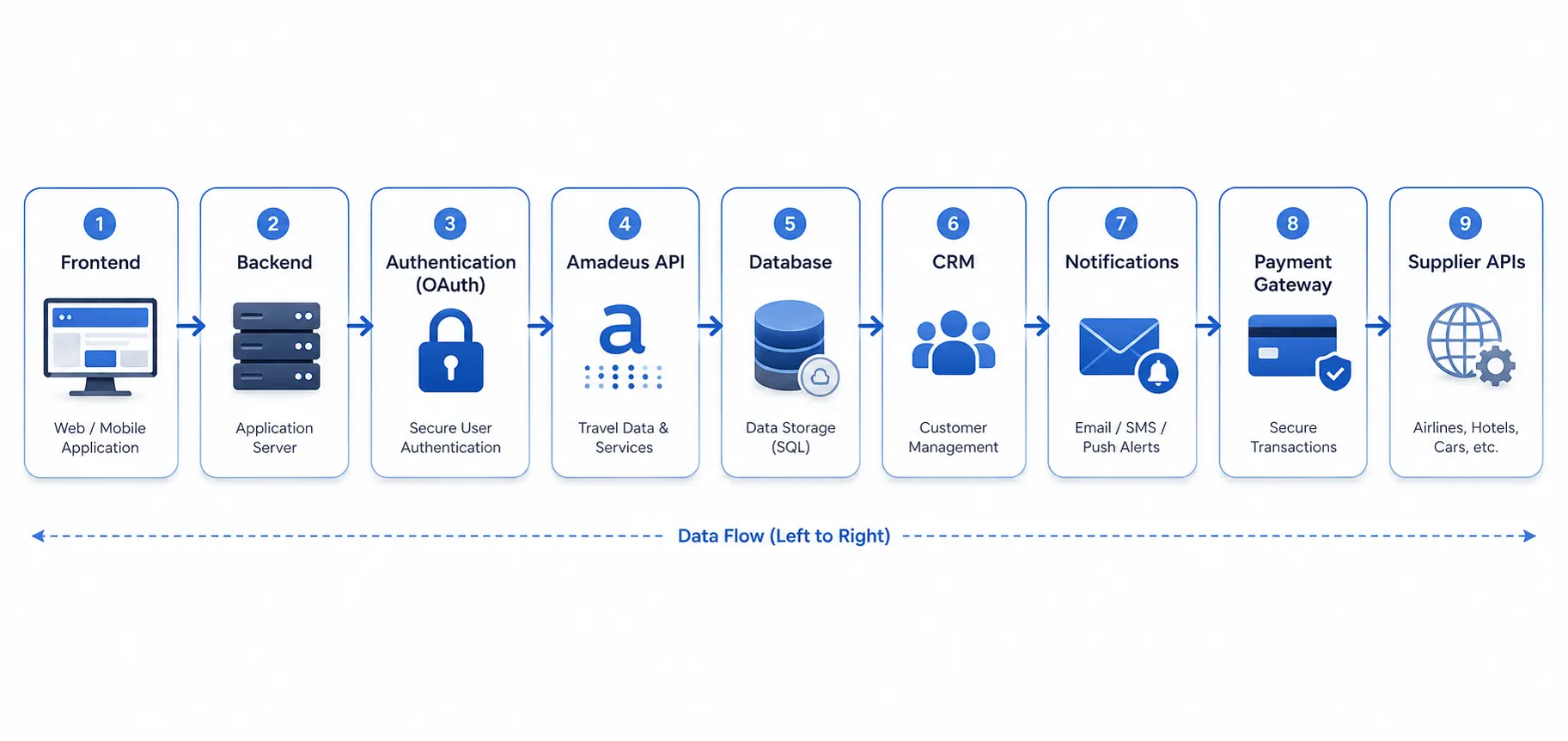
Each layer has a job that's easy to underestimate:
- Frontend handles search state and needs to gracefully manage the gap between "results shown" and “results still valid.”
- Backend owns session management, rate-limit handling, and orchestrating multi-step booking transactions
- Authentication manages OAuth token lifecycle; tokens expire, and refresh logic has to be bulletproof, or bookings silently fail
- The database stores booking state independently of Amadeus, because you need a source of truth that doesn't depend on a live API call
- CRM syncs customer and booking data for support teams; this is often bolted on late and causes data drift
- Notifications handle schedule changes, which airlines push asynchronously and which your system has to catch and relay
- The payment gateway has to be sequenced tightly with the ticketing step
- Supplier APIs beyond Amadeus (hotel aggregators, car suppliers) often get added later and complicate the orchestration layer further
Authentication with OAuth
Amadeus uses OAuth 2.0 client credentials flow for authentication. In practice, the integration challenge isn't the initial handshake; it's token lifecycle management at scale. Access tokens expire (typically within 30 minutes), and a naive implementation that requests a new token on every API call will hit rate limits fast.
The correct pattern is to cache the token, track its expiration, and refresh proactively before it lapses, not reactively after a 401 response, which adds latency and can cause failed bookings mid-transaction if the refresh happens during a critical step like ticketing.
Flight Search, Pricing, Booking, Ticketing, and PNR Management
Flight Search
This is the entry point and the highest-traffic endpoint by far. The main engineering decision here is caching strategy: how long you cache search results before they're considered stale, balanced against Amadeus API call costs.
Pricing
Price confirmation re-validates the search result against live fare data. This step exists specifically to prevent the "price changed at checkout" problem, and skipping it or under-implementing it is one of the fastest ways to generate customer complaints and chargebacks.
Booking
The booking step creates the PNR. This is where passenger data, contact details, and special requests all get bundled and submitted. Validation errors here are common, especially around passport data formatting and name-matching rules that vary by airline.
Ticketing
Ticketing is a separate step from booking in most implementations, and for good reason: it's the moment money changes hands (functionally), and the reservation becomes a real, penalty-bearing commitment. Sequencing payment confirmation before the ticketing call, never after, is critical.
PNR Management
Post-booking, you need to handle schedule change notifications pushed by airlines, voluntary changes requested by passengers, involuntary changes (flight cancellations and aircraft swaps), and split bookings for group travel. This is the layer most MVP builds skip entirely, then have to retrofit under pressure once real bookings start generating support tickets.
Hotels and Cars
Hotel and car booking follow a similar search → price → book pattern but with different data structures and supplier quirks. Hotel content in particular often comes from a mix of Amadeus's own inventory and aggregated third-party suppliers, which means rate parity and availability accuracy can vary by property.
Most platforms building a flights-first OTA add hotels and cars as a second phase rather than launching all three simultaneously; it's a smaller build, but it introduces a second content-quality problem worth budgeting time for.
Common Integration Challenges
This is the section most documentation and agency blogs skip entirely, because it's not about capability; it's about what breaks in production.
Error Handling Matrix
| Problem | Common Cause | Solution |
| Price changed | Cached search results, fare expired between search and book | Re-confirm price immediately before booking step |
| Seat unavailable | Booking class sold out between search and confirmation | Fallback to re-search, present alternative fares |
| Airline timeout | Supplier-side latency or outage | Implement retry with exponential backoff, timeout thresholds |
| Duplicate booking | Retry logic without idempotency keys | Use idempotency keys on all write operations |
| Expired session | Token or user session lapsed mid-flow | Proactive token refresh, session state persistence |
| Failed payment | Payment gateway declined after ticketing initiated | Never ticket before payment confirmation is received |
Rate Limits, Caching, and Retries
Amadeus enforces rate limits per API and per environment, and hitting them mid-transaction is one of the more common causes of failed bookings during traffic spikes. Caching search results reduces call volume but reintroduces the stale-price problem discussed above; the balance point depends on your traffic pattern and fare volatility in your target markets.
Retries need idempotency keys on any write operation (booking, ticketing, cancellation). Without them, a timeout followed by an automatic retry can create duplicate bookings, one of the costlier and more embarrassing production bugs an OTA can ship.
Webhooks, Queues, and Monitoring
Schedule changes and booking status updates often arrive asynchronously. A queue-based architecture (rather than synchronous polling) handles this more reliably at scale, and proper logging on every API call, not just errors, makes post-incident debugging dramatically faster when a customer disputes what happened to their booking.
Security Best Practices
- Store OAuth credentials and tokens server-side only; never expose them to the frontend
- Encrypt passenger PII (passport numbers, contact details) at rest
- Implement PCI-compliant handling for payment data, ideally by tokenizing through your payment gateway rather than touching card data directly
- Log API requests and responses for audit purposes, but redact sensitive fields before storage
- Apply rate limiting on your own endpoints to prevent abuse that could exhaust your Amadeus API quota
Performance Optimization
- Cache static or slow-changing data (airport codes, airline metadata) aggressively; cache search results conservatively.
- Use connection pooling for outbound API calls to reduce latency overhead.
- Monitor API response times separately from your own backend response times; this makes it clear whether a slowdown is on your side or the supplier's.
- Set sensible timeout thresholds per endpoint; search endpoints can tolerate longer timeouts than ticketing endpoints, where speed matters more to the user experience.
Production Deployment Checklist
- Self-service to production migration approved (or enterprise contract finalized).
- OAuth token refresh logic tested under load.
- Idempotency keys implemented on all write operations.
- An error handling matrix implemented for all known failure modes.
- Payment-to-ticketing sequencing verified end-to-end.
- A webhook or polling system in place for schedule change notifications.
- Rate limit monitoring and alerting configured.
- PII encryption and PCI-compliant payment handling confirmed.
- Logging in place for all API requests, with sensitive data redacted.
- Load testing completed against expected peak traffic.
- Rollback plan documented in case of production issues post-launch.
Amadeus vs Other Travel APIs
| Provider | Model | Best fit | Integration complexity |
| Amadeus | GDS + NDC | Established OTAs, enterprise travel platforms | Moderate-high |
| Sabre | GDS + NDC | Similar profile to Amadeus, strong in North America | Moderate-high |
| Travelport | GDS + NDC | Enterprise, strong European/APAC coverage | Moderate–high |
| Duffel | NDC-first, modern REST API | Startups, NDC-focused builds | Low–moderate |
| Mystifly | Consolidator API | Budget-focused OTAs, emerging markets | Low–moderate |
| Verteil | NDC aggregator | NDC-first platforms wanting simplified onboarding | Low–moderate |
The legacy GDS providers (Amadeus, Sabre, Travelport) offer the broadest content coverage but come with more integration overhead. The newer NDC-first providers trade some of that breadth for faster, lower-complexity onboarding, a reasonable tradeoff for platforms prioritizing speed to market over maximum airline coverage.
Integration Timeline
A realistic timeline for a focused team-building flight search-through-booking functionality:
- Week 1: Authentication setup, sandbox access, initial API exploration
- Week 2: Flight Search implementation and caching strategy
- Week 3: Pricing and Seat Availability integration
- Week 4: Booking flow, passenger data handling
- Weeks 5-6: Testing, including edge cases from the error handling matrix above
- Week 7+: Production migration and go-live
This assumes flights only. Adding hotels and cars, or building a full orchestration layer with CRM and notification sync, typically extends this by 4-8 additional weeks depending on team size and existing infrastructure.
Cost Considerations
Beyond the published API rate card, the real cost of an Amadeus integration includes:
- Developer hours, both initial build and ongoing maintenance as Amadeus updates its API versions.
- Infrastructure servers, caching layers, and queue systems to handle production traffic reliably.
- Testing sandbox-to-production migration requires demonstrated testing coverage, which takes real time.
- Ongoing maintenance booking lifecycle edge cases (schedule changes and refund disputes) generate an ongoing engineering and support load well after launch.
Platforms that skip budgeting for the maintenance phase are often the ones that end up under-resourced six months post-launch, when the initial build is done, but the operational reality of running live bookings sets in.
FAQs
How long does Amadeus API integration take?
A focused flights-only integration typically takes 6-8 weeks for a small team, from authentication through production go-live. Adding hotels, cars, or a full orchestration layer with CRM and notification systems extends this timeline.
Is Amadeus API free?
Self-Service APIs use a pay-per-call pricing model with a free testing tier for sandbox development. Production access and enterprise agreements involve negotiated commercial terms.
What is the difference between self-service and enterprise APIs?
Self-Service is self-onboarded with published pricing and is suited to lower-volume platforms. Enterprise involves a managed relationship, broader catalog access, and negotiated volume pricing, suited to established, higher-volume businesses.
Does Amadeus support NDC?
Yes, Amadeus offers NDC content alongside traditional GDS content, though NDC access typically requires additional agreements and content aggregation work on the integration side.
Can I build an OTA using only Amadeus?
Yes, for flights, hotels, and cars, Amadeus alone can power a full OTA. Many platforms later add supplementary suppliers for improved hotel coverage or regional content depth.
What programming languages are supported?
Amadeus provides REST APIs consumable from any language capable of making HTTP requests, along with official SDKs for several popular languages.
How secure is OAuth authentication?
The OAuth 2.0 client credentials flow is an industry-standard authentication method, secure when implemented correctly, meaning credentials are never exposed client-side, and tokens are refreshed and stored securely server-side.
What are the production requirements?
Moving from sandbox to production typically requires demonstrating a working, tested integration, including proper error handling and booking flow completion, before Amadeus approves live access.
Can Amadeus integrate with existing travel software?
Yes. Amadeus APIs are commonly integrated into existing booking engines and travel management platforms rather than requiring a ground-up rebuild, provided the existing system's architecture can accommodate the authentication and data flow requirements described above.
Final Thoughts
Amadeus API integration looks, on paper, like a documentation exercise: authenticate, call an endpoint, and get a response. In practice, it's an orchestration problem spanning booking lifecycle management, error handling, payment sequencing, and long-term operational monitoring. The teams that get this right treat the API connection as the starting point, not the finish line. They budget time for the booking lifecycle beyond search, build idempotent retry logic from day one, and plan for the production maintenance load before it arrives rather than after.
Platforms like TravelBookingPanel exist because this orchestration layer connecting supplier APIs, managing booking state, and handling the operational complexity described throughout this guide is exactly the part most in-house teams underestimate. Whether you build this internally or evaluate a platform that has already solved it, the architecture and challenges outlined here are the same ones worth stress-testing before you commit engineering resources.
Tags
Own Your Travel Platform. Forever.
Buy once, own forever. Full source code · No monthly fees · No hidden charges.